
Repair or Replace? A Homeowner's Decision Framework
A clear framework for the repair-or-replace decision: weigh age, failure history, condition. Repair size — then decide on written numbers, not formulas.

When an AC fails, you face a big spending decision. It usually lands on a hot day, and it usually feels urgent. Most advice about this decision comes as a simple cutoff: an age, a dollar figure, a formula. This guide takes a different approach. It teaches you how the decision works, as one connected problem. Age, failure history, overall condition, and repair size are not four separate questions. Each one changes what the others mean. The right answer comes from weighing them together, in order, using written numbers.
You will learn why two systems of the same age can deserve opposite answers. You will see why a repair never makes a system younger than its oldest part. You will see how refrigerant supply and efficiency quietly change the math on older system. And you will learn how to check a big recommendation before you act on it.
Key takeaways
- There is no birthday when an AC must be replaced. Condition and history matter more than age.
- Weigh four things in order: age (the background), failure history (where things are heading), condition (from a real diagnosis). Repair size (the numbers).
- A major repair buys the remaining life of therestof the system — not a new system's life.
- Costs vary by home, system, and repair. Ask Texas Heat & Air for a written estimate before work begins. They cannot make the decision.
- Both numbers — repair and replacement — belong in writing before you choose.
How it works
A system ages as a set, not as a single part
An AC is a set of parts installed on the same day. They have shared every hour of running since: the compressor (the pump in the outdoor unit that squeezes and moves the refrigerant around the sealed loop), two coils, two motors, controls. Wiring. That shared history is the single most useful idea in this guide. When one major part fails at year fifteen, the question is never just "what does this part cost?" It is "what am I keeping?" The new part goes back into a machine whose every other part is also fifteen years old.
This is why a repair does not reset the clock. A new compressor makes exactly one part young. The rest of the system still sets how much life is left. A small repair escapes this logic. Its price is low enough that even a few more seasons can make it worthwhile. A major repair cannot escape it. It spends a large share of a new system's price on a system whose other parts are near the end of their own lives.
Lifespan is a range because condition moves systems within it
The typical service life of a central AC runs about 15 to 20 years. ENERGY STAR suggests thinking about replacement when system is more than 10 years old and performing poorly. Read that as a planning range, not an expiration date. Where your system lands inside. Or outside. That range depends on how it was sized, installed. Cared for. A system that is the right size, kept clean, and serviced often ages slowly. An oversized system wears out early. It starts and stops in short bursts instead of running steadily. A pattern called short cycling. A dirty, neglected system strains its compressor. A failed compressor is usually what ends a system's life.
Age also shows up in a less direct way. Failures tend to cluster. A system that runs ten years without a repair and then needs one has usually had a single unlucky event. A system that has needed work three summers in a row is showing a pattern. And patterns like that do not reverse. When you weigh a repair, you are really making a forecast. Your repair history is the best forecasting details you own.
Two slow forces push old systems toward replacement
Even a well-kept old system faces two headwinds that a new system does not. The first is efficiency. Ratings have climbed steadily over the years. So a 15- to 20-year-old unit uses notably more electricity to deliver the same cooling as today's system. That gap is a running cost of keeping the old system. It never appears on a repair quote, but it is real. And it grows as the system ages.
The second is refrigerant supply. Refrigerant is the fluid sealed inside the system that carries heat. Many systems installed before 2010 use an older refrigerant called R-22. The U.S. EPA has phased R-22 out of production, so what remains is recycled and stockpiled supply. A leaking R-22 system faces rising refill costs and shrinking parts support. Price any leak repair with that trend in mind. Refilling buys time, not a fix. Neither force decides the question by itself. Both belong on the replacement side of the scale. Both get heavier every year.
The decision starts with information, not with a quote
You can gather three of the four weights yourself: the manufacture date, your repair history, your warranty paperwork. Your electric bills. Only one weight — condition — needs a pro. A diagnosis tells you what failed, what else is worn. What is likely to fail next. That is why this decision should begin with a diagnostic visit, not a sales conversation. Guide 8 explains what that visit costs and includes (/hvac-help/guides/diagnostic-fees-and-pricing/).
The situations homeowners ask about
The age ladder: 10, 15, and 20 years
The same framework gives different answers at different ages. That is precisely why age cutoffs fail. At10 years, a system is at mid-life. Most of its service life is still ahead of it. Major parts may still be under the maker's warranty. Repair is normally the sensible choice. Unless the repair is unusually large or the failure history is already bad. The short answer: Q43 — Is a 10-year-old AC worth repairing? (/hvac-help/is-a-10-year-old-ac-worth-repairing/)
At15 years— the lower edge of the typical range — the question changes. It is no longer "is it worth fixing?" It becomes "how much life does this repair buy. At what price per season?" A modest repair on a system that cooled well last summer can be a bargain. Replacing a compressor or a coil at fifteen costs far more. And it keeps a machine whose other parts are just as old. The short answer: Q44 — Is a 15-year-old AC worth repairing? (/hvac-help/is-a-15-year-old-ac-worth-repairing/)
At20 years, the system has delivered a full service life. The rule narrows to this: fix small, or do not fix at all. A minor electric repair on a system that still cools acceptably can make perfect sense. That is especially true if your own plans. A move, a renovation. Argue for choosing the replacement moment yourself. A major repair at twenty fails three ways: on cost, on the company it keeps (every other part is twenty too). On shrinking parts and refrigerant supply. The short answer: Q45 — Is a 20-year-old AC worth fixing? (/hvac-help/is-a-20-year-old-ac-worth-fixing/)
How long the range runs. What moves a system within it, is covered in Q42. HOw long does an AC last in North Texas? (/hvac-help/how-long-does-an-ac-last-in-north-texas/)
The compressor question
The compressor is the most expensive common repair, so it gets its own test. First, the diagnosis must be proven. Cheaper electric faults can imitate a failed compressor: a capacitor (an electric part that helps a motor start and run), a contactor (the heavy-duty switch that turns the outdoor unit on), or a wiring problem. No one should approve compressor work on a guess. Second, check the warranty. If the compressor is under the maker's parts warranty, you may pay mainly labor. The repair often wins outright. Third, if it is out of warranty, compare two numbers: the installed price of the compressor job. The installed price of a new system. Then weigh the condition of everything else in the box. There is no honest percentage where repair suddenly becomes wrong. The reasoning is the test. The closer the repair price comes to replacement. While the rest of the system is old — the clearer the answer. The short answer: Q46 — When is a compressor repair too expensive? (/hvac-help/when-is-compressor-repair-too-expensive/)
The formula question
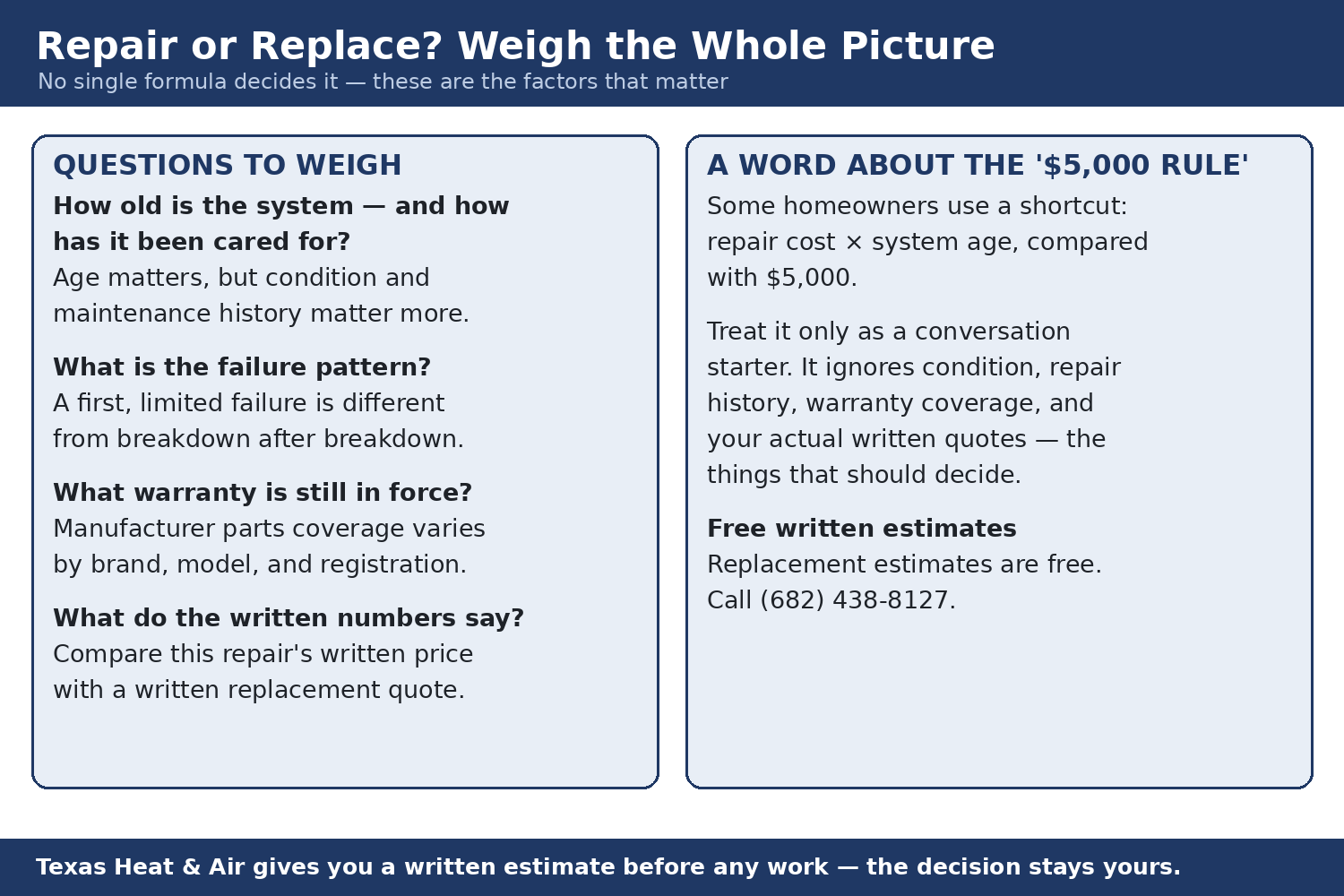
Costs vary by home, system, and repair. Ask Texas Heat & Air for a written estimate before work begins. It captures one true thing. Big repairs on old systems deserve suspicion. And it is a reasonable prompt tostartthis analysis. Then it fails in both directions. It would replace a well-kept 12-year-old system whose failed part is still under warranty. It would repair a neglected 8-year-old that fails every summer. The formula has no inputs for warranty, history, or condition. Its threshold is industry folklore. ENERGY STAR publishes factors and warning signs, not a cost-times-age formula. Use the rule, if at all, to decide whether to have the conversation. Then decide with the four weights. The short answer: Q47 — Is there a simple repair-versus-replacement rule? (/hvac-help/repair-versus-replacement-rule-of-thumb/)
Verifying a big recommendation
A recommendation to replace your system is a five-figure claim. Checking it is normal consumer practice, not an insult. A second contractor can confirm the diagnosis and price the same scope of work. Bring the first company's written diagnostic report and estimate — those documents are yours. Then compare on structure: Did both find the same failure? Is the system size the same, and how was it chosen? Is the same scope of work included? Are the warranties stated separately? Is the total installed price in writing? Pressure to sign "today only" is itself details. The short answer: Q50 — Can I get a second opinion before replacing my AC? (/hvac-help/second-opinion-before-replacing-ac/)
The framework itself, worked as a single decision, is Q41. SHould I repair or replace my AC? (/hvac-help/repair-or-replace-air-conditioner/)
Diagrams and comparisons
"Repair or replace: weigh age and condition, failure pattern, warranty status. Your written quotes — no single formula decides." The two-panel graphic lays out the questions worth weighing. Costs vary by home, system, and repair. Ask Texas Heat & Air for a written estimate before work begins.
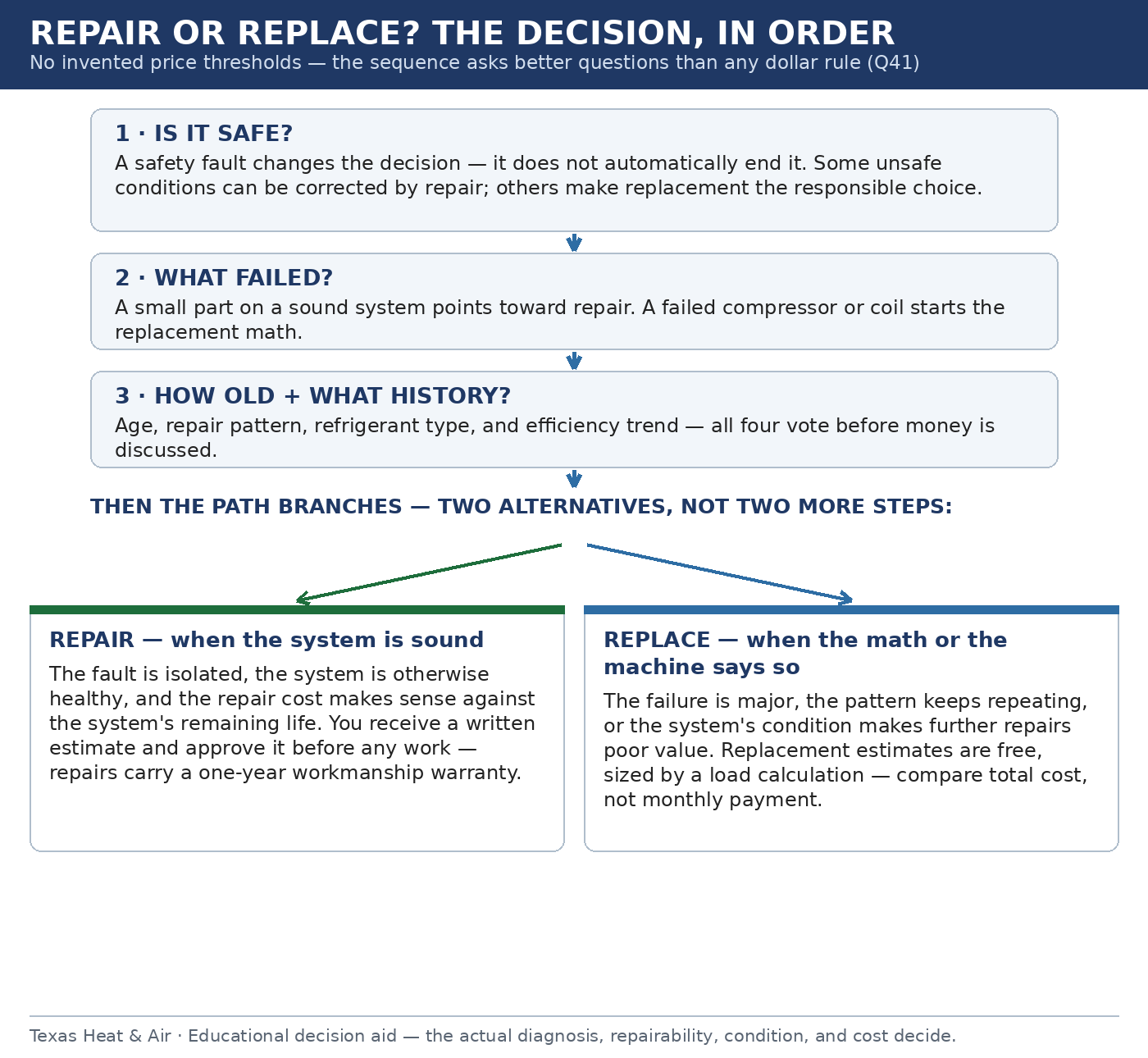
"Four questions, in order, that settle most repair-or-replace decisions." The flowchart sequences the four weights. Age, failure history, condition, repair size. And routes you toward repair or toward getting the replacement number. (This asset carries a technical-review flag, noted in this guide's metadata.)
The decision tree, in text
Work down the rows in order. Stop at the first row that settles your situation; if none settles it, the last row's comparison decides.
| Step | Question | If yes | If no |
|---|---|---|---|
| 1 | Is the failed part under the maker's warranty? | Repair usually wins — you pay mainly labor — unless the rest of the system is failing too | Go to step 2 |
| 2 | Is the repair modest (a wear part such as a capacitor, contactor. Motor) and did the system cool well last summer? | Repair — you are maintaining a proven system | Go to step 3 |
| 3 | Has the system needed repairs most summers in recent years? | Get the written replacement number before approving any major repair | Go to step 4 |
| 4 | Is the system past roughly 15 years and the repair major (compressor or coil)? | Replacement usually wins — compare both numbers in writing to confirm | Go to step 5 |
| 5 | Divide the repair cost by the seasons it realistically buys. Is the cost per season clearly lower than a new system's cost per season over its expected life? | Repair, with the comparison documented | Replacement — or a second opinion before deciding (Q50) |
The four weights at a glance
| Weight | Favors repair | Favors replacement |
|---|---|---|
| Age | Under about 10 years, or mid-life and healthy | Past about 15 years, near typical end of life |
| History | Rare failures | A repair most summers |
| Condition | Coils, compressor, and airflow sound | Corrosion, obsolete refrigerant, several worn parts |
| Repair size | Modest part, or a major part still under warranty | Major part at a large share of replacement cost |
What you can safely do yourself
- Find the manufacture date on the outdoor unit's label (read it without opening any covers) and note the refrigerant type printed there.
- Gather past repair bills, warranty paperwork, and recent summer electric bills. Together they supply three of the four weights.
- Write down how the system performed last summer: Did it keep up on the hottest days? Were some rooms uncomfortable? Was it noisy?
- If paperwork is lost, have the model and serial numbers ready so warranty coverage can be checked.
- Never approve a major repair from a verbal quote. Both options belong in writing.
What a technician checks
A condition assessment is the one input you cannot supply yourself. The technician confirms the failed part with tests. Compressor failure in certain must be proven, because cheaper electric faults can imitate it. Then the technician evaluates the rest of the system: compressor health, coil condition, the refrigerant circuit and type, electric wear. Airflow. A useful assessment also says what is likely to fail next. It gives a realistic estimate of remaining life. That way, you can judge the repair quote against the whole machine, not just the broken part. On the replacement side, a serious proposal states the system size and how it was chosen. It states the scope of work included. And it states the warranty terms — parts and labor separately.
Making the decision
Compare documents, not impressions.Put the written repair estimate and the written replacement proposal side by side. Check that the replacement scope is complete: system, duct work, electric work, permits, disposal. A low quote sometimes reaches its price by leaving work out. Also decide what each choice doesnotsolve. A new outdoor unit will not fix leaking ducts or an airflow problem. And replacing system to cure a duct problem buys a new system with the old complaint.
Use the member benefit if it applies.Ask Texas Heat & Air what maintenance plan options are current. Get the full terms in writing before you enroll. Plan details live in Guide 10 (/hvac-help/guides/maintenance-and-membership/).
Take the time the decision deserves.A sound quote survives a night of thought. On major work, it survives a second opinion too. Decide before peak season if you can. A choice made from written numbers in a comfortable house beats the same choice made during a heat wave. If financing is part of the replacement path, judge it by its total written cost, as Guide 9 explains (/hvac-help/guides/buying-a-new-hvac-system/). Terms vary by lender and applicant, and approval is never guaranteed.
North Texas notes
North Texas systems age by run-hours as much as by birthdays. Long, hot summers mean more running hours each year. They mean more heat stress on electric parts and more compressor wear than the same system would see in a mild climate. That is one reason installation quality and regular maintenance move a system so far within the 15-to-20-year range here. The region's older homes also hold many pre-2010 R-22 systems, where the refrigerant headwind is strongest. Timing matters too. Breakdowns cluster in the first serious heat. Exactly when every homeowner is making this decision at once. Getting a replacement estimate on file while the old system still runs turns a possible emergency buy into a planned one. Ask Texas Heat & Air what an estimate for a replacement system costs before you book.
Related resources
- Q41 — Should I repair or replace my AC? (/hvac-help/repair-or-replace-air-conditioner/)
- Q42 — How long does an AC last in North Texas? (/hvac-help/how-long-does-an-ac-last-in-north-texas/)
- Q43 — Is a 10-year-old AC worth repairing? (/hvac-help/is-a-10-year-old-ac-worth-repairing/)
- Q44 — Is a 15-year-old AC worth repairing? (/hvac-help/is-a-15-year-old-ac-worth-repairing/)
- Q45 — Is a 20-year-old AC worth fixing? (/hvac-help/is-a-20-year-old-ac-worth-fixing/)
- Q46 — When is a compressor repair too expensive? (/hvac-help/when-is-compressor-repair-too-expensive/)
- Q47 — Is there a simple repair-versus-replacement rule? (/hvac-help/repair-versus-replacement-rule-of-thumb/)
- Q50 — Can I get a second opinion before replacing my AC? (/hvac-help/second-opinion-before-replacing-ac/)
- Guide 8 — Diagnostic Fees, Repair Pricing, and Written Estimates: What You Are Paying For (/hvac-help/guides/diagnostic-fees-and-pricing/)
- Guide 9 — Buying a New HVAC System: Efficiency, Sizing, Financing, and Warranties (/hvac-help/guides/buying-a-new-hvac-system/)
Texas Heat & Air next step
Ask Texas Heat & Air what a review or estimate costs before you book. Call (682) 438-8127.

Understanding the system comes first: learn how the pieces work together, use the safe checks. Let a qualified technician confirm anything inside the system.
Related Homeowner Questions
 How long does an air conditioner last in North Texas?Is a 10-year-old AC worth repairing?Is a 15-year-old AC worth repairing?Is a 20-year-old AC worth fixing?When is a compressor repair too expensive?Is there a simple repair-versus-replacement rule?Can I get a second opinion before replacing my AC?

Still Have Questions? Ask an HVAC Expert.
Couldn't find the answer you need? Tell us what's happening. Our team will review your question and contact you to help.
Ask Your Question →Sources
- https://www.energystar.gov/saveathome/heating-cooling/replace — replacement timing factors, replacement signs, and typical service life (ENERGY STAR)
- https://www.energy.gov/femp/purchasing-energy-efficient-residential-central-air-conditioners — sizing, installation quality, duct considerations. The efficiency gap of current system (U.S. Department of Energy)
- https://www.epa.gov/hfcs/frequent-questions-phasedown-hydrofluorocarbons — refrigerant phasedown and what it means for very old systems (U.S. EPA)
- https://www.trane.com/residential/en/resources/troubleshooting/air-conditioners/ac-fan-not-working/ — compressor and fan testing context (Trane)