
Should I repair or replace my air conditioner?
Weigh age, repair history, condition, and repair size. In that order. Then decide with both numbers in writing.

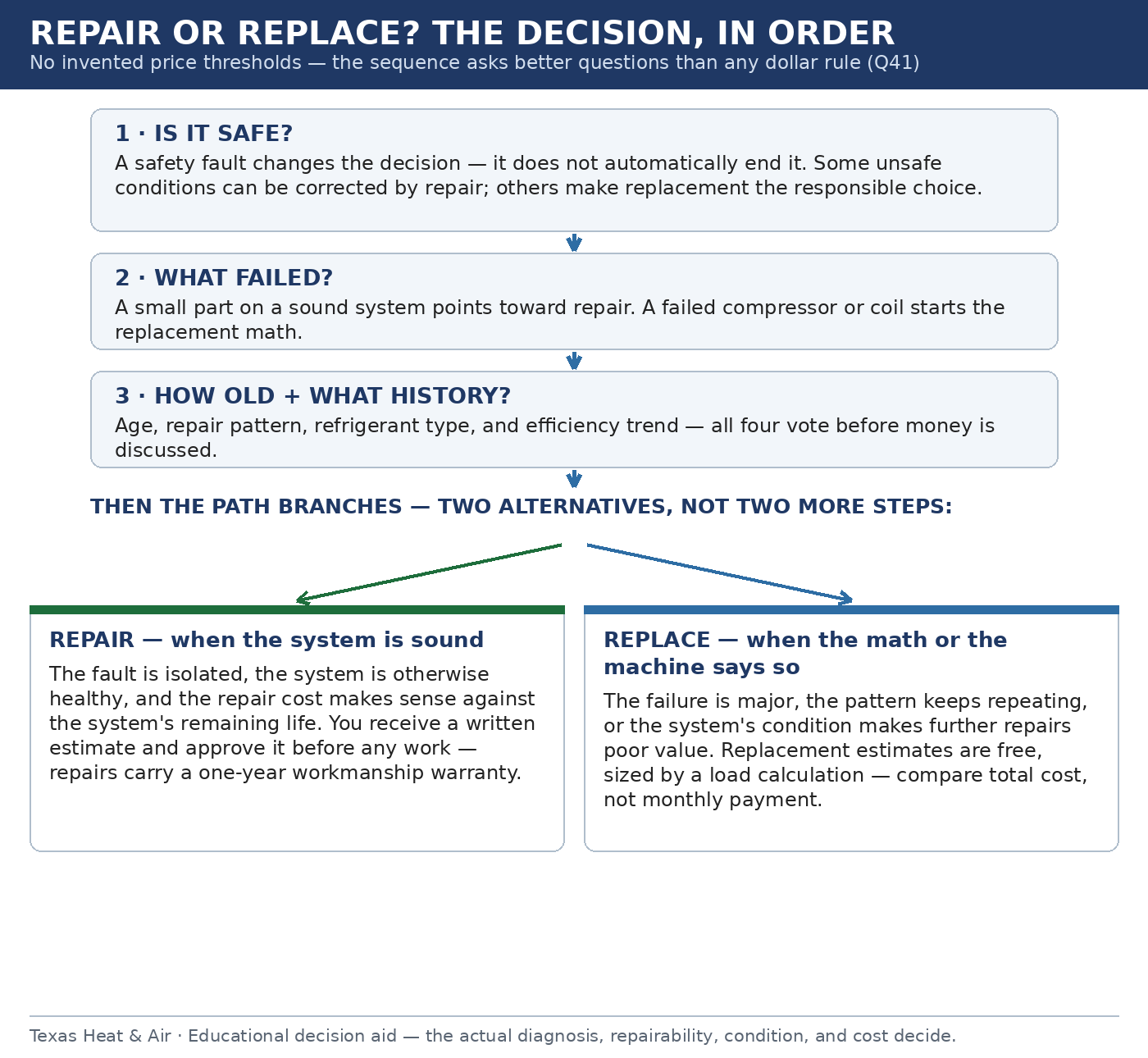
There is no birthday when an AC must be replaced. Weigh four things: how old the system is, how often it has failed, what shape the rest of it is in. How big the repair is compared with the cost of a new system. A small repair on a healthy system usually wins. A major repair on an old system that keeps failing usually does not.
What you can safely check
- Gather past repair bills, the system's age (the outdoor unit's label shows the manufacture date). Notes on how it cooled last summer.
- Find your warranty paperwork. A major part still under the maker's warranty changes what a repair really costs you.
- Never approve a major repair from a verbal quote. Both options belong in writing.
How to compare your options
Work through the four weights in order, because each one changes what the next one means.
Age sets the context.A system under ten years old with no major failures in its past usually deserves repair. Most of its life is still ahead of it. A system past fifteen deserves a harder look. The typical service life of a central AC runs about 15 to 20 years (Q42). Money spent near the end of that range buys less time.
Repair history tells you where things are heading.A system that has needed a repair every summer is making an announcement: the failures are not slowing down. A system with one failure in ten years is a different case at the same age. Count the history, not just the birthday.
Condition is what the diagnosis adds.The coils may be corroding. The refrigerant type may be out of date. The compressor — the pump in the outdoor unit that moves the refrigerant around the loop — may be wearing out. Airflow may be poor. A technician's condition check tells you whether this repair restores a sound system or props up a failing one. Homeowners cannot supply this weight themselves. That is why the framework starts with a real diagnosis (Q51), not a guess. ENERGY STAR's warning signs belong in this weight too: some rooms too hot or too cold, humidity problems. A system that has grown noisy.
Repair size is where the comparison becomes simple math.A modest repair — an electric part, a motor — on a system the first three weights favor is usually money well spent. A major part — a compressor, a coil — on a system the first three weights condemn is usually money spent delaying the inevitable. Every other part of that system is exactly as old as the one that just failed. Warranty belongs in this weight too: if the costly part is covered, your true repair cost may be mainly labor. The math flips.
Refrigerant — the fluid sealed inside the system's loop that carries heat — can change the math on older systems. Many systems installed before 2010 use R-22, which the EPA has phased out of production. It survives only in recycled and stockpiled supplies, so recharging an old, leaking system costs more every year. Price a leak repair honestly against replacement — topping up buys time, not a fix.
| Weight | Favors repair | Favors replacement |
|---|---|---|
| Age | Under ~10 years, or mid-life and healthy | Past ~15 years, near typical end of life |
| History | Rare failures | A repair most summers |
| Condition | Coils, compressor, airflow sound | Corrosion, obsolete refrigerant, several worn parts |
| Repair size | Modest part, or a major part still under warranty | Major part at a large share of replacement cost |
When to call a professional
Call when you need the two weights you cannot supply yourself: a confirmed diagnosis and an honest condition check. The technician examines the failed part, then the rest of the system. Compressor health, coil condition, the refrigerant circuit. Airflow. They can tell you whether a repair restores a sound system or props up a failing one. If the quoted repair is major, that visit is also when to ask for both paths priced in writing (Q50 explains second opinions).
What happens next
Two habits protect you while you weigh it. First, get both numbers in writing: the repair estimate. A replacement proposal for the same home. Ask Texas Heat & Air what you will get in writing, and what your approval covers, before you book. Ask Texas Heat & Air what an estimate for a replacement system costs before you book. Ask Texas Heat & Air to confirm the diagnostic fee when you book.
Second, ask what each choice doesnotsolve. A new outdoor unit will not fix leaky ducts or an airflow problem (Q49, Q84). Replacing system to cure a duct problem buys a new system with the old complaint. And if financing enters the conversation, hold it to the same standard. Ask Texas Heat & Air what payment and financing options are current before you decide. The only terms that count are the ones in the lender's own written documents (Q59).
A contractor who walks all four weights with you. Including the one that argues against the bigger ticket. Is giving you the honest version of this decision.
Texas Heat & Air next step
Facing the decision now? Call (682) 438-8127 — diagnosis first, then both numbers in writing, then your call. Ask Texas Heat & Air what a review or estimate costs before you book.
Related Questions
 When is a compressor repair too expensive?Is there a simple repair-versus-replacement rule?Can I get a second opinion before replacing my AC?

Still Have Questions? Ask an HVAC Expert.
Couldn't find the answer you need? Tell us what's happening. Our team will review your question and contact you to help.
Ask Your Question →Sources
- https://www.energystar.gov/saveathome/heating-cooling/replace — replacement timing factors, replacement signs, and typical service life (ENERGY STAR)
- https://www.energy.gov/femp/purchasing-energy-efficient-residential-central-air-conditioners — sizing, installation quality, and duct considerations in replacement decisions (U.S. Department of Energy)
- https://www.epa.gov/hfcs/frequent-questions-phasedown-hydrofluorocarbons — refrigerant phasedown and what it means for very old systems (U.S. EPA)