
When is a compressor repair too expensive?
Warranty first, then the share test: what a compressor job really includes. When it is the smart move. The questions to get answered in writing.

A compressor replacement stops making sense when it costs a large share of a new system's price and the rest of your unit is old or in poor condition — especially out of warranty. In warranty, on a sound system, the same repair can be the smart move. Either way, the diagnosis must be confirmed first.
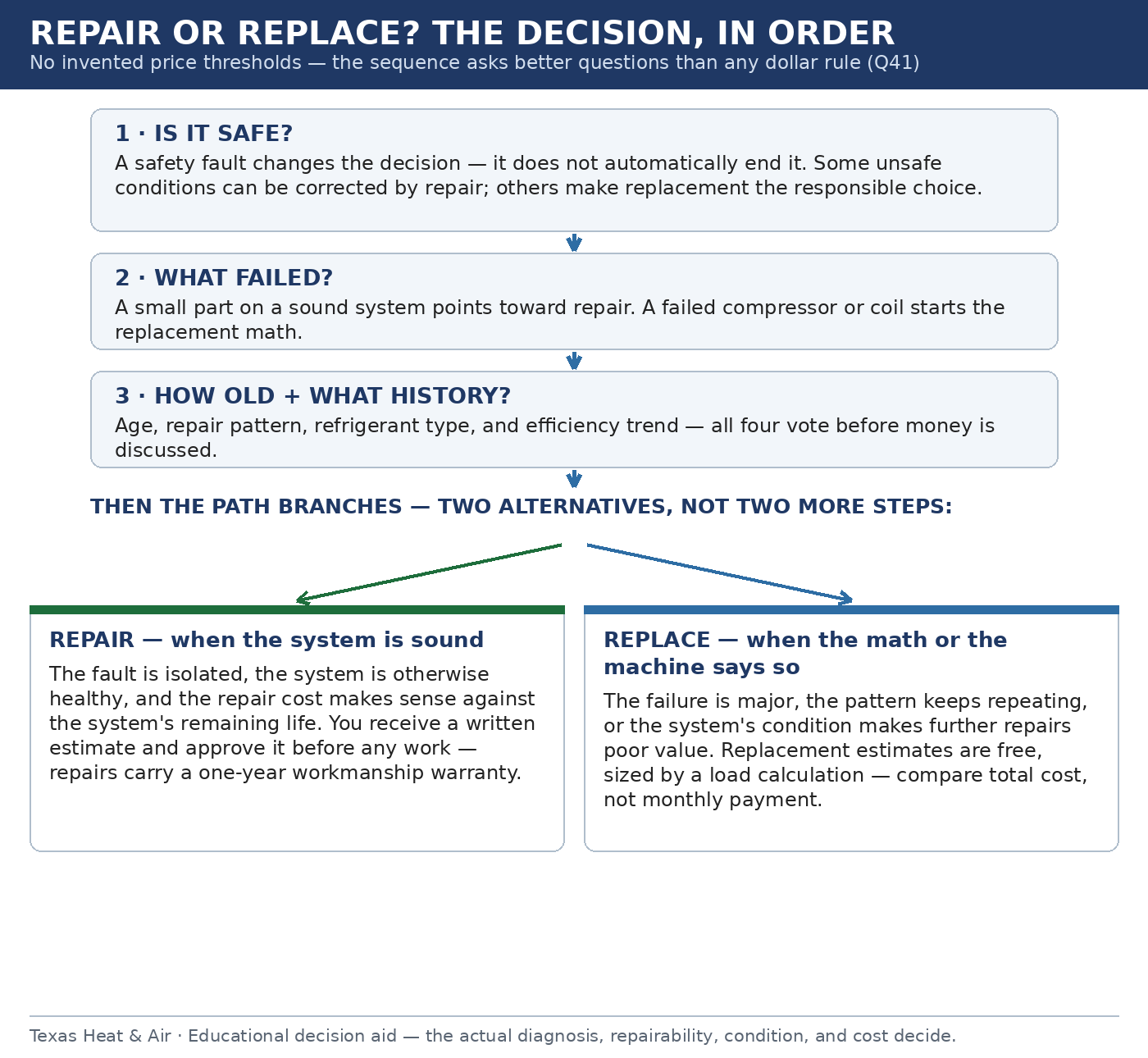
Visual explanation
The four-question flowchart shown with this article (from Q41, "Four questions, in order, that settle most repair-or-replace decisions") is the parent tool. This article is the deep version of its fourth question: how large is the repair?
What to have ready
- Find your warranty paperwork and installation date first. It is the biggest factor in this decision. If the paperwork is lost, have the model and serial numbers ready so coverage can be checked.
- Never approve compressor work on an unconfirmed diagnosis (Q23).
How the cost is figured
The compressor is the pump in the outdoor unit. It squeezes the refrigerant and circulates it around the sealed loop, so the system can move heat. Replacing one is a big job. The technician recovers the refrigerant, removes the failed unit, installs the new compressor, then evacuates and recharges the system to specification. Add hours of skilled labor. It is the priciest repair in residential HVAC. The closest thing to open-heart surgery the system has. The installed price sits in a different class from every other repair. It deserves a different decision process.
Warranty comes first, before any math.If the compressor is under the maker's parts warranty, the part itself is covered. You may pay mainly labor. The math improves dramatically. On a system in otherwise sound condition the repair often wins outright. Warranty status is the single biggest variable in this entire article (Q60).
Out of warranty, apply the share test.On a system past roughly 12–15 years, a compressor replacement can eat a large share of what a complete new system costs. Yet it leaves you with coils, a fan. Controls exactly as old as the part that just died. The repair buys a new heart for an aging body. One honesty note: no federal guidance states a universal percentage where repair becomes wrong. This article will not invent one. Anyone quoting you a magic number is selling a rule of thumb as physics (Q47). The reasoning underneath is what counts. A compressor repair buys therest of the system'sremaining life, not a new system's life. The closer the two prices, the clearer the answer.
Condition can override the share test.A younger system with a clean history and good coils can be a good repair candidate. For example, when an outside cause killed the compressor, such as a failed fan that let it overheat. An older system with corroded coils and yearly failures is a poor candidate at the same quote. Ask for the condition check in the written report: what else is worn, what is likely next. How the technician rates the system's remaining life with the new compressor installed.
| Question | Repair-friendly answer | Replacement-friendly answer |
|---|---|---|
| Under warranty? | Yes — part covered | No |
| System age/condition? | Younger, otherwise sound | Past ~12–15 years, other wear showing |
| Cost vs. new system? | Small share | Large share |
| Diagnosis confirmed by tests? | Required either way | Required either way |
When to call a professional
Before any of this arithmetic, protect the premise. Cheaper faults can imitate compressor failure — capacitors, contactors, and other electric problems (Q23). Ask what tests were performed: electric readings, and performance under load. Ask whether the compressor is under warranty. Ask for the full installed price of replacement system. For a repair of this size, a second opinion is not paranoia. It is proportionate (Q50).
What happens next
Get those three answers in writing, and the right decision is usually obvious. A contractor who welcomes all three questions is showing you how they work. Ask Texas Heat & Air about the warranty terms that apply to your repair before work begins. That is separate from whatever maker coverage applies to the part (Q60). Ask Texas Heat & Air what a review or estimate costs before you book. Either way, the comparison should be documents against documents. Not a quote against a ballpark.
Texas Heat & Air next step
Quoted a compressor? Get the warranty answer and the replacement number on the same page — call (682) 438-8127.
Related Questions
 Should I repair or replace my air conditioner?Can I get a second opinion before replacing my AC?What warranty comes with an HVAC repair?

Still Have Questions? Ask an HVAC Expert.
Couldn't find the answer you need? Tell us what's happening. Our team will review your question and contact you to help.
Ask Your Question →Sources
- https://www.energystar.gov/saveathome/heating-cooling/replace — replacement-timing framework (ENERGY STAR)
- https://www.trane.com/residential/en/resources/troubleshooting/air-conditioners/ac-fan-not-working/ — compressor and fan testing context (Trane)