
Is a 10-year-old AC worth repairing?
Ten years is mid-life, not old age. Warranty first, then the repair's size, then the system's report card. The order that decides it.

Usually, yes. Ten years is mid-life for a well-kept central AC, not old age. Repairing a 10-year-old system is normally the sensible choice. Unless the repair is unusually large, a major part is out of warranty. The system has a bad failure history.
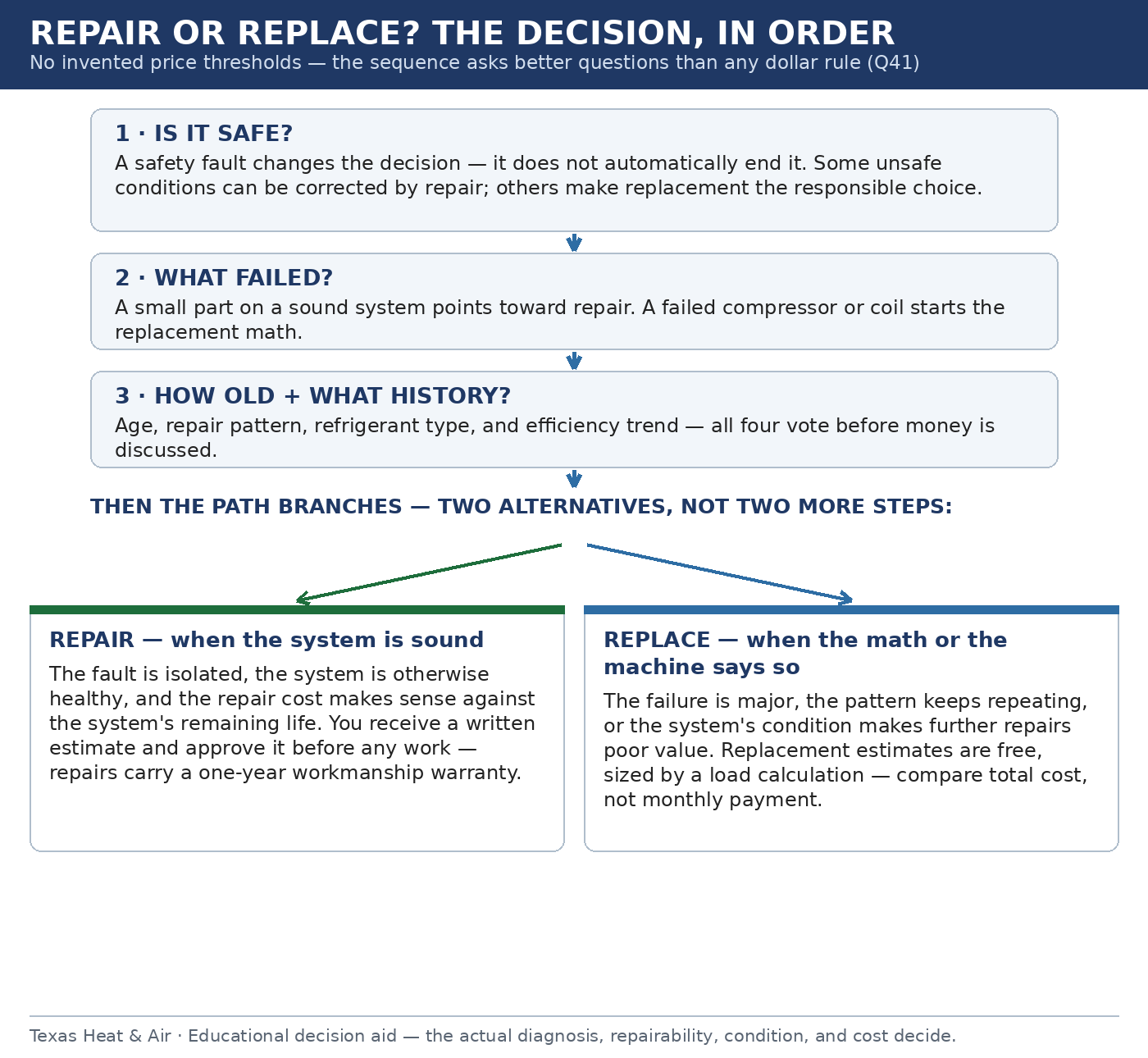
Visual explanation
The four-question flowchart shown with this article (from Q41, "Four questions, in order, that settle most repair-or-replace decisions") is this article's decision tool. This article works those same questions at the 10-year mark.
What you can safely check
- Gather service records and warranty paperwork. Parts coverage at ten years often decides this question by itself. If the paperwork is lost, have the model and serial numbers ready so coverage can be checked.
- Ask for the repair number and the replacement number in writing if the repair is major (Q41).
How to compare your options
Work three steps in order.First, the warranty.Many major parts carry maker coverage that extends to around this age, especially when the warranty was registered at installation. A failed part under warranty changes the math completely. You may pay mainly labor for a repair that restores years of service (Q60 explains how parts and labor coverage split). A repair decision made without the warranty picture is a guess wearing a calculator.
Second, the repair itself.Run the four weights from Q41 at this age. The answer usually falls out quickly. Age: at ten years, most systems still have meaningful life ahead. The typical range runs 15 to 20 (Q42). History: if this is the system's first or second real failure, the trend is good. The repairs that usually make sense at ten are the wear parts. A capacitor (an electric part that helps a motor start and run), a contactor (the heavy-duty switch that turns the outdoor unit on), a fan motor. And even a coil repair on an otherwise healthy, well-cooling system. Money spent there maintains a system with years left.
Third, the system's report card.How did it cool last summer. Evenly. To the set temperature on the hottest days? A decade of Texas summers is real wear. But a maintained system at ten is typically sound in its coils, compressor, and airflow.
The exceptions deserve equal clarity. A failed compressor — the pump in the outdoor unit that moves the refrigerant around the loop — just out of warranty, on a system that has already needed repeated repairs, starts to look like good money after bad. So does any major repair on a system whose refrigerant or coils are in poor shape. The pattern in both exceptions is the same: the repair is largeandthe other weights have turned against the system. At ten years, the burden of proof sits on replacement, not on repair.
| Repair proposed | Usual verdict |
|---|---|
| Capacitor, contactor, fan motor | Repair — mid-life maintenance |
| Coil repair, system otherwise healthy | Repair, with condition confirmed |
| Compressor, in warranty | Repair — warranty carries the part |
| Compressor, out of warranty + repeated failures | Get the replacement number before deciding (Q46) |
When to call a professional
Call for the diagnosis. And ask the two questions that bring out the truth at this decision point: "What is the overall condition of the rest of the system?" and "If I make this repair, what is the next most likely failure?" The answers tell you whether you are maintaining a system or funding a decline. A technician who answers both plainly has earned the work either way.
What happens next
Check the warranty first, then decide on written numbers. Ask Texas Heat & Air what you will get in writing, and what your approval covers, before you book. No repair starts until you approve it. Ask Texas Heat & Air what a review or estimate costs before you book. Both paths can sit on the same page before you choose (Q41).
Texas Heat & Air next step
Ten years old and failed? Check the warranty first. Then call (682) 438-8127 for the diagnosis and an honest condition report.
Related Questions
 Is a 15-year-old AC worth repairing?When is a compressor repair too expensive?What warranty comes with an HVAC repair?

Still Have Questions? Ask an HVAC Expert.
Couldn't find the answer you need? Tell us what's happening. Our team will review your question and contact you to help.
Ask Your Question →Sources
- https://www.energystar.gov/saveathome/heating-cooling/replace — lifespan and replacement-timing framework (ENERGY STAR)