
Is there a simple repair-versus-replacement rule?
Multiply repair cost by age — you've heard the rule. What it gets right, the two directions it fails in. The four real inputs that decide instead.

There is a famous one. Multiply the repair cost by the system's age. Costs vary by home, system, and repair. Ask Texas Heat & Air for a written estimate before work begins. It is a decent screening tool and a poor decision-maker. Warranty status, repair history, condition. Efficiency all change the answer. The rule cannot see any of them.
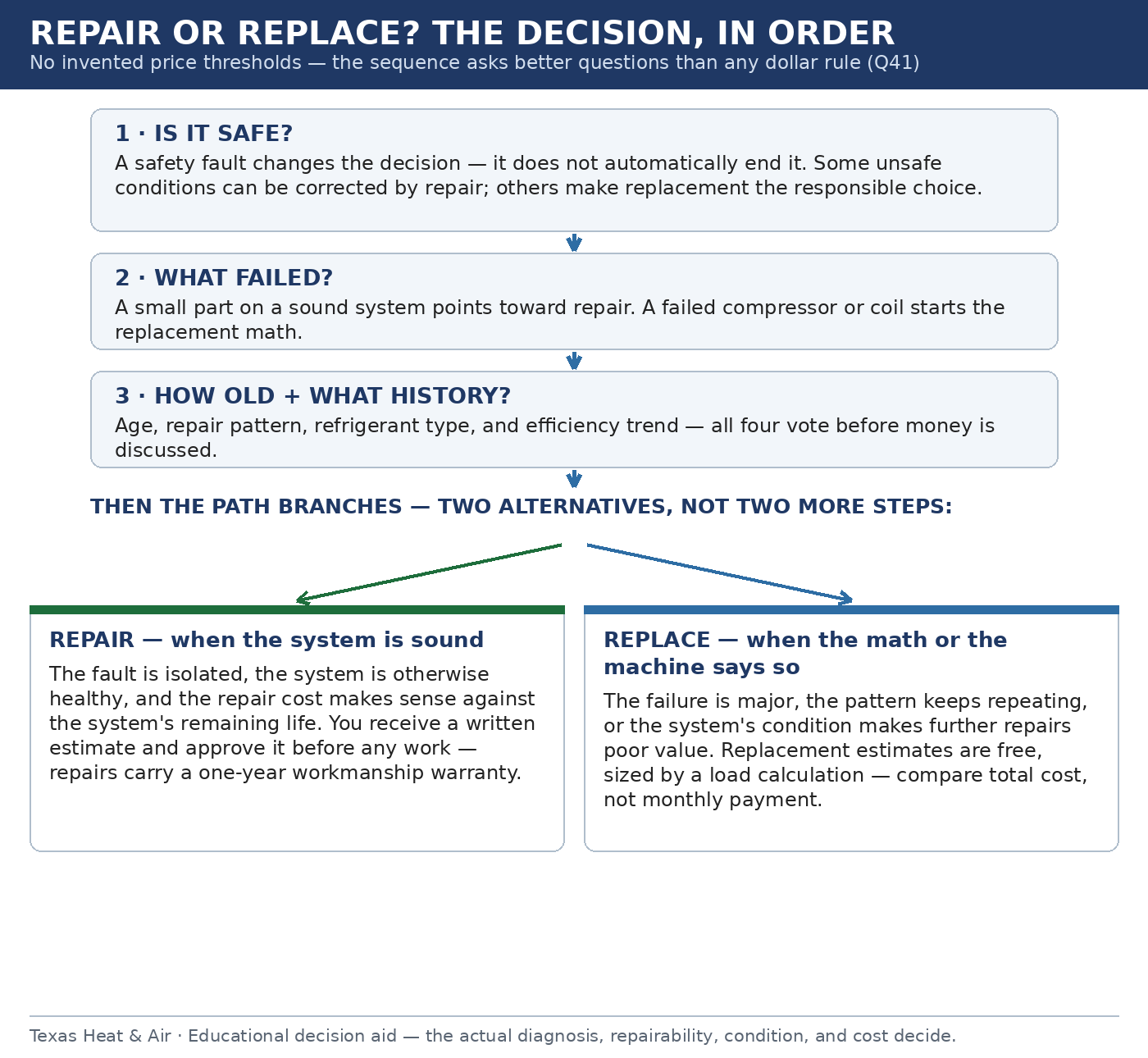
Visual explanation
The decision tool is the four-question flowchart shown with this article (from Q41, "Four questions, in order, that settle most repair-or-replace decisions"). This uses the inputs the formula leaves out.
What you can safely check
- Collect the four facts that beat any formula: age, repair history, warranty status, recent energy bills.
- If a contractor quotes the rule at you, ask for the numbers behind it — in writing.
How this works
Give the rule its due before taking it apart. Costs vary by home, system, and repair. Ask Texas Heat & Air for a written estimate before work begins. As a first-pass screen that tells you whether to have the repair-versus-replace conversation seriously, it does its job. The appeal is real. The decision arrives on a hot day, under time pressure, against a number with a comma in it. A formula promises to make it arithmetic instead of judgment.
As a decision-maker, it fails in both directions, and the failures are instructive. It would tell you to replace a well-kept 12-year-old system over a repairable fault while its major parts are still under warranty. That throws away coverage the formula never asks about. It would tell you to repair a neglected 8-year-old that has failed every summer. Youth flatters its arithmetic, while history condemns the machine. A formula with no inputs for warranty, history. Condition is not simplifying the decision. It is amputating it.
Its threshold is folklore, too. Costs vary by home, system, and repair. Ask Texas Heat & Air for a written estimate before work begins. ENERGY STAR publishes signs and considerations, not a cost-times-age formula. And the right threshold for a small home and a large one could not be the same number anyway.
The rule is also silent about everything outside the box. It says nothing about efficiency gains that change the true cost of keeping the old system (Q48). Nothing about refrigerant obsolescence that can strand an old system's next repair (Q80). Nothing about comfort problems the system never caused. Nothing about whether the home's ducts and sizing are the real issue (Q49). Two homes with identical age-and-repair numbers can have opposite right answers, for reasons the formula cannot pronounce.
So use the rule the way it deserves: to decidewhether to have the conversation. Then have it with real numbers. Written repair and replacement quotes, warranty status, failure history. An honest condition report. Those are exactly Q41's four weights. They are not harder to gather than the formula's two inputs. They are simply the ones that survive contact with your actual system. And treat one behavior as a tell: a contractor who hides behind a formula instead of showing you those numbers is not helping you decide. They are helping you stop deciding — usually in one certain direction. Hear a quoted formula as a summary of their recommendation, not as evidence for it.
| The rule uses | The decision also needs |
|---|---|
| Repair cost | Warranty status (Q60) |
| Age | Failure history (Q41) |
| — | Overall condition from a real diagnosis |
| — | Efficiency gap and refrigerant outlook (Q48, Q80) |
| — | Whether ducts/sizing are the actual problem (Q49) |
When to call a professional
Ask the contractor to walk through the trade-offs for your system, not recite a rule: the condition assessment, the warranty position. Both prices in writing. If the recommendation cannot survive that light, it was never a recommendation. It was a formula doing a salesperson's work. That is a Q50 moment: get a second opinion.
What happens next
Run the four real inputs on your system (Q41). Ask Texas Heat & Air what you will get in writing, and what your approval covers, before you book. The decision rests on documents, not on arithmetic folklore. If the weighing favors repair, you will know why. If it favors replacement, you will know why. The formula never told you either.
Texas Heat & Air next step
Been quoted a formula? Ask for the four real numbers behind it. Or call (682) 438-8127 and ask us to walk them.
Related Questions
 Is a 10-year-old AC worth repairing?Is a 20-year-old AC worth fixing?When is a compressor repair too expensive?

Still Have Questions? Ask an HVAC Expert.
Couldn't find the answer you need? Tell us what's happening. Our team will review your question and contact you to help.
Ask Your Question →Sources
- https://www.energystar.gov/saveathome/heating-cooling/replace — the decision factors ENERGY STAR publishes: replacement signs and considerations (ENERGY STAR)
- Costs vary by home, system, and repair. Ask Texas Heat & Air for a written estimate before work begins. No federal source publishes it as a recommendation. This article recommends against deciding by it.