
Is a 15-year-old AC worth repairing?
At fifteen, ask how much life a repair buys. At what price per season. When a modest repair is a bargain and when a major one is a delay.

Sometimes — fifteen is the genuine judgment-call age. A modest repair on a system that still cools well can buy several good seasons. A major repair — a compressor or a coil — spends a large share of a new system's cost on system where every other part is also fifteen years old.
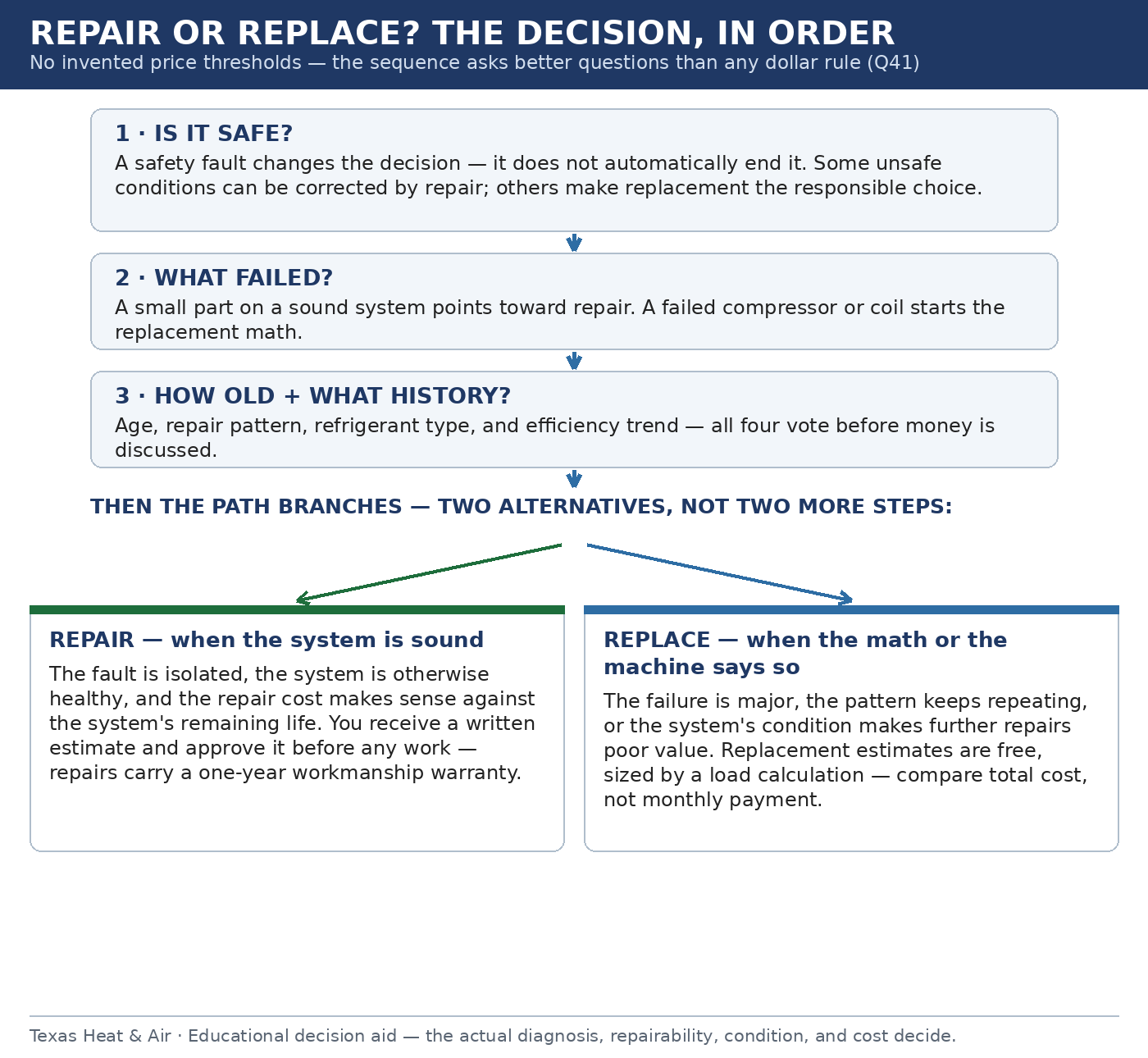
Visual explanation
The four-question flowchart shown with this article (from Q41, "Four questions, in order, that settle most repair-or-replace decisions") is this article's decision tool. At fifteen, the flowchart's answers genuinely split — the table below does the age-specific weighing.
What you can safely check
- Write down the last few years of repair costs and how your summer electric bills have trended.
- Add the system's refrigerant type from the outdoor unit's label. At this age it can cast the deciding vote.
- Ask Texas Heat & Air what a review or estimate costs before you book.
How to compare your options
At 15 years, your system sits at the lower edge of the typical 15-to-20-year service life (Q42). So the question changes shape. At ten, you asked, "Is it worth fixing?" At fifteen, ask: "How much life am I buying with this repair. And at what price per season?"
A modest repair can pass that test easily.A system that cooled fine last summer, with a clean recent history, now needs an electric part or a motor. The repair is small. The system it restores is proven. Several more seasons from it is a realistic outcome. Refusing that repair on age alone would waste a working asset.
A major repair faces a harder audit.Replacing a compressor or a coil costs a large share of a new system. And it installs that new part inside a machine whose fan, controls, second coil. Cabinet are all fifteen years old. The repair does not make the system young. It makes one part young. The next failure is already aging somewhere in the same box. Ask the blunt, simple question of any major repair at this age: what does this buy buy? How many seasons — and at what risk of the next failure arriving in mid-July?
Failure history is the tiebreaker.Fifteen years old with two repairs ever is a different system from fifteen years old with a repair every summer since it turned twelve. The first deserves the modest-repair benefit of the doubt. The second has been announcing its trajectory for years (Q41).
Two quieter factors add weight.Efficiency: a 15-year-old unit uses notably more electricity than current system to do the same cooling. So part of the replacement cost quietly comes back through lower bills (Q48). A credit the repair path never earns. Refrigerant: a 15-year-old system may still run R-22 or an early HFC. A leaking system on a phased-down refrigerant faces rising recharge costs. Price the leak repair against replacement without optimism (Q80).
| Situation | Lean |
|---|---|
| Modest repair, cooled well last summer, clean history | Repair — buying real seasons |
| Major repair (compressor/coil) | Replacement — unless warranty changes the math |
| Repair every summer recently | Replacement — the trend is the answer |
| Leaking system on R-22 refrigerant | Replacement — scarcity compounds the cost |
| Planning to sell the home soon | Modest repair may serve the plan; disclose honestly |
When to call a professional
Ask the technician to explain the remaining risks honestly — what else is worn. Ask them to assess the system end to end: condition, refrigerant type and availability, the efficiency comparison against new system. A realistic estimate of remaining life. That condition report is the weight you cannot supply yourself. At this age it matters more than the repair quote alone.
What happens next
Get both numbers in writing. The repair estimate and the replacement proposal. And decide on the comparison, not on pressure. Reject any "today only" framing at this age most of all. A 15-year decision deserves a night of thought. A sound quote survives it. And make the decision before the system dies on the hottest weekend of the year. A decision made from written numbers on a mild day beats the same decision made in a hot house with guests coming Friday. Ask Texas Heat & Air what an estimate for a replacement system costs before you book.
Texas Heat & Air next step
Fifteen and failed? Get both numbers in writing while the house is still comfortable — call (682) 438-8127.
Related Questions
 Is a 10-year-old AC worth repairing?Is a 20-year-old AC worth fixing?Can a new AC lower my power bill?

Still Have Questions? Ask an HVAC Expert.
Couldn't find the answer you need? Tell us what's happening. Our team will review your question and contact you to help.
Ask Your Question →Sources
- https://www.energystar.gov/saveathome/heating-cooling/replace — service-life range and replacement timing (ENERGY STAR)
- https://www.energy.gov/femp/purchasing-energy-efficient-residential-central-air-conditioners — efficiency of current system versus older systems (U.S. Department of Energy)