
Is a 20-year-old AC worth fixing?
At twenty years — a full service life — fix small or don't fix at all. Why major repairs fail on cost, company, and supply.

At twenty years, only a small, inexpensive repair on a system that still works well usually makes sense. Major repairs at this age are risky. The repair does not make the system young. The next failure is statistically close. And parts and refrigerant for very old systems grow scarce.
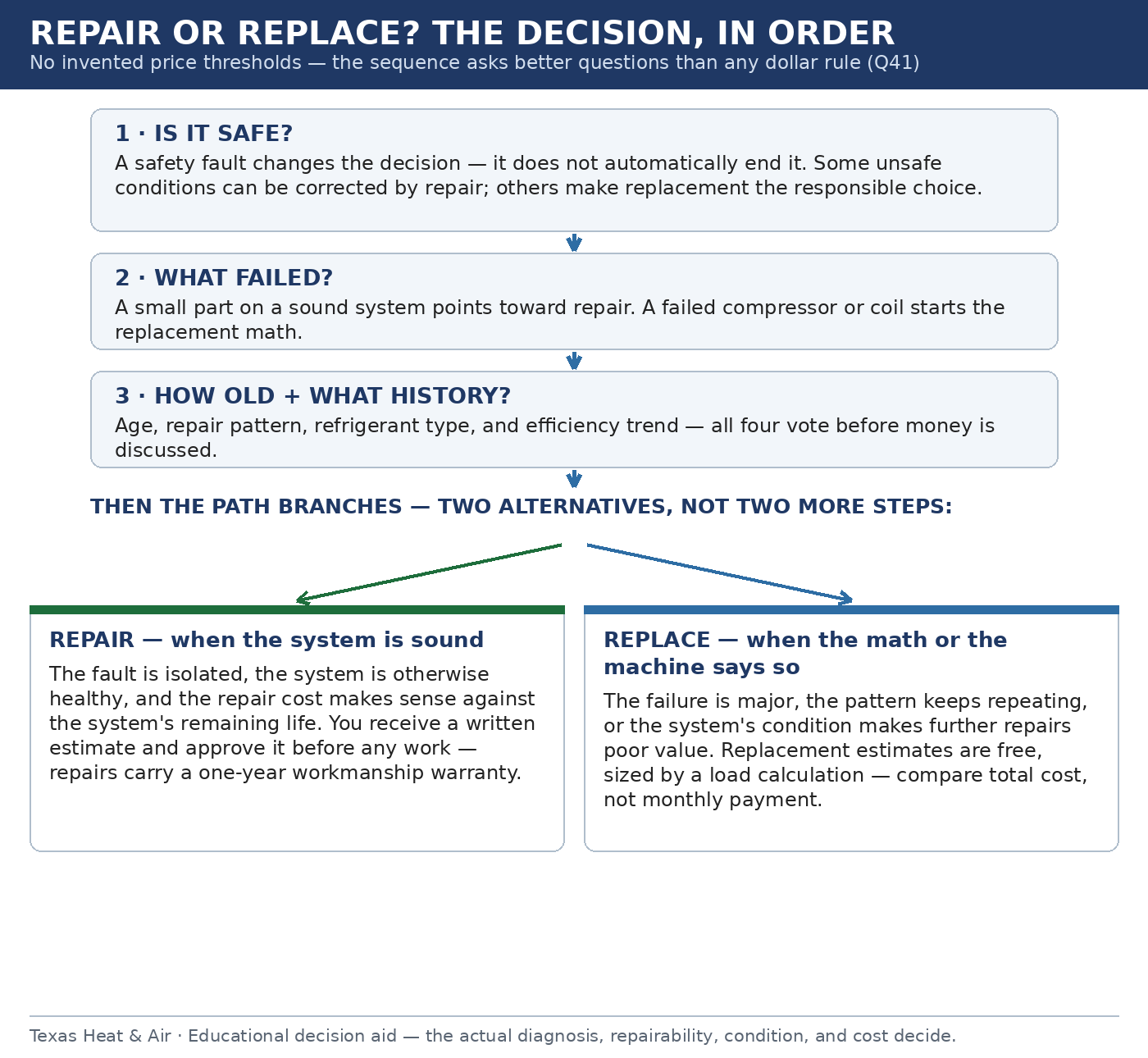
Visual explanation
The four-question flowchart shown with this article (from Q41, "Four questions, in order, that settle most repair-or-replace decisions") is this article's decision tool. At twenty, its verdict is the narrowest in the series: repair small. Do not repair at all.
What you can safely check
- Collect energy bills, repair notes. The system's age and refrigerant type from the outdoor unit label. (Refrigerant is the fluid sealed inside the system's loop that carries heat.)
- Never approve a major repair on a 20-year-old system from a verbal quote alone.
How to compare your options
Give the system its due first. Twenty years is a full service life — beyond the typical 15-to-20-year range (Q42). Twenty years of Texas summers is more run-hours than most system anywhere is ever asked for. Anything it does from here is overtime. That framing produces a clear rule. At twenty, the question is no longer "Can it be fixed?" Almost anything can. The question is "What does fixing it buy, and for how long?"
The small-repair case is genuinely sensible.If the system still cools acceptably and the failure is a capacitor (an electric part that helps a motor start and run) or a contactor (the heavy-duty switch that turns the outdoor unit on), a modest spend keeps a working machine working. That is especially true if you are planning a move or a renovation. Simply want to choose your replacement moment instead of having it chosen for you during a heat wave. Name the frame out loud, though: it is your plans, not the system's health, doing the work. There is no prize for replacing a working system early.
The major-repair case fails on three counts.Cost: a compressor or coil at this age spends a large share of a new system's price. Company: every other part in the box. The other motor, the controls, the second coil, the wiring. Is also twenty years old. The next failure is not a possibility; it is a schedule. Supply: very old systems, especially R-22 system, face parts and refrigerant that are increasingly scarce and expensive, because production of that refrigerant has been phased out. A major repair can even strand you midway: the part exists, but the refrigerant to charge it barely does. A leaking R-22 system at twenty is close to a replacement case by definition. Treat replacement as the default, and make repair argue its way in.
Against that, a new system brings more than reliability. Correctly sized and installed, it delivers a large efficiency gain over two-decade-old system. The widest gap in this whole category. It also starts a fresh maker warranty, with terms that vary by brand, model, and registration (Q60). If you need financing, compare it on total written cost, with no promised terms (Q59).
| Repair proposed | Usual verdict |
|---|---|
| Capacitor or contactor, system otherwise cooling | Fix it — rational overtime |
| Fan motor, system otherwise sound | Fix, with eyes open about the next failure |
| Compressor or coil | Replace — cost, company, and supply all argue against |
| Any major repair on R-22 system | Replace — refrigerant scarcity compounds the risk (Q80) |
| Everything still works; asking ahead of time | Budget and quote the replacement now; run the old system while it serves |
When to call a professional
Ask for the full remaining-life picture: overall condition, parts and refrigerant availability for your model, the efficiency gap against new system. The true installed cost of both options. On a 20-year-old system, a technician who talks yououtof a major repair they would profit from is showing you the honest version of this trade.
What happens next
Decide on the math, not on the pressure of a hot house: written numbers for the repair and for replacement, side by side (Q41). If the old system dies outright in a heat wave, you are allowed to take a night rather than sign the first paper put in front of you. Twenty years of service earned the system a considered retirement decision, not a panic buy. Ask Texas Heat & Air what a review or estimate costs before you book. The comparison itself is the first product worth buying.
Texas Heat & Air next step
Twenty years old and down? Get the repair and replacement numbers in writing, then decide in a cool room — call (682) 438-8127.
Related Questions
 Is a 15-year-old AC worth repairing?Can a new AC lower my power bill?Do new refrigerant rules mean I must replace my AC?

Still Have Questions? Ask an HVAC Expert.
Couldn't find the answer you need? Tell us what's happening. Our team will review your question and contact you to help.
Ask Your Question →Sources
- https://www.energystar.gov/saveathome/heating-cooling/replace — service life and replacement timing (ENERGY STAR)
- https://www.energy.gov/femp/purchasing-energy-efficient-residential-central-air-conditioners — efficiency gains of current system (U.S. Department of Energy)
- https://www.epa.gov/hfcs/frequent-questions-phasedown-hydrofluorocarbons — refrigerant phasedown and scarcity (U.S. EPA)