
Why is one room hotter than the others?
One hot room is usually heat gain plus weak air delivery. Sun load, a long leaking duct run, or a starved return path. Why a bigger AC rarely fixes it.

Usually it is a mix of two things: the room takes in more heat than the others. It gets less cooled air. Heat comes from things like west-facing windows or a room over a hot garage. Weak air comes from a long duct run, a partly closed vent, or a leaking duct. A bigger AC rarely fixes a one-room problem. The cause is usually in that room's air path.
What you can safely check
- Open the room's vent fully and move furniture or rugs off it.
- Close blinds or shades during strong afternoon sun.
- Feel whether air flows strongly at the vent while the system runs.
- Note the pattern. Hot all day points to weak air delivery. Hot only in afternoon sun points to heat coming in.
- Do not close vents in other rooms to "force" air into the hot one. The system needs its full airflow. Starving it hurts the whole system and rarely helps the room.
- Do not crawl into attic areas to chase ducts. Heat and tight access make that pro work.
What might be causing this
Work the room like a detective, in the order the causes usually rank.
Heat gain first.Ask what loads this room with heat the others do not carry. West-facing windows drinking in the afternoon sun. A room over a hot garage, with heat rising up through the floor. A ceiling under a thinly insulated part of the attic. Heat-making things inside the room: gaming computers, big TVs, a home office running all day.
A room can have a perfectly good air supply and still lose. Its load is simply bigger than its share.
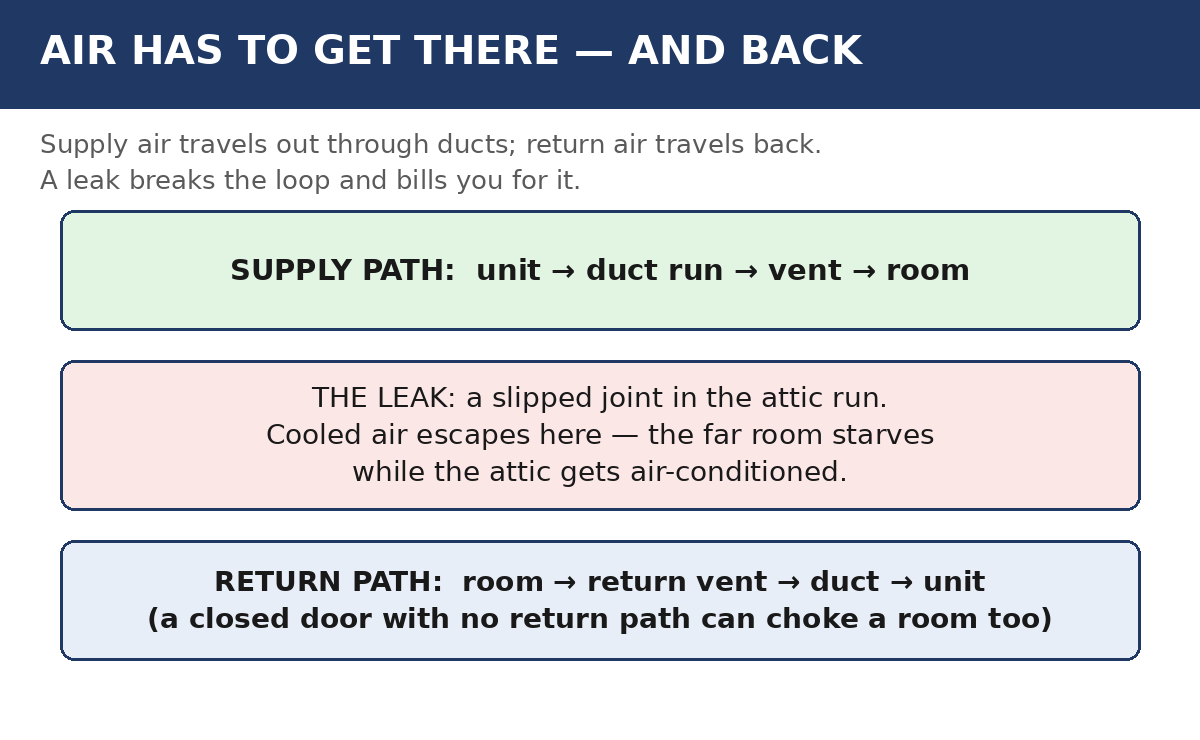
Air delivery second — and delivery has two halves.The first half is supply: cooled air must arrive, through a vent fed by a duct run. The run to a far bedroom is the longest in the house. Every leak, crush, or loose joint along it quietly dumps air into the attic before it arrives (Q84). That escaping air is duct leakage. Cooled air slipping out through holes, gaps. Loose joints instead of reaching the room.
The second half is return: the air must also be able toleave. A room with its door closed and no return vent or gap under the door pressurizes itself. It chokes its own supply. A vent can be wide open and a room still starved, for want of a way out.
Balance third.Sometimes every room's hardware is fine, but the sharing was never adjusted. Duct sizes or dampers set at construction give some rooms more than their share and this room less. Balancing is adjustment work, not system work.
| Suspect | Test you can do | Professional test |
|---|---|---|
| Heat gain (sun, garage, attic) | Note the room's exposure and hours | Load assessment |
| Supply (duct run) | Feel airflow at the vent | Duct inspection: leaks, crushes, disconnections |
| Return path | Door open vs. closed comfort | Return-air evaluation |
| Balance | Compare vent strength room to room | Airflow measurement + damper adjustment |
When to call a professional
Call if the room stays far warmer than the rest after the checks above. A technician will measure airflow at the vent. They will inspect the duct run for leaks, crushes, or disconnections. They will check the return-air path and size up the room's heat load. That turns suspicion into numbers before anyone recommends a fix.
What happens next
The investigation protects you from the common wrong buy. Most one-room causes are room-and-duct causes. That is why a bigger AC disappoints: it feeds the same uneven duct system more air. Every room gets more in the same uneven shares. The hot room stays relatively hot. You pay more, and you add an oversized system's humidity problems (Q76).
Diagnose the room first. System is the last suspect in a one-room mystery, not the first. (Q74 covers the case where a ductless mini-split genuinely is the answer. An addition, a conversion. A room ducts cannot reach.)
Texas Heat & Air next step
Room still far warmer after the checks? The duct run and airflow to that room need instruments, not guesses. Call Texas Heat & Air at (682) 438-8127 and describe the pattern. All day, or afternoons only. It helps aim the visit.
Related Questions
 Why is airflow weak at some vents?Can leaky ducts raise my energy bill?What is a ductless mini-split?

Still Have Questions? Ask an HVAC Expert.
Couldn't find the answer you need? Tell us what's happening. Our team will review your question and contact you to help.
Ask Your Question →Sources
- https://www.energystar.gov/saveathome/heating-cooling — ENERGY STAR, Heating & Cooling hub: air delivery, duct condition. Room-load factors (accessed October 13, 2026)
- https://bsesc.energy.gov/energy-basics/hvac-ducted-returns — U.S. DOE (BSESC), "HVAC Ducted Returns": how return paths complete the air loop (accessed October 13, 2026)