
Airflow, Ductwork, Humidity, and Whole-Home Comfort
Why one room bakes while another freezes: follow the air. How duct leaks, attic heat, insulation gaps, and humidity connect — and what fixes them.

Most comfort complaints are not really about the AC. They are about what happens to the air after the system makes it. Heat pours in faster than the system can remove it. Cooled air leaks into the attic before it reaches a room. A return path starves a closed bedroom. Or moisture never gets wrung out, because the system runs in short bursts.
This guide follows the air through a whole home. You will learn how heat gain, ductwork, insulation, and humidity connect. You will see why one room bakes, why the upstairs never catches up. Why a vent blows weakly. You will see why the house can feel damp with the AC running. And you will learn how to tell which cause matches your symptom. Before anyone sells you a bigger machine.
Key takeaways- Comfort is a loop: air must get to the roomand back. A break anywhere — leak, blockage, closed door, missing return — shows up as a comfort problem somewhere. - One hot room is almost never an system problem. It is a heat-load problem, an air-delivery problem, or both, in that room's air path. - Duct leakage. Conditioned air escaping through holes, gaps, or loose joints in the ducts. Is commonly estimated at around 20 to 30 percent in typical older, unsealed systems (DOE and ENERGY STAR guidance). That is an estimate about typical systems, not a measurement of your home. - Humidity removal is a side effect of run time. Anything that shortens cooling cycles. An oversized system, short bursts, a fan left on ON. Leaves air cool but clammy. - Duct cleaning is a targeted remedy for specific, visible problems. Not a routine every home needs on a schedule.
How it works
Heat arrives through predictable paths
Your home gains heat all day. Sun comes through west-facing glass. The roof bakes above the attic. Heat radiates through ceilings. Warm air leaks in around fixtures and hatches. The attic is the amplifier. On a hot Texas afternoon, an attic can grow extremely hot. Everything between that space and your living rooms — insulation depth, air sealing. The ducts running through it — decides how much of that heat you feel. Rooms over garages, rooms under thin insulation. Top-floor rooms sit closest to the load. That is why comfort problems follow the sun and the floor plan, not the system badge.
Air travels a loop, not a line
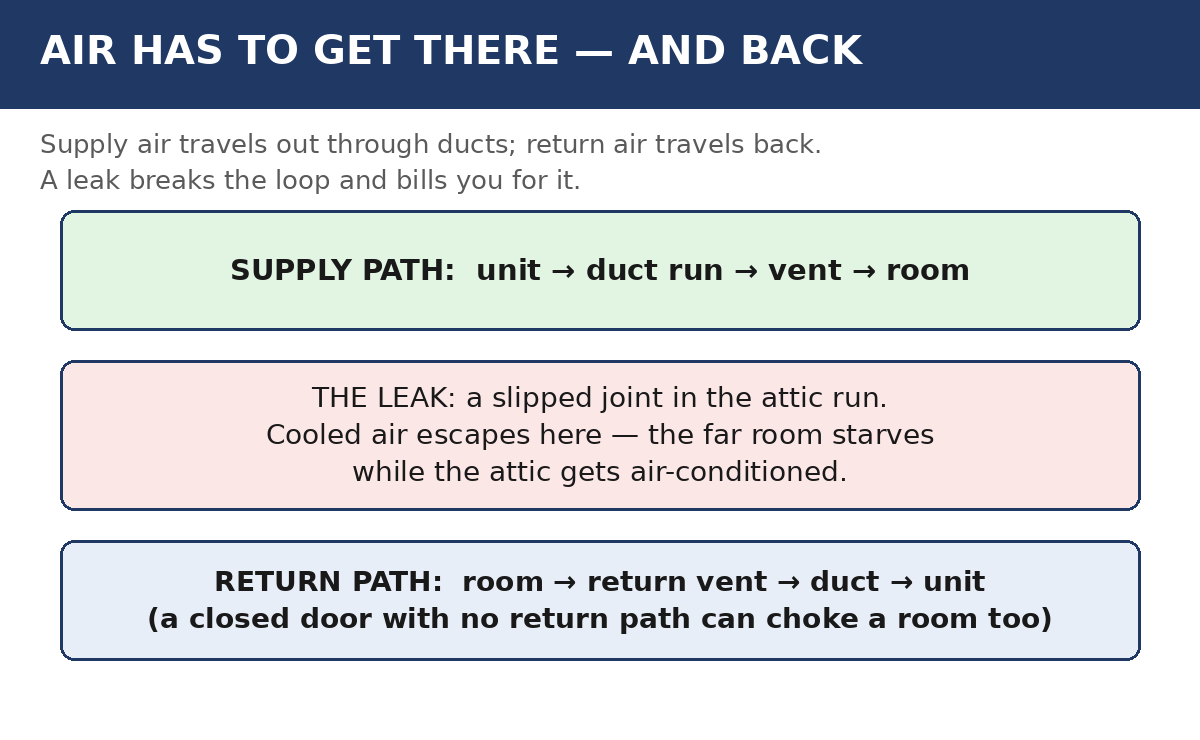
A duct system is a circuit. The blower pushes cooled air out through supply ducts to each room. The same amount of air must get back to the unit through return paths. Anything that breaks the circuit breaks comfort for the rooms beyond the break:
- Leaksspill cooled air into the attic, walls, or crawl space before it arrives. Leaky returns do the reverse. They pull hot attic air — and its dust — into the system.
- Blockages and restrictions— a matted filter, a crushed flex duct, a closed or furniture-covered vent — starve everything downstream.
- A missing return pathquietly defeats a room. Picture a closed bedroom door with no return grille and no gap under the door. Supply air has nowhere to go, so delivery chokes itself.
- Distance and balancematter. The far bedroom's run is the longest in the house. If dampers and duct sizes were never balanced, some rooms simply get more than their share.
Ducts lose energy two ways
Leakage is the obvious loss. The second is conduction. Ducts crossing a very hot attic carry cooled air through an oven. Poorly insulated duct walls let that heat warm the air on its journey. A duct can be perfectly sealed and still deliver lukewarm air if it is bare. That is why duct work and insulation are one conversation, not two. It is also why improving the home's shell reduces the load onanysystem, old or new.
Humidity is removed by run time, not by temperature
An AC removes humidity as a side effect. Moisture condenses — gathers as water — on the cold indoor coil while air moves across it during a cooling run. No run, no removal. So the homes that feel clammy are usually homes where runs are short. An oversized system blasts the thermostat to its setpoint and quits. A fan set to ON keeps blowing across a wet coil after cooling stops. Pushes moisture back into the air. Or a moisture source. A leak, a wet crawl space, unvented showers — outpaces normal removal.
As general guidance, the U.S. EPA suggests keeping indoor humidity below 60%, ideally between about 30% and 50%. Treat that as a comfort and mold-control target, not a pass-or-fail grade for every home. An inexpensive indoor humidity meter tells you whether you have a humidity problem at all, or just a temperature one.
The situations homeowners ask about
"One room is always hotter than the rest"
Work the room like a detective, in order.Heat gain first:west-facing windows, a room over the garage, electronics, thin insulation above.Delivery second:is the vent fully open and uncovered? Can air get back out. Door open, a gap under the door, a return path that exists?The run third:the duct to a far room is the longest in the house. A leak or crush anywhere along it dumps its air into the attic.Balance last:other rooms may be taking more than their share. Notice what isnoton the list — the size of the AC. A bigger unit feeds the same uneven ducts more air. The hot room stays relatively hot.
The short answer: Q81 — Why is one room hotter than the others? (/hvac-help/why-is-one-room-hotter-than-the-others/)
"The upstairs never catches up"
Physics stacks this deck three ways. Warm air rises through the house and collects upstairs. The roof above those rooms takes full sun and radiates heat down through the attic and ceiling. And the thermostat usually lives downstairs. It is satisfied while the upstairs still bakes. Design can deepen the gap. One system serving both floors pushes air through long attic runs to the top floor. Loses cool along the way. The fixes follow the causes: seal and insulate ducts, close insulation gaps, rebalance airflow. Only sometimes do they involve system changes like zoning. Be wary of anyone whose whole answer is a larger single system.
The short answer: Q82 — Why is upstairs hotter than downstairs? (/hvac-help/why-is-upstairs-hotter-than-downstairs/)
"Air barely comes out of this vent"
Start with scope, because scope is the diagnosis. One weak vent points local: that room's run. Leaked, crushed, or disconnected. A closed damper, or furniture over the vent. Weak airflow everywhere points central. Check the clogged filter first. It is the most common cause by far. The check takes two minutes. Then look to the blower or the coil. A matted filter does more than starve vents. The airflow loss can spread into frozen coils and overheating elsewhere in the system. If a clean filter and open vents do not restore flow, the next step is measurement, not guessing.
The short answer: Q83 — Why is airflow weak at some vents? (/hvac-help/why-is-airflow-weak-at-some-vents/)
"Am I paying to air-condition my attic?"
Partly, in most older homes — yes. DOE and ENERGY STAR guidance has made the same point for years. In a typical older, unsealed duct system, leakage is commonly estimated at around 20 to 30 percent of the air moving through the ducts. Treat that range as the scale of the problem in typical systems. It is not a measurement of your home. Only an assessment can give you that. The symptoms are the ones throughout this guide: weak vents, one hot room, an upstairs that will not cool, long run times. Dust — because leaky returns pull attic air in. Sealing joints with mastic, reconnecting slipped runs. Insulating attic ducts is unglamorous work. It pays back every hour the system runs. It keeps paying after an system replacement, too. That is why a duct assessment belongsbeforea new-system quote, not after.
The short answer: Q84 — Can leaky ducts raise my energy bill? (/hvac-help/can-leaky-ducts-raise-my-energy-bill/)
"A company says my ducts need cleaning"
Maybe — but the EPA's criteria should decide, not a sales photo. The agency does not recommend duct cleaning on a fixed schedule for every home. It also notes that what we know about the benefits of routine cleaning is still limited. Cleaning is worth considering for specific, visible problems: substantial mold growth inside ducts or on parts, a pest infestation. Ducts clogged with debris that is blowing into the home. Two rules protect you. Ask any provider to show you photos ofyourducts before you agree to work. And fix the root cause. Mold means moisture. Pests mean entry points. Debris means filtration or duct problems. Skip the root cause, and the result is rented, not owned.
The short answer: Q85 — Does every home need duct cleaning? (/hvac-help/does-every-home-need-duct-cleaning/)
"Would attic insulation help more than a bigger AC?"
Often, yes — because insulation attacks the load instead of the symptom. On a Texas summer afternoon, an attic can exceed 130°F. How hot yours gets depends on the season, your roof's color and material, sun exposure, and ventilation. Treat that figure as an example of the heat load, not a fixed rating. Your ceilings sit between that heat and your living space. Insulation is the barrier. Air sealing closes the leaks around light fixtures, hatches, and wall tops. Where the barrier is thin or spotty, the AC fights a constant load it was never sized for. No system upgrade fixes a load problem efficiently. Insulation, air sealing, and duct sealing work as one job. They make every system, old or new, work less.
The short answer: Q86 — Can attic insulation improve cooling? (/hvac-help/can-attic-insulation-improve-cooling/)
"The house is cool but feels damp"
That clammy feeling is the run-time problem from the principles section, felt on skin. The usual suspects: an oversized system short-cycling. Turning on and off again and again in short bursts instead of running steady, longer cycles. A fan left on ON, pushing coil moisture back into the air; poor airflow; or a drainage or moisture-source problem. Start by measuring. An inexpensive hygrometer (humidity meter) replaces guessing with a number. Readings that stay above the EPA's general guidance range invite mold growth and dust mites. That trades a comfort problem for a health one. The fix depends on the cause: system behavior and fan settings, airflow. A moisture source in the home. Longer, gentler runs remove more moisture. That is one reason variable-speed system feels different in humid weather.
The short answer: Q87. WHy does my home feel damp when the AC is on? (/hvac-help/why-does-my-home-feel-damp-when-the-ac-is-on/)
"Will a smart thermostat fix my comfort problem?"
It will fix aschedulingproblem, and only that. A thermostat — the wall control that reads the room temperature and tells the system when to start and stop — saves energy by easing off while you sleep or are away, then recovering before you return. The physics are real. A smaller gap between indoor and outdoor temperatures slows heat movement through your walls. But no thermostat seals a duct, insulates an attic. Lengthens a short-cycling system's runs. And no thermostat guarantees a lower bill. Savings depend on your home, system, weather, and habits. The traps are compatibility and wiring. Check your system type before buying. Heat pumps can lose setback savings to costly backup-heat recovery if the thermostat fights the system. And some systems need a common wire the old thermostat never used. If either is unclear, pro installation is cheap insurance.
The short answer: Q89 — Can a smart thermostat help save energy? (/hvac-help/can-a-smart-thermostat-help-save-energy/)
Diagrams and comparisons
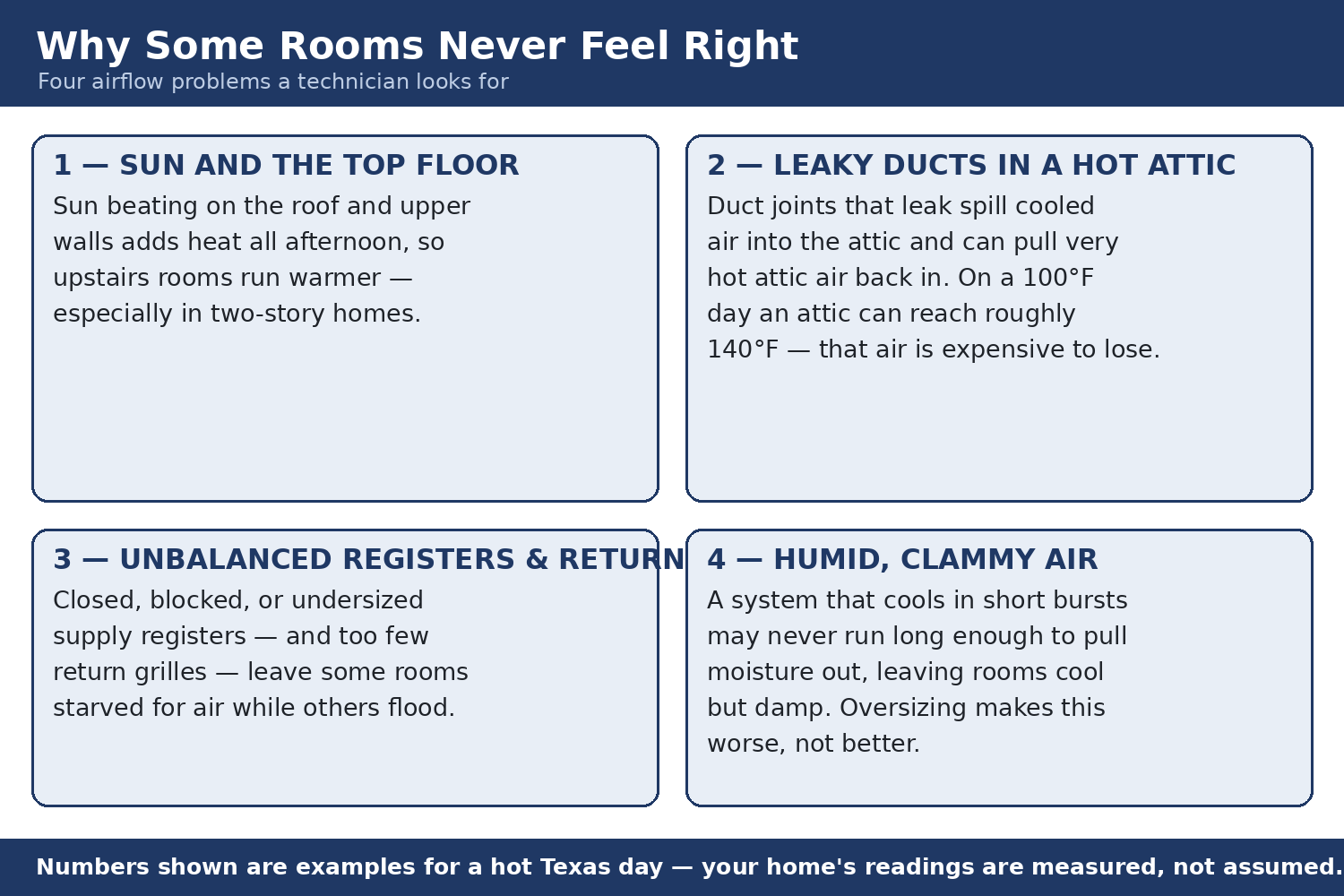
F14R-airflow-ducts.png— Why some rooms never feel right, in four panels: sun load on upper floors, leaky ducts in a hot attic, unbalanced registers and returns. Humidity left behind by short cooling cycles. Example temperatures in the graphic are conditioned examples for a hot Texas day. A home's own readings are measured, not assumed.
b3-17-q81-duct-airflow-diagram.png— Conditioned air has to get to the room — and back. The diagram follows supply air to a far bedroom and return air back to the unit. A leak in the attic run is marked where cooled air escapes. It teaches the loop: every symptom in this guide is a break in it somewhere.
| Duct leakage problem | Insulation problem | |
|---|---|---|
| What is failing | Conditioned air escapes before (or after) the room | Heat pours in through the ceiling faster than cooling removes it |
| Signature symptoms | Weak vent, dust at registers, one starved room, normal run times that never satisfy | Air arrives fine, but the room. Often upstairs or under the attic. Still runs hot on sunny afternoons |
| Where it hides | Joints, slipped connections, crushed runs, leaky returns in the attic or crawl space | Thin or spotty attic insulation, unsealed fixture and hatch leaks |
| The fix family | Mastic sealing, reconnecting, duct insulation | Added insulation depth, air sealing — usually assessed together with the ducts |
What you can safely do yourself
- Change a dirty filter.Two minutes, and it is the first check for weak airflow anywhere in the house.
- Open every vent fully and uncover it.Check the hot room's vent and the rooms around it; keep furniture off registers.
- Give air a way back.Keep interior doors open where you can, especially in rooms that run hot with the door closed.
- Block the sun you can.Close blinds on west-facing glass during strong afternoon sun.
- Run ceiling fans for people, not rooms.Fans cool skin, not air — switch them off when you leave.
- Measure humidity before treating it.An inexpensive indoor humidity meter tells you whether you have a moisture problem or a temperature problem.
- Look, don't crawl.From the attic hatch. Without entering unsafe areas. Note whether insulation looks thin, uneven, or disturbed. Whether any duct runs look disconnected.
What a technician checks
- Measured airflow at the vents, room by room, to separate a delivery problem from an system problem.
- The duct system itself: leakage by inspection and, where offered, pressure testing; disconnected or crushed runs; damper positions; duct insulation condition.
- Return-air paths, including whether closed-door rooms can return the air delivered to them.
- Insulation depth and coverageabove problem rooms, plus the air-leak points around fixtures and hatches.
- System behavior behind humidity complaints: cycle length and sizing, airflow and fan settings (AUTO versus ON), coil and drain condition. And moisture sources in the home itself.
Making the decision
Sequence matters more than spending. Diagnose the air path before you replace system. A new system connected to leaking, unbalanced ducts inherits every problem in this guide. The usual order is filter and vents (free), duct sealing and insulation (the load and the leaks), airflow balancing. Only then system changes. Get a duct assessment before any new-system quote, so the comparison is honest. Ask Texas Heat & Air about the training and credentials of the technician coming to your home. For a thermostat, verify compatibility with your system type first. Treat promised savings percentages as marketing until your own bills prove otherwise. Ask for findings in writing. A good assessment names the measured cause. This run leaks, this room has no return path, this insulation is four inches thin. Not just a product to buy.
North Texas notes
This region stress-tests every weakness in this guide at once. The cooling season is long. Afternoon sun loads west-facing rooms for hours. Attics reach their most extreme temperatures exactly when systems run hardest. So a duct leak or an insulation gap that would be a nuisance in a mild climate becomes the difference between a house that holds and a house that bakes by 6 p.m. Gulf humidity rides the same season. That is why cool-but-clammy is such a common local complaint: moisture removal here is not a luxury. It is half the job. Homes in Cleburne, Fort Worth. The surrounding communities also span many decades of construction. Duct and insulation conditions vary enormously from one street to the next. One more reason assessments here are measured, not assumed.
Related resources
- Q81 — Why is one room hotter than the others? (/hvac-help/why-is-one-room-hotter-than-the-others/)
- Q82 — Why is upstairs hotter than downstairs? (/hvac-help/why-is-upstairs-hotter-than-downstairs/)
- Q83 — Why is airflow weak at some vents? (/hvac-help/why-is-airflow-weak-at-some-vents/)
- Q84 — Can leaky ducts raise my energy bill? (/hvac-help/can-leaky-ducts-raise-my-energy-bill/)
- Q85 — Does every home need duct cleaning? (/hvac-help/does-every-home-need-duct-cleaning/)
- Q86 — Can attic insulation improve cooling? (/hvac-help/can-attic-insulation-improve-cooling/)
- Q87 — Why does my home feel damp when the AC is on? (/hvac-help/why-does-my-home-feel-damp-when-the-ac-is-on/)
- Q89 — Can a smart thermostat help save energy? (/hvac-help/can-a-smart-thermostat-help-save-energy/)
- Guide 3 — Why Your Air Conditioner Is Not Cooling (/hvac-help/guides/ac-not-cooling/) — when weak airflow is one branch of a system that is not cooling at all
- Guide 11 — Air Filters, Indoor Air Quality. Safe Homeowner Maintenance (/hvac-help/guides/filters-and-indoor-air-quality/) — the filter and dust side of the air path
Texas Heat & Air next step
If a room will not cool, vents blow weakly. The house feels damp with the AC running, the useful next step is a diagnostic visit that measures the air path. Not a guess at a bigger unit. Ask Texas Heat & Air to confirm the diagnostic fee when you book. Call (682) 438-8127 and describe which rooms misbehave and when. That pattern is the first clue.

Understanding the system comes first: learn how the pieces work together, use the safe checks. Let a qualified technician confirm anything inside the system.
Related Homeowner Questions
 Why is my upstairs hotter than downstairs?Why is airflow weak at some vents?Can leaky ducts raise my energy bill?Does every home need duct cleaning?Can attic insulation improve cooling?Why does my home feel damp when the AC is on?Can a smart thermostat help save energy?

Still Have Questions? Ask an HVAC Expert.
Couldn't find the answer you need? Tell us what's happening. Our team will review your question and contact you to help.
Ask Your Question →Sources
- https://www.energystar.gov/saveathome/heating-cooling — ENERGY STAR heating and cooling hub: air delivery, duct condition, filter guidance, and room-load factors
- https://bsesc.energy.gov/energy-basics/hvac-ducted-returns — U.S. DOE Building Science Education (BSESC): how ducted return paths work and where duct systems lose air
- https://www.energy.gov/femp/purchasing-energy-efficient-residential-central-air-conditioners — U.S. DOE FEMP guide to buying residential central AC units, including duct and envelope context
- https://www.epa.gov/indoor-air-quality-iaq/should-you-have-air-ducts-your-home-cleaned — U.S. EPA: when duct cleaning is and is not recommended, and moisture guidance
- https://www.epa.gov/indoor-air-quality-iaq/what-can-i-do-improve-indoor-air-quality-my-home — U.S. EPA: indoor humidity targets (below 60%, ideally 30–50%) and moisture control