
Can leaky ducts raise my energy bill?
Leaky ducts can waste roughly 20–30% of the air in a typical older, unsealed system. The two ways ducts tax your bill, the symptoms, and the lasting fix.

Yes — significantly. Air that leaks into your attic, walls. Crawl space is air you paid to cool or heat and never used. In typical older, unsealed systems, duct leakage is commonly estimated around 20 to 30 percent. The system runs longer to make up for it, comfort drops, and the bill climbs.
What you can safely check
- Note which rooms have weak airflow — the pattern of which rooms lag is evidence.
- Look for obviously loose vent covers. Look for visibly disconnected ducts at points you can see without entering the attic.
- Do not crawl into attic areas. Heat, footing, and materials make duct inspection pro work.
How this works
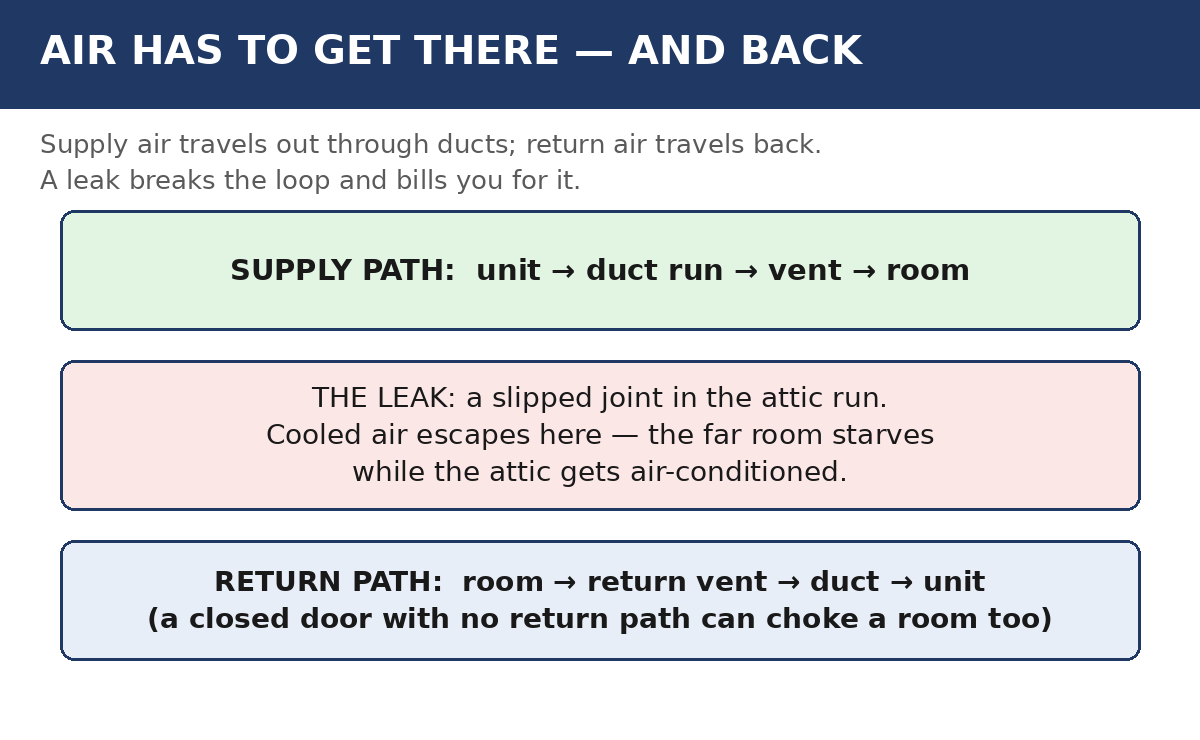
Duct leakage is conditioned air escaping through holes, gaps. Loose joints in the ducts. Cooled or heated air ends up in the attic or inside walls instead of in the rooms.
Follow a dollar's worth of cooled air through a leaky system. The system does its job: the air leaves the unit cold and dry. Then the duct run takes its tax. Joints sealed with tape that dried out a decade ago. Connections that slipped. Boots that never sealed. At each flaw, conditioned air escapes into the attic.
DOE and ENERGY STAR duct guidance has estimated the typical loss for years in the range this article cites: around 20 to 30 percent of the air moving through an older, unsealed duct system never reaches a room. You paid full price to cool all of it. Treat that range as the scale of the problem in typical older systems. Not as a measurement of your home. Only an assessment can measure yours.
Then the second tax, the heat one. Ducts crossing a hot attic lose energy through their walls even without leaks. Thin or missing duct insulation lets the attic warm the cooled air on its way, so what arrives at the vent is poorer than what left the unit. The system works longer to deliver the same comfort — and longer is the bill.
The symptoms are this whole topic's table of contents: weak vents (Q83), one hot room (Q81), an upstairs that never catches up (Q82), long run times. The dust of Q90. Return-side leaks breathe in attic air and everything in it, then spread it through the house. Duct problems rarely present as "duct problems." They present as a house that is expensive to keep comfortable.
| Loss | Mechanism | Fixed by |
|---|---|---|
| Leakage (~20–30% in typical older unsealed systems) | Escaped conditioned air | Mastic/metal-tape sealing, reconnections |
| Thermal loss | Hot attic warms air in transit | Duct insulation |
| Return-side infiltration | Attic air + dust pulled in | Return sealing (Q90) |
| Consequence | Longer runs, weak rooms, higher bills | Assessed before new system |
When to call a professional
Ask for a duct leakage assessment if the symptoms persist. Weak rooms, long run times, bills that feel out of line. Ask for one always before installing new system. A technician inspects the runs for leaks, disconnections, and crushing. They check duct insulation and measure airflow room by room. Where offered, pressure testing can put a number on the leakage.
What happens next
The fix is unglamorous and permanent: sealing joints with mastic or metal-backed tape, reconnecting slipped runs. Insulating attic ducts properly. Never use the cloth "duct tape". Its name lies about its fitness for the job.
Sealing and insulating are among the very few upgrades that help every hour the system runs. They keep helping after an system replacement, too. That is why asking about your ducts' condition belongsbeforea new-system quote, not after. A new machine feeding the same sieve buys the sieve's performance at new-machine prices.
Texas Heat & Air next step
Bills high and rooms uneven? Ask for a duct leakage assessment before pricing new system. Call Texas Heat & Air at (682) 438-8127 and mention which rooms lag. The pattern helps aim the inspection.
Related Questions
 Why is airflow weak at some vents?Can attic insulation improve cooling?Why is there dust around my air vents?

Still Have Questions? Ask an HVAC Expert.
Couldn't find the answer you need? Tell us what's happening. Our team will review your question and contact you to help.
Ask Your Question →Sources
- https://bsesc.energy.gov/energy-basics/hvac-ducted-returns — U.S. DOE (BSESC), "HVAC Ducted Returns": duct-system losses and return paths (accessed October 13, 2026)
- https://www.energy.gov/femp/purchasing-energy-efficient-residential-central-air-conditioners — U.S. DOE FEMP, "Purchasing Energy-Efficient Residential Central Air Conditioners": duct condition in system efficiency (accessed October 13, 2026)