
Why is airflow weak at some vents?
One weak vent points to that room's duct run; weak air everywhere points to the filter or blower. The check order, and the icing sign that means stop and call.

Weak airflow means air is being blocked, leaked away, or not pushed hard enough. The usual causes are a dirty filter, a closed or covered vent, a leaking or crushed duct, or a failing blower. The motor that moves the air. The pattern tells you where to look. One weak vent points at that room's duct run. Weak airflow everywhere points at the filter or blower.
What you can safely check
- Check the filter first. If it looks dirty or matted, replace it (Q65). This takes two minutes and is the single most common fix.
- Confirm supply vents are open and uncovered. Check that return vents are not blocked by furniture, rugs, or storage.
- Note the pattern — one vent, or the whole house — and write it down. It directs the diagnosis.
- If you see ice on the refrigerant lines or the indoor coil, turn the system off. Set the fan to ON so the ice can thaw, and call. Do not keep running it (Q19).
What might be causing this
Scope is the master clue, so start there: is the weakness at one vent, or at every vent?
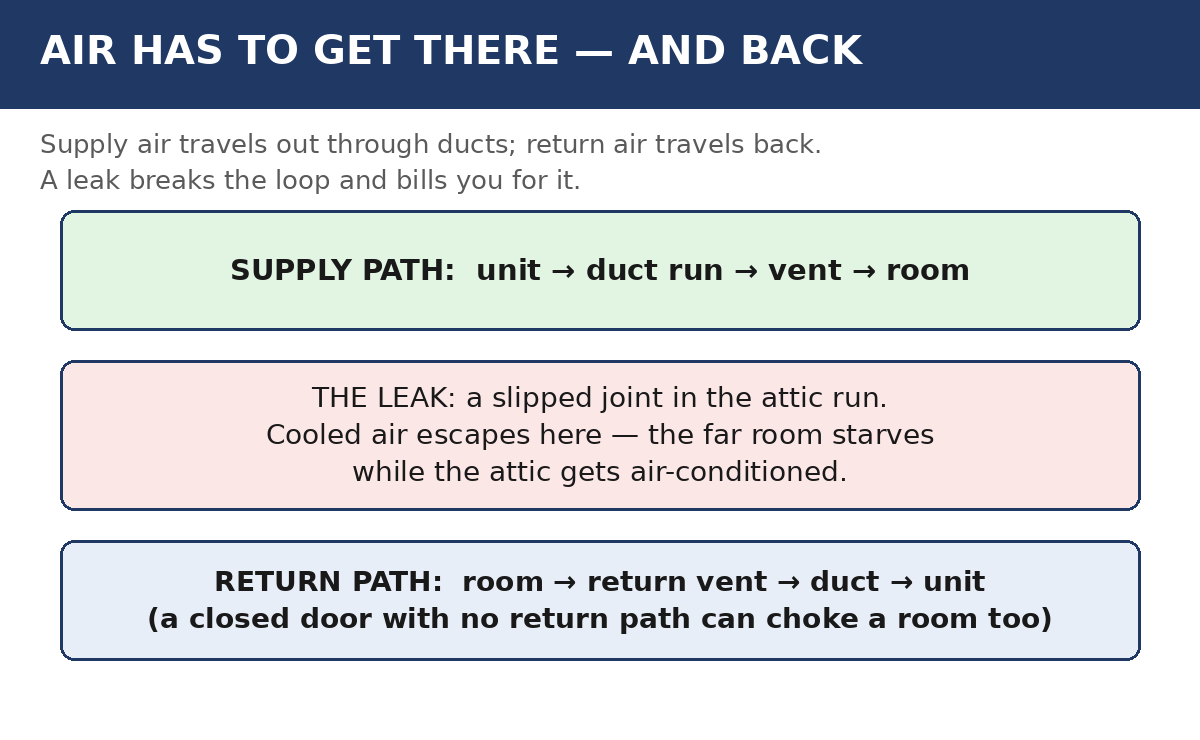
One weak vent points local.That room's duct run is the suspect list. Long runs lose pressure naturally. A leak along the run bleeds air into the attic (Q84). A crushed or disconnected section chokes it outright. A closed damper — sometimes set years ago by someone balancing by feel — throttles it. Or furniture sits over the vent, doing the same job for free. Q81's one-room investigation is the local branch of this same tree.
Weak airflow everywhere points central.The first suspect is the cheapest part in the house: the filter. A matted filter can cut airflow across the whole system. Its side effects are the serious ones: frozen coils (Q19). Furnaces overheating until their safety limits shut them down.
Past the filter, the central list runs: a dirty blower wheel or indoor coil choking the airstream from inside. A failing blower motor losing strength (Q25). The blower motor is the motor in the indoor unit that pushes air across the coil and through the ducts; or duct leakage so extensive the whole system bleeds.
The return side deserves its own sentence,because homeowners forget the system must breathe in, too. Blocked returns — furniture, rugs, closed doors with no gap underneath, room after room — starve the blower at its intake. Every vent downstream weakens together.
| Scope | Likely causes | First move |
|---|---|---|
| One vent | Long/leaking/crushed run, closed damper, blocked vent | Vent + furniture check, then duct inspection |
| Every vent | Clogged filter, dirty blower/coil, failing blower, blocked returns | Filter check (Q65) |
| Every vent + icing | Airflow failure in progress | Stop and call (Q19) |
When to call a professional
Call if airflow stays weak after a clean filter and open vents. Call promptly if icing appears. Weak airflow is not a wait-and-see symptom. Run long enough, it can freeze the coil. In heating season it can overheat a furnace. That turns a filter-and-blower story into a compressor story. A technician will measure airflow, inspect the ducts. Test the blower rather than guess.
What happens next
The homeowner sequence is short and ordered: filter first, vents and returns open second, pattern noted third. If the problem remains, it needs instruments. When you call, report the pattern. One vent or house-wide. Whether any icing showed up. That one observation can cut the diagnosis in half before the visit starts.
Texas Heat & Air next step
Still weak after a clean filter and open vents? It needs measurement, not more guessing. Call Texas Heat & Air at (682) 438-8127 and report the scope you noted — one vent, or everywhere.
Related Questions
 Why is one room hotter than the others?Can leaky ducts raise my energy bill?Why is the indoor blower not running?

Still Have Questions? Ask an HVAC Expert.
Couldn't find the answer you need? Tell us what's happening. Our team will review your question and contact you to help.
Ask Your Question →Sources
- https://www.energystar.gov/saveathome/heating-cooling — ENERGY STAR, Heating & Cooling hub: filter and airflow guidance (accessed October 13, 2026)
- https://bsesc.energy.gov/energy-basics/hvac-ducted-returns — U.S. DOE (BSESC), "HVAC Ducted Returns" (accessed October 13, 2026)