
What does HVAC mean?
HVAC means Heating, Ventilation. Air Conditioning — the system that heats, cools, dehumidifies. Moves air through your home as one system.

HVAC stands for Heating, Ventilation, and Air Conditioning. It is the system that heats your home, cools it, removes moisture, and moves air through it. When people say "the HVAC system," they mean the whole package. The outdoor unit, the indoor unit, the thermostat. The ductwork — working as one machine.
Before you call
Two things are worth finding before any service conversation:
- Your system's model details and owner's manual. Knowing your system type. Furnace plus AC, heat pump, or ductless mini-split. Makes every other question in this library easier to use.
- What gives fresh-air ventilation in your home, if indoor air ever feels persistently stale or stuffy. That is a real question worth asking on its own.
How this works
The three letters name three jobs. Most homes give all three jobs to one connected system.
H — Heatingwarms the air: a gas furnace, a heat pump, or electric heating elements.
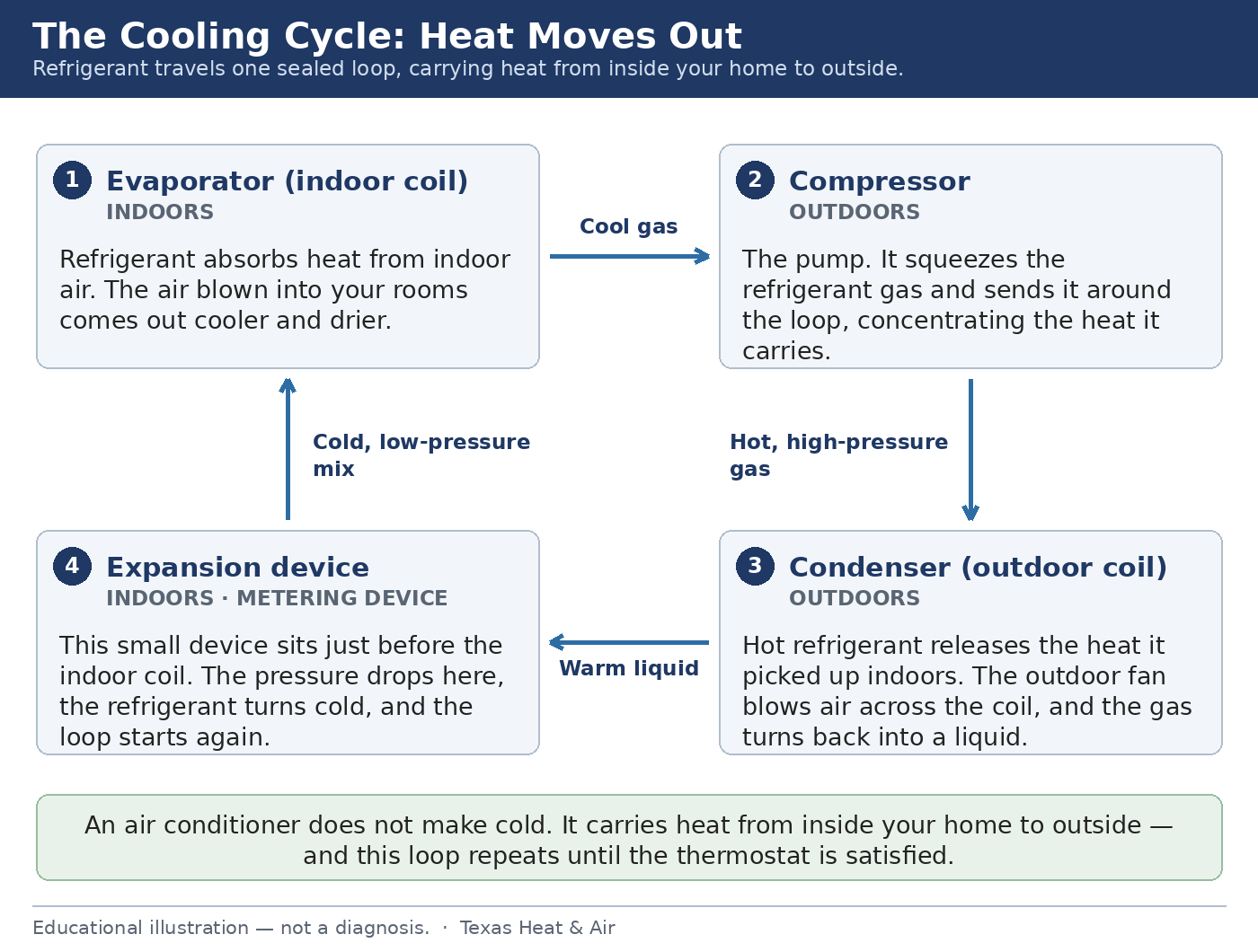
AC — Air Conditioningcools the air. Just as important in Texas, it also pulls moisture out of the air. A running AC is also your dehumidifier.
V — Ventilationis the air-movement job: the blower motor, the ducts, and the vents. The blower motor is the motor in the indoor unit that pushes air through the ducts to the rooms. The system then brings air back to be treated again.
One honest point about the V. In most homes, "ventilation" means recirculation — the same indoor air moving around the loop. It does not usually mean fresh outdoor air being drawn in. Dedicated fresh-air systems do exist, but they are not the standard setup in a typical house. If your home feels stale all the time, that is a separate ventilation question. It does not mean the acronym misled you.
The definition matters because it helps you spot problems. The parts form one system, so a fault in one part can look like a failure of the whole thing. Leaky ducts let treated air escape before it reaches the rooms, so good system can feel broken. A failing blower starves a healthy furnace of air. A cheap filter quietly makes everything after it work worse. That is why technicians answer symptom questions with system answers. The machine really is one machine.
One fact is a good first step: know what type of system you have. Furnace plus AC, heat pump. Mini-split changes the meaning of half the articles here. Your thermostat will usually tell you. The thermostat is the wall control that reads the room temperature and tells the system when to start and stop. An EMERGENCY HEAT setting signals a heat pump. Your owner's manual will tell you, too.
When you need a technician
Call a technician when one part of the system stops doing its job and the cause is not obvious. Signs include a room that never reaches the set temperature, air that barely moves, ice, leaks, or new noises. Because the parts work together, a technician checks the system as a system. System, airflow, and controls together. That beats swapping parts until something changes.
What happens next
If you are booking a first visit, have your system type and model details ready. Ask Texas Heat & Air to confirm the diagnostic fee when you book. You receive a written diagnostic report and a written estimate before you approve any repair.
Texas Heat & Air next step
Not sure which system type you have? Your thermostat's modes or a photo of the outdoor unit's label will tell us — call (682) 438-8127.
Related Questions
 What is the difference between an AC and a heat pump?What is a ductless mini-split?

Still Have Questions? Ask an HVAC Expert.
Couldn't find the answer you need? Tell us what's happening. Our team will review your question and contact you to help.
Ask Your Question →Sources
- https://www.energystar.gov/saveathome/heating-cooling — ENERGY STAR's heating and cooling hub. Supports the framing of heating/cooling system, thermostat. Air distribution as one home system.