
What is the difference between an AC and a heat pump?
One machine with a reversing valve: a heat pump is an AC that can run its loop backward to heat. What changes, what doesn't, and which fits your home.

A standard AC only cools. A heat pump cools in summer and heats in winter. It does this by reversing the direction heat flows. In heating mode, it gathers heat from outdoor air and brings it inside, instead of creating heat with a flame or electric elements. The system looks nearly identical.
Before you call
Not sure which machine you own? Two safe ways to tell:
- Check your thermostat. A heat pump thermostat usually offers an EMERGENCY HEAT mode. The tell that you own a heat pump.
- Check your owner's manual or the outdoor unit's label, which names the system type. Read labels only; no covers need opening.
How this works
Start with the surprising part: a heat pumpisan AC — the same loop from Q72 — with one extra part, a reversing valve. The valve lets the refrigerant run the loop backward. Everything else follows from that valve.
In summer mode, the two machines are indistinguishable. Heat moves from indoors to outdoors. Moisture condenses and drains away. The thermostat is satisfied.
Flip the valve for winter, and the loop reverses. The outdoor coil becomes the absorber: it gathers heat from the outdoor air. Cold air still contains usable heat, because "cold" outdoors is still far warmer than the refrigerant inside the coil. The indoor coil becomes the releaser, delivering that gathered heat into your home. No flame, no glowing elements: the heat was moved, not made. That is the source of the heat pump's efficiency reputation. Moving heat takes less energy than creating it, so a heat pump can deliver more heat energy than the electricity it uses.
The trade-offs are just as mechanical:
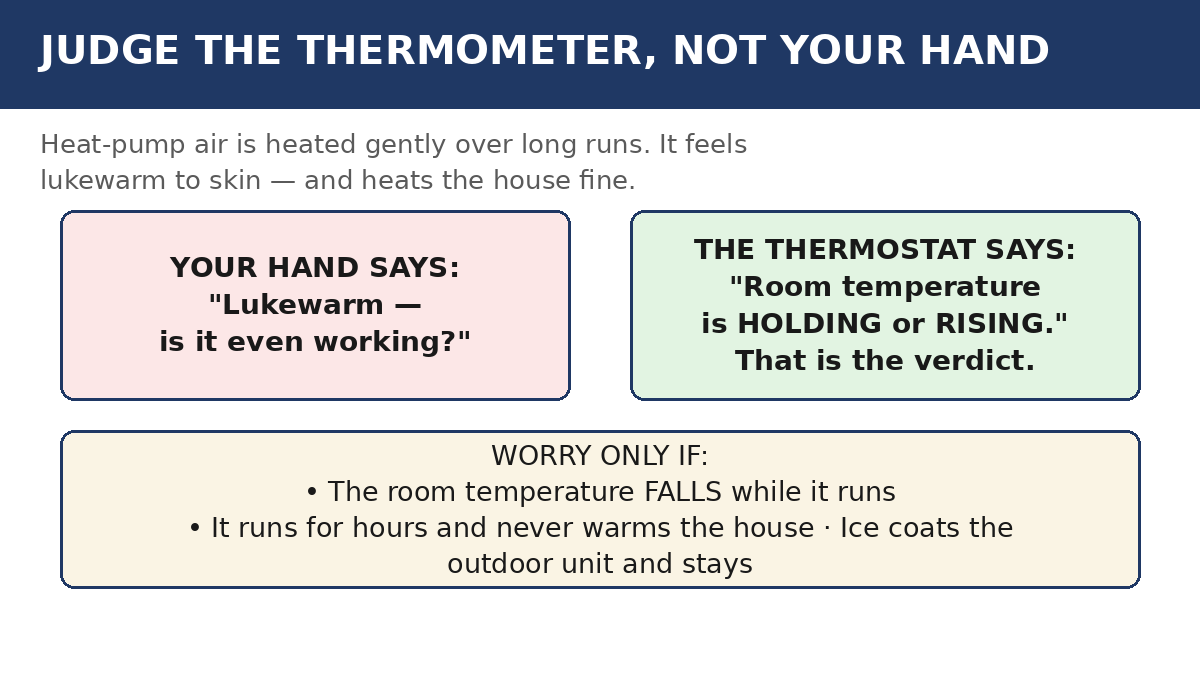
- Air delivered by gathered heat feels cooler to the skin than furnace air, even while it heats the house correctly. Judge a heat pump by whether the room reaches and holds the set temperature, not by how the air feels on your hand.
- In deep cold, outdoor heat gets scarcer. The system leans on backup heat. Auxiliary heat, the extra heat that turns on automatically to help the heat pump when outdoor air is too cold for it to keep up alone.
- The outdoor unit runs in winter too, with a defrost cycle. A short, normal cycle in which the heat pump briefly reverses itself to melt frost that has built up on its outdoor coil. Steam and a short pause in warm air are normal parts of it.
A standard AC, by contrast, does one job and pairs with a separate heat source — usually a gas furnace. A dual-fuel pairing also exists: a heat pump plus a furnace as its backup.
| Standard AC | Heat pump | |
|---|---|---|
| Cools | Yes | Yes — same loop |
| Heats | No — needs a furnace or elements | Yes — by reversing the loop |
| Heat feel | Furnace air feels hot | Delivered air feels lukewarm (normal) |
| Winter behavior | Outdoor unit rests | Runs; defrost cycles |
| Backup heat | Is the furnace | Electric strips or a furnace |
Which arrangement fits your home depends on your fuel options, your climate, your electric capacity, and what you already own. It is a genuine replacement-time question. Not a declaration that one machine is simply "better." North Texas has mild winters and hot summers, so both arrangements are common here. Both can be the right answer.
When to call a professional
Ask whether a heat pump fits your home before replacing system, especially if you now heat with gas or electric resistance. A technician weighs your home's load, your existing fuel and electric setup. Duct condition before recommending a type.
What happens next
Ask Texas Heat & Air what an estimate for a replacement system costs before you book. The comparison — AC plus furnace versus heat pump — can be priced for your home either way. Ask Texas Heat & Air to confirm the diagnostic fee when you book.
Texas Heat & Air next step
Weighing the two at replacement time? Ask Texas Heat & Air what a review or estimate costs before you book.
Related Questions
 Why does my heat pump blow lukewarm air?What is emergency heat on my thermostat?

Still Have Questions? Ask an HVAC Expert.
Couldn't find the answer you need? Tell us what's happening. Our team will review your question and contact you to help.
Ask Your Question →Sources
- https://www.energystar.gov/saveathome/heating-cooling — ENERGY STAR heating and cooling hub; heat pump use and system types.
- https://www.energy.gov/femp/purchasing-energy-efficient-residential-central-air-conditioners — U.S. Department of Energy guidance on system use and parts.