
HVAC Engineering Explained Simply: How Cooling, Sizing, and Efficiency Really Work
The engineering under your comfort, in plain language: how an AC moves heat, why size comes from a load calculation. What SEER2 ratings really mean.

Most comfort problems that get blamed on system start earlier. With sizing nobody explained, ratings nobody translated. A cooling process most homeowners were never shown. This guide fixes that. It builds one mental model, piece by piece. An AC is a heat-moving loop. Your home gains heat at a measurable rate, called its load. System is chosen to match that load. And efficiency ratings tell you what the matching costs to run.
You do not need any math background. By the end, you will be able to look at an system proposal and ask the four questions that separate engineering from guesswork: What is my home's load? How was it calculated? What does this rating mean in dollars? And how does this machine behave on a mild day, not just a brutal one?
Key takeaways
- An AC does not make cold. It moves heat from inside your home to outside, in a loop. And moisture removal rides along free.
- System size is measured in tons. One ton of cooling removes 12,000 BTUs of heat per hour. The right tonnage comes from a load calculation on your home, never from square footage alone.
- Too big is a defect, not a luxury: oversized system short-cycles. It turns on and off in short bursts — leaves air clammy. Wears itself out starting and stopping.
- SEER2 is the current efficiency test (since January 1, 2023). For most new split-system AC units in the South, the federal minimum is 14.3 SEER2. But the exact minimum depends on the type of system and its size. Ratings pay off only when sizing and installation are right.
- Variable-speed system is a dimmer where older systems are a light switch. Steadier comfort and better humidity control, at a higher price.
How it works
Heat moves. Your AC just gives it a ride.
Start with the one idea everything else hangs on: heat naturally flows from warmer places to cooler ones. An AC is a machine for moving heat against that flow — out of your house. The courier is refrigerant: the fluid sealed inside the system's loop that carries heat from indoors to outdoors.
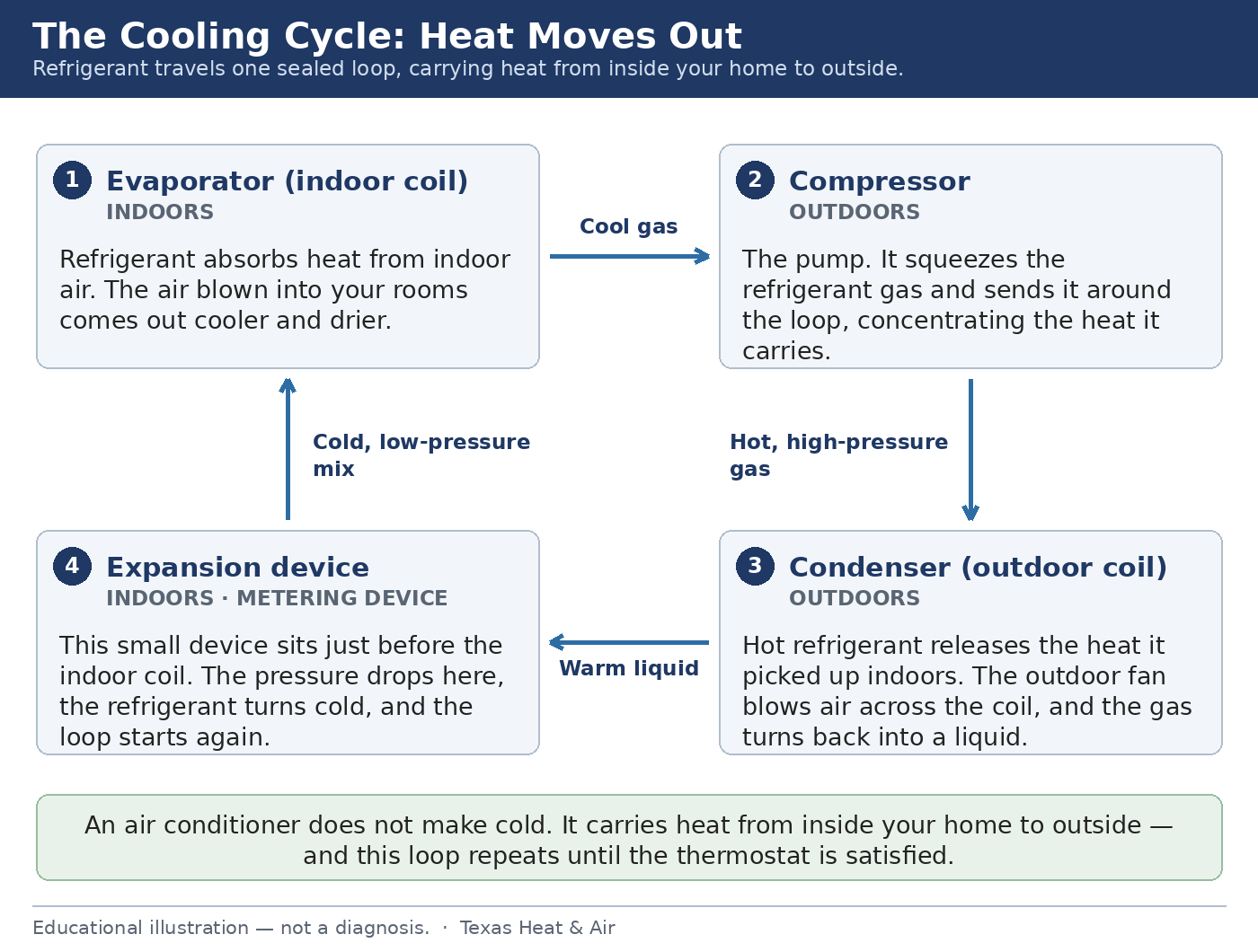
Follow one trip around the loop. Inside your home, refrigerant arrives at the indoor coil cold and at low pressure. Your blower pushes warm room air across that coil. The refrigerant absorbs the air's heat and boils into a gas. The indoor coil where this happens is the evaporator coil. As a bonus, moisture from the air condenses on the cold coil and drains away. This is why AC dries the air. Why a working AC produces a steady drip outside on a humid day.
The warmed gas then travels outside to the compressor. The compressor is the pump in the outdoor unit. It squeezes the refrigerant and circulates it around the loop. And squeezing makes the gas hot and dense. Next comes the outdoor coil, called the condenser. A fan blows outdoor air across it. The heat escapes into the yard. Stand next to a running outdoor unit and you can feel your home's heat leaving. Finally, the refrigerant passes the expansion (metering) device, where its pressure drops sharply. That turns it cold again. It flows back inside to repeat the trip. The loop runs until the thermostat. The wall control that reads the room temperature — is satisfied.
Two consequences follow. First, almost every cooling symptom is this loop failing at one station: too little air across a coil, too little refrigerant in the loop, a compressor that cannot squeeze, a drain that cannot drain. Second, the same loop run in reverse is a heat pump. Which is why one machine can both heat and cool.
Load versus capacity: the two numbers that must match
Engineers measure heat in BTUs. A BTU (British thermal unit) is a measure of heat. In AC, it describes how much heat a system can move in one hour. Your home gains heat at some rate: through sunlit glass, a hot attic, leaky walls, cooking, people, and appliances. That gain rate is the home'sload. It changes with the weather, the hour, and the house itself. System removes heat at its own rate, itscapacity, sold in tons. One ton of cooling removes 12,000 BTUs of heat per hour. A leftover from the days of melting ice.
Comfort is what happens when capacity matches load. Match them, and on the hottest afternoon the system runs long, steady cycles. Those cycles hold temperature and wring out humidity. Mismatch them in either direction, and specific, predictable problems appear. The sizing section below names them. This is also why "what size is my neighbor's?" is a meaningless question. His load is not your load, even in an identical floor plan with different windows, shade, and insulation.
Efficiency: output divided by input
SEER and SEER2 answer a different question than size: not "how much cooling?" but "how much electricity per unit of cooling, over a test season?" The rating is cooling output divided by electric input. Miles per gallon, for AC units. In plain terms, SEER2 tells you how much cooling you get for each dollar of electricity. Higher numbers mean more cooling per dollar. Two subtleties matter and get their own section below: the test changed in 2023 (SEER became SEER2. The numbers shifted), and a rating is earned on a test stand. Your home collects it only if the system is sized and installed correctly.
The situations homeowners ask about
What "the HVAC system" actually includes
HVAC is short for heating, ventilation. AC — the system that heats your home, cools it, removes moisture, and moves air through it. In most homes the parts work as one machine: an outdoor unit, an indoor unit, a thermostat. The ductwork tying them together. That unity explains a puzzle homeowners meet often. One weak part — leaky ducts, a tired blower, a clogged filter — makes the whole system feel broken, even when the heating and cooling system itself is fine. When someone says "the HVAC system," picture the whole package, not one box.
The short answer: Q71 — What does HVAC mean? (/hvac-help/what-does-hvac-mean/)
The loop, station by station
The "How it works" section walked the loop; here is what to notice as a homeowner. Your responsibilities touch exactly two stations: the filter in front of the indoor coil. Clear vents — the loop's air supply. The outdoor station asks only for clearance around the unit. Everything sealed inside the loop. Refrigerant, compressor, expansion (metering) device. Is technician territory, by law and by safety. And the drain deserves one sentence of respect: the moisture the loop removes has to go somewhere. A clogged drain turns a cooling success into a water problem.
The short answer: Q72 — How does central AC work? (/hvac-help/how-does-central-air-conditioning-work/)
Ductless mini-splits: the same loop, no ducts
A mini-split runs the identical refrigeration loop. The difference is delivery: it brings cooling and heating directly where it is used. One outdoor unit connects by refrigerant lines to one or more slim indoor units on walls or ceilings. Each indoor unit controls its own room or zone. Most mini-splits are heat pumps. Systems that move heat instead of making it. So they heat and cool. The design shines where ducts cannot go: a home with no ductwork, an addition, a converted garage, a stubborn hot room. Zoning means unused rooms need no full conditioning. The trade-offs are real: higher cost per room when many zones are needed. A visible unit on the wall; a filter in each indoor unit to keep clean; and sizing that still matters. An oversized mini-split short-cycles like any other system, so a load calculation belongs in its quote too.
The short answer: Q74 — What is a ductless mini-split? (/hvac-help/what-is-a-ductless-mini-split/)
Reading a rating: SEER, SEER2, and the number that matters
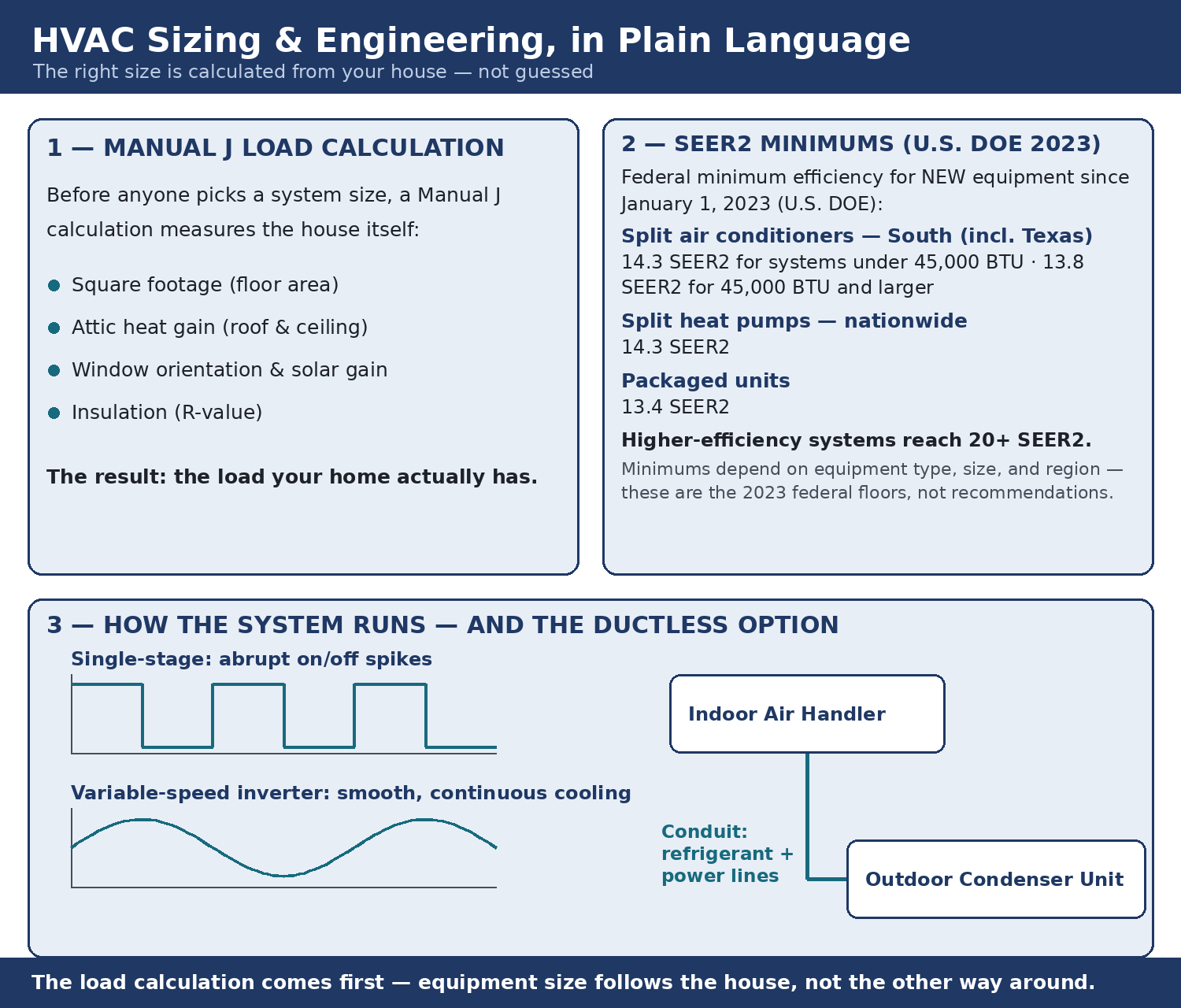
SEER2 replaced SEER in federal testing on January 1, 2023. The new test runs system against higher external pressure, closer to real duct systems. So SEER2 numbers read slightly lower than SEER numbers for the same machine. A 15.2 SEER2 unit is roughly comparable to a 16 SEER unit. Not worse than an old 15. For most new split-system AC units in the South, the federal floor is 14.3 SEER2. But there is no single minimum for everything: the exact floor depends on the type of system and its capacity. Heat pumps, packaged units. Larger split systems each have their own needed numbers. Above the floor for its class, ratings climb toward 20+ SEER2 for the most efficient variable-speed system.
Now the two warnings that keep the rating honest. First, the rating is potential, not a promise. Wrong sizing, poor installation. Bad ducts can waste the efficiency you paid for. That is why installation quality outranks small rating differences. Second, higher is not automatically better value. The price jump to the highest ratings buys shrinking electricity savings. In many homes, the same money does more good in duct sealing or insulation. Compare ratings within the same system type. Always weigh the rating against the total installed price.
The short answer: Q75 — What are SEER and SEER2 ratings? (/hvac-help/seer-and-seer2-ratings-explained/)
Sizing: too big, too small, just right
Oversized first, because it surprises people. A too-big AC blasts the air cold quickly, shuts off, and repeats. That is short cycling: the system turns on and off again and again in short bursts, instead of running steady, longer cycles. The thermostat is satisfied, but the air is under-dehumidified and clammy, because moisture removal needs long runs. Parts wear with constant starts, and energy is wasted on every restart. Undersized is the mirror image: the system runs forever on hot days and still loses ground. Rooms never quite arrive. Correct sizing threads the needle. Long, steady runs on the hottest afternoons that hold temperature and dry the air.
And the load itself is mostly invisible: how much sun hits the glass, how leaky the attic and ducts are, how many people and appliances add heat. That invisibility is exactly why rule-of-thumb sizing. "A ton per 500 square feet" — misleads. It is also why the old unit's size proves nothing. It may have been wrong for decades. The home may have changed since it was chosen.
The short answer: Q76 — How large should my AC be? (/hvac-help/how-large-should-my-air-conditioner-be/)
Manual J: the calculation that replaces guessing
Manual J is the standard calculation used to size a new system for a specific home. It is published by ACCA (the Air Conditioning Contractors of America). It works from the home's size, insulation, windows, sun exposure, and local climate. Its inputs are measurements, not habits: floor area and layout, window sizes and directions, insulation levels, air leakage, duct location and condition, local climate data. Internal heat from people and appliances. Its output is your home's load in BTUs — the number system capacity must match.
A proper calculation takes time at your home, with measuring and questions. A contractor who quotes a size from the driveway has not done one. You do not need to audit the math: ask whether a Manual J or equivalent recognized calculation will be performed. Ask to see its result before approving system. It is the single best protection against paying for the wrong system.
The short answer: Q77 — What is a Manual J load calculation? (/hvac-help/what-is-a-manual-j-load-calculation/)
Variable speed: the dimmer, not the switch
A traditional single-stage system is a light switch: 100% on, or fully off. So temperature swings between overshoot and drift. Humidity control is whatever happens during the on-blasts. Variable-speed system is a dimmer. On a mild day it may cruise at low speed for long stretches, quietly using little electricity and steadily removing moisture. On a brutal afternoon it ramps to full power. Those long, gentle runs are the secret. They are why these systems control Texas humidity so much better. Why they are noticeably quieter.
The honest caveats: the system costs more, the controls are more complex. The benefits depend on compatible thermostats, correct setup. Ducts that can handle the airflow range. It is an upgrade to weigh at replacement time with real numbers for your home, not an automatic yes.
The short answer: Q78 — What does variable-speed HVAC mean? (/hvac-help/what-does-variable-speed-hvac-mean/)
Diagrams and comparisons
F12R2-seer2-standards.png—The sizing engineer's three questions: how much heat does this home gain (Manual J), how efficiently does the system remove it (SEER2). How does it behave at part load (variable speed) — plus the ductless alternative.Use the three panels to keep three separate decisions separate: the load calculation describes your house, the SEER2 scale describes the machine's appetite. The operating graph describes its manners. A proposal is strong only when all three are addressed.
b3-16-q72-cooling-cycle-diagram.png—The cooling loop: refrigerant absorbs heat at the indoor coil and releases it at the outdoor coil, while moisture drains away.Trace the red arrow: that is your home's heat leaving. Every station on this loop is a place a real system can fail. Which is why the symptom guides elsewhere in this library keep pointing back to airflow, coils, refrigerant. Drainage.
| Single-stage | Variable-speed | |
|---|---|---|
| Operation | Full blast or off — a light switch | Ramps up and down to match the moment — a dimmer |
| Temperature feel | Swings between overshoot and drift | Steady, small variation |
| Humidity control | Only during on-blasts; can leave air clammy | Long gentle runs remove moisture continuously |
| Noise | Full-speed starts and stops | Mostly low-speed, quiet use |
| Cost and complexity | Lowest system cost, simplest controls | Higher cost, more complex controls; needs compatible thermostat and adequate ducts |
What you can safely do yourself
- Learn what you own: find the model details and owner's manual. Note whether your system is a furnace plus AC, a heat pump, or a mini-split. Every later decision gets easier.
- Protect the loop's air supply: keep the filter clean and the vents clear. The two stations the loop depends on you for.
- When proposals arrive, line the SEER2 ratings up next to the total installed prices. Efficiency only counts per dollar spent.
- List the rooms with comfort problems and any renovation plans. Give both to the installer — they change the load calculation.
What a technician checks
The pro side of this guide is verification. A proper installation begins with the load calculation itself. Measurements taken in your home, not a size copied from the old unit. At and after installation, three checks decide whether you receive the rated performance: airflow through the system, refrigerant charge matched to specification. Duct condition and capacity. For variable-speed system, the ducts and thermostat must also suit the system's speed range. When a system underperforms its rating, one of those checks is almost always where the rating leaked away.
Making the decision
Read any system proposal with four questions. Was a load calculation performed, and can I see the result? What capacity did it call for. Does the proposed system match it. Or is the size just copied from the old unit? What is the SEER2 rating. What is the total installed price next to it — not the system price alone? And how will this machine behave on a mild October day, not only on the hottest afternoon in August? A proposal that answers all four is engineering. One that answers only the price question is a guess with a number attached. When replacement is the decision, remember to ask Texas Heat & Air what an estimate for a complete replacement costs before you book. The comparison itself should cost you nothing but time.
North Texas notes
Engineering decisions compound in a North Texas climate, because the runtime is so long. A sizing error or an efficiency gap is not a one-week problem. It is thousands of operating hours a year. The region's heat also loads the attic and duct side of the load calculation heavily. Sun on the roof and hot attic air around the ducts are first-order inputs here, not rounding errors. They are a common reason two outwardly identical homes in the same neighborhood need genuinely different systems.
Related resources
- Q71 — What does HVAC mean? (/hvac-help/what-does-hvac-mean/)
- Q72 — How does central AC work? (/hvac-help/how-does-central-air-conditioning-work/)
- Q74 — What is a ductless mini-split? (/hvac-help/what-is-a-ductless-mini-split/)
- Q75 — What are SEER and SEER2 ratings? (/hvac-help/seer-and-seer2-ratings-explained/)
- Q76 — How large should my AC be? (/hvac-help/how-large-should-my-air-conditioner-be/)
- Q77 — What is a Manual J load calculation? (/hvac-help/what-is-a-manual-j-load-calculation/)
- Q78 — What does variable-speed HVAC mean? (/hvac-help/what-does-variable-speed-hvac-mean/)
- Guide 10 — Preventive Maintenance and the Home Comfort Maintenance Plan (/hvac-help/guides/maintenance-and-membership/)
- Guide 11 — Air Filters, Indoor Air Quality, and Safe Homeowner Maintenance (/hvac-help/guides/filters-and-indoor-air-quality/)
Texas Heat & Air next step
Texas Heat & Air serves Cleburne, Burleson, Granbury, and Fort Worth. Call (682) 438-8127 to confirm coverage for your address. Ask for the load calculation behind any proposed size. Compare proposals on total installed price and rating together. Call (682) 438-8127 to request an estimate.

Understanding the system comes first: learn how the pieces work together, use the safe checks. Let a qualified technician confirm anything inside the system.
Related Homeowner Questions
 How does central air conditioning work?What is a ductless mini-split?What are SEER and SEER2 ratings?How large should my air conditioner be?What is a Manual J load calculation?What does variable-speed HVAC mean?

Still Have Questions? Ask an HVAC Expert.
Couldn't find the answer you need? Tell us what's happening. Our team will review your question and contact you to help.
Ask Your Question →Sources
- https://www.energy.gov/femp/purchasing-energy-efficient-residential-central-air-conditioners — U.S. Department of Energy guidance on residential central AC units: system use and parts, ductless systems, SEER/SEER2 definitions and the 2023 test change, sizing from a load calculation. Variable-speed use
- https://www.energystar.gov/saveathome/heating-cooling — ENERGY STAR heating and cooling hub: heating/cooling system, thermostat. Air distribution framed as one home system