
How does central air conditioning work?
An AC moves heat rather than making cold: filter and blower, cold indoor coil, compressor, outdoor coil. Learn the loop once, and most cooling symptoms explain themselves.

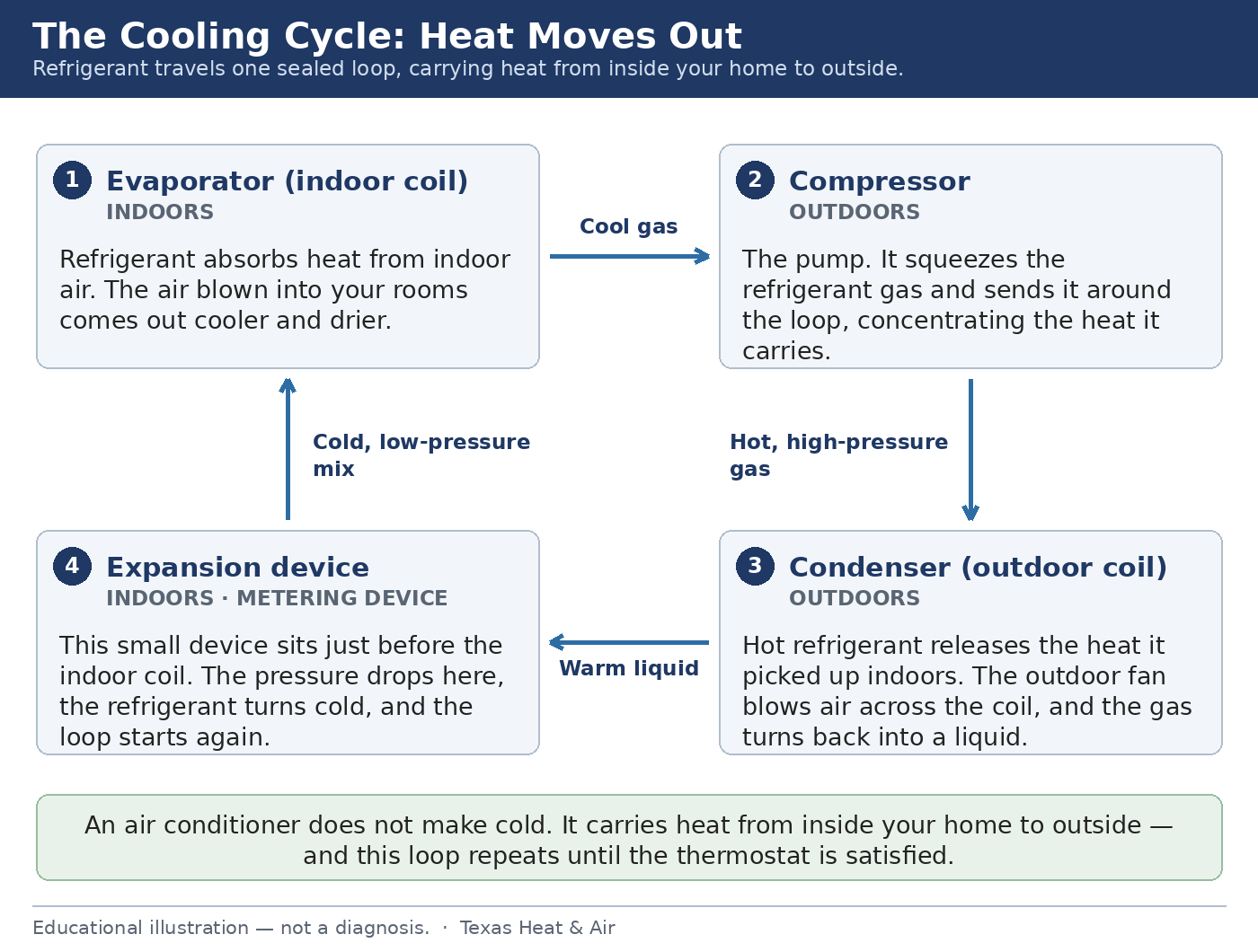
A central AC does not make cold; it moves heat. Indoor air passes across a cold coil, where refrigerant. The fluid sealed inside the system — absorbs the air's heat. The refrigerant carries that heat outside and releases it. The blower then sends the cooled air back through the ducts. Moisture condenses on the cold coil and drains away.
What you can safely check
This loop depends on you for exactly two things:
- Keep the filter clean. A clogged filter starves the indoor coil of air.
- Keep supply and return vents clear of furniture, rugs, and closed doors where possible.
Beyond that, watch rather than open. Note ice on lines, water where it should not be, or new noises — then stop and call. Do not open system panels. Do not touch refrigerant lines, wiring, or capacitors. A capacitor is an electric part that stores a charge and helps a motor start and run. It can hold that charge even with the power off.
How this works
It works like your refrigerator, scaled up to a whole house. A loop with four stations, endlessly repeated. On the air side, the blower motor. The motor in the indoor unit. Pulls warm indoor air out of your rooms. The air passes through the filter. This keeps dust off the system. The blower pushes the air toward the indoor coil. What happens to the refrigerant inside that coil is the loop itself:
Station one: the indoor (evaporator) coil.The evaporator coil is the indoor coil, where refrigerant absorbs heat from indoor air. The refrigerant inside it is cold. As your air crosses the coil, the refrigerant takes in the air's heat, and the air leaves cooler. A bonus happens on the same cold surface: moisture from humid indoor air condenses into water. The water collects in a drain pan and leaves through the condensate line. The pipe that carries that water away. This is why an AC dries the air as well as cools it. It is also why the drain exists at all.
Station two: the compressor, outside.The compressor is the pump in the outdoor unit that squeezes and circulates the refrigerant around the loop. The warmed refrigerant — now carrying your home's heat — reaches the compressor, which squeezes it and concentrates the heat. The refrigerant, now hot, flows into the outdoor coil.
Station three: the outdoor (condenser) coil and fan.The condenser is the outdoor coil, where hot refrigerant releases its heat. The coil and fan dump that heat into the outdoor air. The warm blast you feel walking past a running unit.
Station four: the expansion (metering) device.Freed of its heat, the refrigerant is still a warm, high-pressure liquid. The expansion device — a small valve or fixed opening — lets it through a little at a time. Its pressure drops sharply. That pressure drop is what makes it cold: it enters the indoor coil cold enough to absorb heat all over again. The loop repeats until the thermostat is satisfied, then rests. The thermostat is the wall control that reads the room temperature and tells the system when to start and stop.
Now the diagnostic payoff. Every major cooling symptom is this loop failing at a specific point:
| Station | Part | Job | Failure looks like |
|---|---|---|---|
| 1 | Indoor (evaporator) coil | Absorb heat; condense moisture | Ice, weak cooling |
| 2 | Compressor | Concentrate the heat | No cooling at all, tripped breaker |
| 3 | Outdoor (condenser) coil + fan | Release heat outdoors | Overheating, poor cooling |
| 4 | Expansion (metering) device | Drop the pressure so refrigerant turns cold | Weak cooling, ice |
| — | Return + filter + blower | Move indoor air across the coil | Weak airflow |
| — | Drain | Remove the condensed water | Leaks |
When to call a professional
Call if the system runs but cool air does not reach the rooms. Also call if any part of the loop misbehaves: ice, water leaks, or unusual noises. A technician walks the same map — checking airflow, coil condition, refrigerant charge, compressor use. Drainage — and measures instead of guessing.
What happens next
Ask Texas Heat & Air to confirm the diagnostic fee when you book. You receive a written diagnostic report and a written estimate. No repair begins until you approve it.
Texas Heat & Air next step
A station misbehaving — ice, leaks, noise, warm vents? The loop tells us where to look: (682) 438-8127.
Related Questions
 What is the difference between an AC and a heat pump?Why is ice forming on my air conditioner?

Still Have Questions? Ask an HVAC Expert.
Couldn't find the answer you need? Tell us what's happening. Our team will review your question and contact you to help.
Ask Your Question →Sources
- https://www.energy.gov/femp/purchasing-energy-efficient-residential-central-air-conditioners — U.S. Department of Energy guidance on residential central AC use and parts.
- https://www.energystar.gov/saveathome/heating-cooling — ENERGY STAR heating and cooling hub; system framing.