
Why is ice forming on my air conditioner?
Ice on the coil is never normal. Restricted airflow or low refrigerant starts a spiral that worsens as it runs. Turn cooling off, thaw fully, check the filter — then know when to call.

Ice on the indoor coil or refrigerant lines is never normal. It forms when the coil gets too cold, usually because airflow is restricted. A dirty filter is the classic cause. Or the refrigerant charge. The amount of refrigerant in the sealed loop — is low. Turn cooling off and let it thaw. Running a frozen system can damage the compressor.
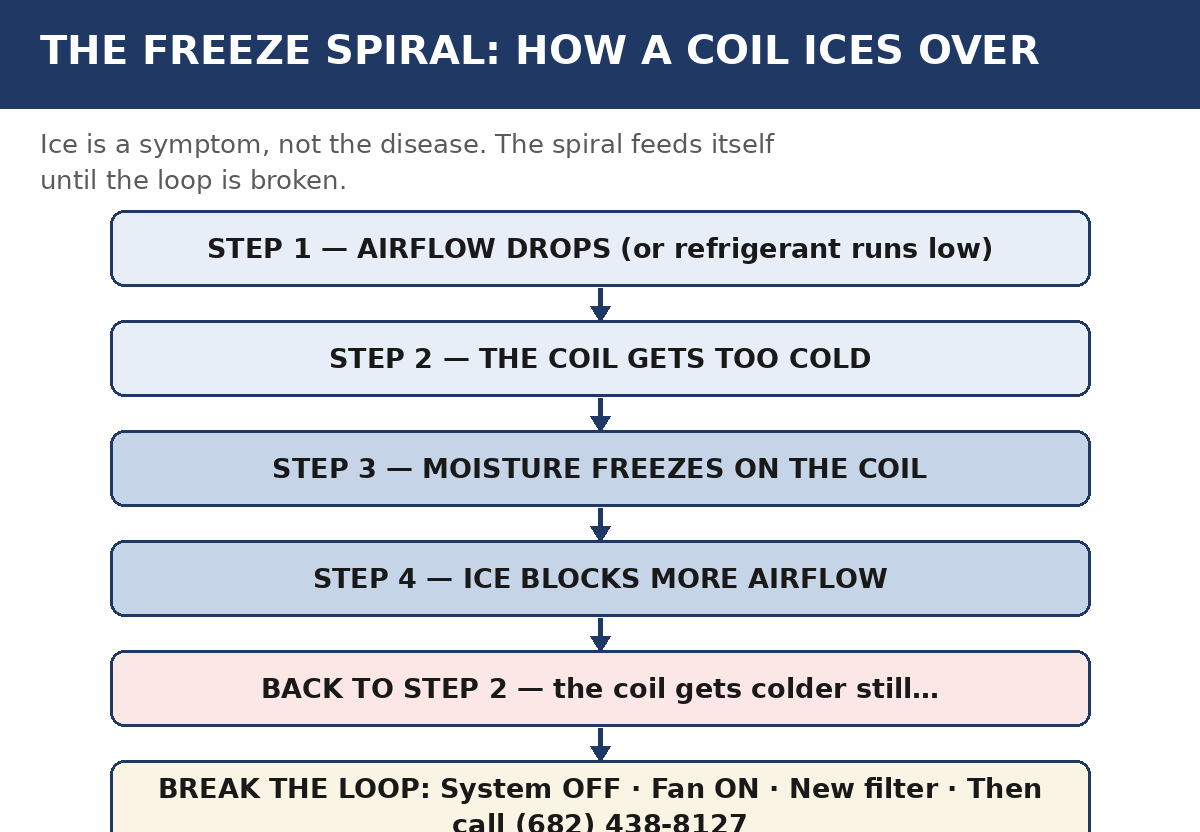
Visual explanation
The freeze-spiral diagram shows the four-step cycle. Less airflow makes the coil colder, ice forms, the ice blocks more airflow. Arranged in a circle with a central instruction: cooling OFF. It teaches why ice gets worse the longer the system runs. Why switching off is the exit.
What you can safely check
- Turn cooling OFF at the thermostat and let all ice melt before any restart. Light frost — a thin white coating — may melt in one to three hours. Heavy ice — thick, solid buildup — can take four to eight hours or more.
- You may set the fan to ON while cooling is off. Moving room air across the coil helps it thaw.
- Expect meltwater. Have towels ready, watch the drain area for overflow (Q18). Stay away from wet electric parts.
- Never chip at the ice. Never use hot water, a hair dryer. Any heat source to speed thawing. The sudden temperature change can crack parts. The coil's thin fins bend and break easily.
- After a full thaw, check the filter and replace it if it is dirty. Then restart and observe — one trial only.
What might be causing this
The indoor coil must stay cold to cool your air, but it must stay above freezing. Two things keep it there: warm air moving across it in volume. The right amount of refrigerant inside it. Refrigerant is the fluid sealed inside the system's loop that carries heat. Ice means one of those two protections has failed. And the failure feeds itself, in a spiral worth understanding step by step.
Step one: airflow drops. A clogged filter, blocked vents, a dirty coil. A weakening blower lets less warm air cross the coil. Step two: with less heat arriving, the coil's temperature falls below freezing. Step three: moisture from the air freezes onto the coil instead of draining away. Step four: the ice layer insulates the coil and blocks airflow even more. So the coil gets colder, and more ice forms. That is the spiral: each layer of ice makes the next one more likely. Cooling gets worse the longer the system runs.
Low refrigerant drives the same spiral from the other side. Too little refrigerant changes the pressures inside the system. That drops the coil temperature below freezing, even with good airflow. This is why "thaw it and restart" is not a fix. If the cause is still there. A filthy filter you did not change. A low charge nobody has explained. The ice will be back. And each frozen run risks the compressor, the most expensive part in the system. The compressor is the pump in the outdoor unit that squeezes and circulates the refrigerant around the sealed loop.
Ice is a symptom, never a diagnosis. Two different problems can produce one frozen coil. Neither you nor a photograph can tell which one you have. Refrigerant is never a homeowner fix in any case. Handling it is certified work. A low charge is found, and its cause fixed, by testing — not by topping off.
| Step | Action |
|---|---|
| 1 | Cooling OFF at the thermostat |
| 2 | Let ice melt fully; watch for water overflow (Q18) |
| 3 | Check the filter; replace if dirty |
| 4 | Restart and observe — one trial only |
| 5 | Freezes again → diagnosis (refrigerant or airflow system) |
When to call a professional
Call if the system freezes again after a full thaw with a clean filter in place. That pattern points to refrigerant or airflow system, both technician territory. Ask the technician to explain the proven cause rather than accepting a guess about refrigerant. The two root causes need different repairs.
What happens next
Tell whoever you call that the system froze — thaw times shape the visit. The word "froze" changes the diagnosis. Ask Texas Heat & Air to confirm the diagnostic fee when you book. You receive a written diagnostic report and a written repair estimate. No repair begins until you approve it.
Texas Heat & Air next step
Frozen once and thawed with a clean filter in place? If it freezes again, call (682) 438-8127 and say the word "froze" — it changes the diagnosis.
Related Questions
 Why is water leaking around my indoor AC unit?What causes a refrigerant leak?How often should I change my air filter?

Still Have Questions? Ask an HVAC Expert.
Couldn't find the answer you need? Tell us what's happening. Our team will review your question and contact you to help.
Ask Your Question →Sources
- https://www.carrier.com/us/en/residential/hvac-resources/air-conditioners/will-frozen-ac-fix-itself/ — frozen coil causes (restricted airflow, low refrigerant), homeowner response (turn off, thaw fully, no heat sources), thaw times of roughly 1–3 hours for light frost and 4–8+ hours for heavy ice. Compressor risk
- https://www.energystar.gov/saveathome/heating-cooling/maintenance-checklist — airflow, filters, and coil condition