
Sounds, Smells, Water Leaks, and Frozen Coils: What Your System Is Telling You
Buzzing, grinding, musty or burning smells, water leaks. Ice on the coil. What each sign may mean, what you can safely check. When to turn the system off.

An AC usually warns you before it quits. It buzzes. It grinds. It drips, freezes, or starts to smell. Those signs are not random. Each one comes from a specific part of the system doing a specific job. Once you know which job connects to which sign, a strange noise at midnight becomes a clear decision: watch it, switch it off, or call.
This guide teaches the pattern behind six common warning signs. You will learn why every drop of water your AC makes follows one path. And what a leak says about that path. You will learn why ice on a coil keeps growing once it starts. And you will learn why smells fall into three groups that need three very different responses.
The short articles linked throughout go deeper on each single sign. This guide shows how the signs connect.
Key takeaways
- A sound, smell, leak. Patch of ice is a clue, not a diagnosis. The same sign can have several causes. Only testing can separate them.
- New mechanical noises — grinding, squealing — mean turn the system off. Running a worn part can turn a moderate repair into a major one.
- All AC water follows one path: coil, drain pan, drain line, outside. A leak means the path broke at the drain, the pan, or a thawing coil.
- Ice is a spiral. It grows because it exists. The exit is always the same: cooling off, a full thaw, then find the cause.
- Smells split three ways: musty means moisture (book service), burning means off and call. Rotten egg means leave the house and call 911.
How it works
Four kinds of signals come from four different jobs the system does. Once you see the jobs, the signals stop being mysterious.
Moving air and spinning parts make the sounds.Fans and motors spin for hours every day. Bearings wear out. Lubrication breaks down. Blades crack. Worn moving parts announce themselves with grinding, squealing, or rattling.
A second family of sounds is electric. A contactor — a heavy-duty electric switch in the outdoor unit — snaps power on and off. A capacitor — an electric part that stores a charge and helps a motor start and run — gives motors their starting push. Aging electric parts buzz. A motor that hums but cannot start is often straining against an electric fault. Sound alone cannot name the part. But the family a sound belongs to tells you how urgent it is.
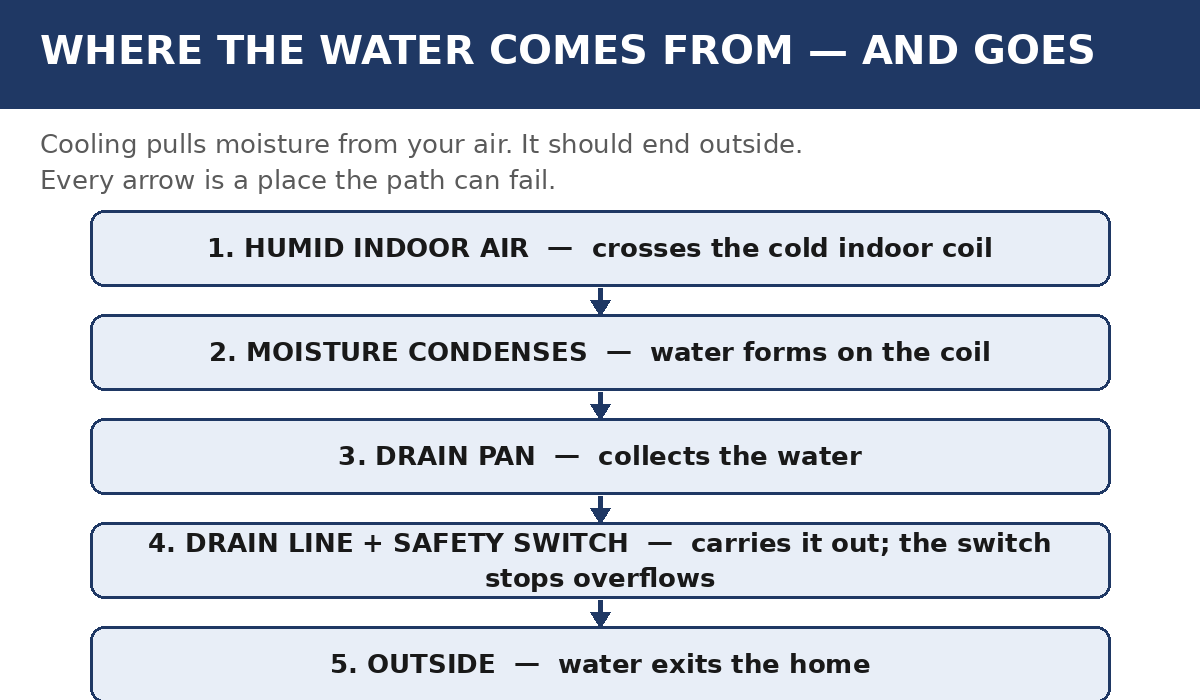
Cooling makes water, and water must leave.As warm indoor air crosses the cold indoor coil, moisture from the air condenses on the coil. It works the same way dew forms on a cold glass. The indoor coil is the evaporator coil. The coil where refrigerant absorbs heat from indoor air, so the air blown into the rooms comes out cooler and drier.
That water is called condensate. The water that forms when warm, humid indoor air is cooled and dried by the system. It collects in a drain pan under the indoor coil. From there it leaves the home through the condensate drain. The pipe or tube that carries the water away. Many systems also have a float switch. That is a small safety device that shuts the AC off if water backs up, so a clog becomes an annoyance instead of a flood. Every water problem in this guide. Leaks, overflows, mystery shut-offs. Is this one path failing at the coil, the pan, the line, or the switch.
The coil walks a temperature line.The indoor coil has to be cold to cool your air. But it must stay above freezing. Two things hold it there: plenty of warm air moving across it. The right amount of refrigerant sealed inside it. Refrigerant is the fluid sealed inside the system's loop that carries heat.
Starve the coil of air. A clogged filter, blocked vents, a weakening blower. And its temperature drops below freezing. Let the refrigerant charge run low. The same thing happens from the other side. A low charge can come from a leak. It can also come from the system being charged wrong during installation or service. Only a technician's test can confirm which one happened. Ice is what a broken balance looks like.
Smells report chemistry.A damp coil, drain. Duct grows mold and bacteria over a wet summer. Moving air carries that musty odor through the house. Heat damage smells different. Overheating motors and failing wiring produce a sharp, burning, electric smell.
And one smell is not the AC's at all. Natural gas is deliberately scented like rotten eggs so leaks can be smelled. Each smell points at a different system and a different response. That is why the odor sections below treat them separately.
These jobs also chain together. A dirty filter blocks airflow. Less air reaches the coil. The coil freezes. The thaw floods the pan. The "ice problem" becomes a "water problem" by morning. A clogged drain trips the float switch. The "water problem" shows up as a dead AC that will not run at all. Reading the chain — not just the symptom in front of you — is the skill this guide builds.
The situations homeowners ask about
Noises: two families, two responses
A new, loud buzz. Or a unit that hums without starting. Belongs to the electric family. The parts that switch power and help motors start live inside the outdoor cabinet. They can hold an electric charge even when the system is off. There is nothing safe to inspect in there.
Note when the sound happens: at startup, while running, or constantly. Turn cooling off if the buzz is loud or new. Then call. The short answer: Q16 — Why is my AC making a buzzing or humming sound? (/hvac-help/ac-buzzing-or-humming-sound/)
Grinding and squealing belong to the mechanical family: a moving part is worn or damaged. A mechanical failure often gets worse while it runs. A failing bearing can seize and take its whole motor with it.
Note whether the sound comes from the indoor or outdoor unit. A short phone recording genuinely helps. Then shut the system down and call. The short answer: Q17 — Why is my AC making a grinding or squealing noise? (/hvac-help/ac-grinding-or-squealing-noise/)
Water where it should not be
A leak around the indoor unit means the condensate path broke. The usual break is the drain line. Dust, algae, and slime slowly narrow it until water backs up over the pan's edge. The second break is the pan itself, rusted through on an older unit. The third is ice: a frozen coil thawing can release more water than the pan handles.
Turn cooling off if water is actively leaking. Move belongings out of it. Keep clear of wet electric system. Water damage inside ceilings and walls moves faster than most people expect. The short answer: Q18 — Why is water leaking around my indoor AC unit? (/hvac-help/water-leaking-around-indoor-ac-unit/)
A drain that clogs once can simply be cleared. A drain that clogs every season is telling a different story. The line may have a slope problem, damage. A blocked vent that needs correcting, not just clearing. That distinction matters. It is the difference between a visit that fixes the cause and a visit that schedules the next leak. The short answer: Q28 — Why does my AC drain keep clogging? (/hvac-help/ac-drain-keeps-clogging/)
Ice on the coil
Ice on the indoor coil or the refrigerant lines is never normal. It is also never the root problem. It is the visible end of the airflow-or-refrigerant balance failing.
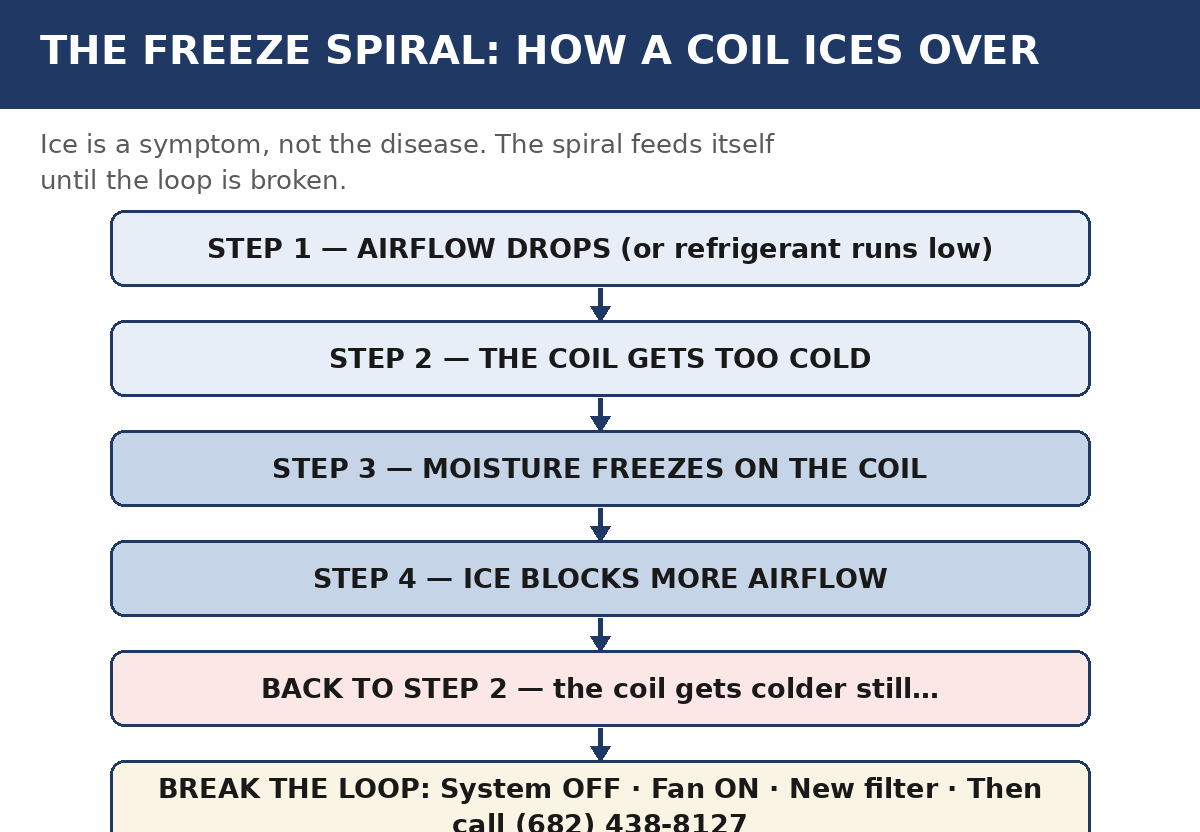
The spiral logic matters more than the cause list. Ice blocks airflow. Blocked airflow makes the coil colder. A colder coil grows more ice. That is why "let it run and see" always ends worse. Running a frozen system can also damage the compressor, the most expensive part in the unit.
Turn cooling off. Let everything melt — the fan can run ON to help thawing. Then check the filter. If it freezes again, the cause is not the filter. The short answer: Q19 — Why is ice forming on my AC? (/hvac-help/ice-on-air-conditioner/)
Smells: moisture, burning, and the one that means leave
Musty or sour odors come from the wet places. Coil, drain, ducts. And from growth living in them. They are unpleasant. They are worth fixing. They are rarely urgent. Note whether the smell appears only at startup or all the time, and book service.
A burning or electric smell is a different category entirely. It can mean a motor overheating or wiring failing. The system goes off and stays off until it is checked. If you see smoke or fire, leave and call 911.
And the rotten-egg smell sits outside the AC system altogether: it means possible natural gas. Do not investigate. Do not touch light switches or anything electric. Leave the home right away. From a safe distance outside, call 911 and your gas utility. The short answer: Q20 — Why does my AC smell musty, sour, or burnt? (/hvac-help/ac-smells-musty-sour-or-burnt/)
Diagrams and comparisons
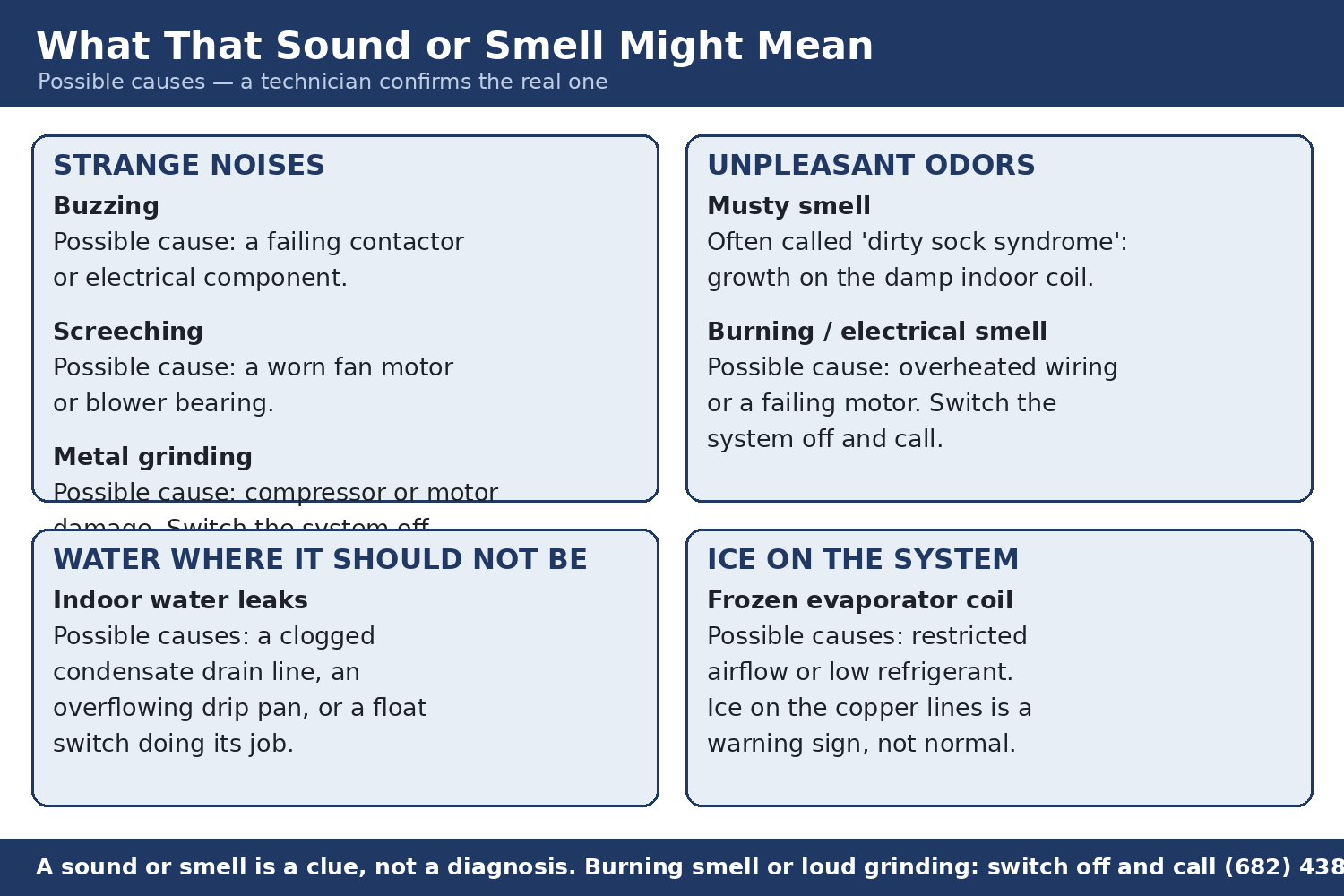
F04R-sensory-guide.png— "What a sound, smell, leak, or ice might mean — possible causes only. A technician confirms the real one." The four signal families side by side, each with its first response. Use it to place your symptom in its family before you read further.
Sound-to-possible-cause chart.Every entry is a possibility, not a diagnosis. The same sound can come from more than one part.
| What you hear | What it may point to | First response |
|---|---|---|
| Steady hum while running, unchanged from usual | Ordinary operation | No action; notice changes |
| New or loud buzzing | Aging contactor or other electric parts | Turn cooling off; call |
| Humming, but the fan or compressor will not start | A failing capacitor, or a motor straining against an electric fault | Turn cooling off; call |
| Squealing or screeching | A worn motor or bearing — a moving part under stress | Turn the system off; call |
| Grinding | Metal-on-metal wear in a motor or fan | Turn the system off now; call |
| Rattling | A loose panel or debris — confirm, do not assume | Note it; mention it at service |
b3-05-q18-condensate-path-diagram.png— "Where AC condensate water comes from. And the three places its path can fail." Follow the water from coil to pan to drain line. Every leak and clog in the situations above happens somewhere along this path.
b3-06-q19-freeze-spiral-diagram.png— "The freeze spiral: less airflow → colder coil → ice → even less airflow. The exit is cooling OFF." The circular layout is the lesson: freezing feeds itself, so waiting never fixes it.
What you can safely do yourself
- Listen from a safe distance and note the pattern: when the sound or smell happens, where it seems to come from. Whether it is new. A short phone recording of a noise helps a technician more than a description.
- Turn the system off for any new grinding, squealing, or loud buzzing, any strong burning smell. Any time you find ice on the coil or lines.
- For ice: cooling OFF, let it thaw fully (fan ON is fine while it melts), then check the filter and replace it if dirty. Never chip ice or pour hot water on the coil.
- For leaks: cooling off while water is active, belongings moved out of the water, and the area dried. Look for visible water near the indoor unit, but do not open the cabinet.
- For a musty smell, note when it occurs and check for visible water near the indoor unit. Do not spray anything into the system.
- Never open system cabinets, touch electric parts. Pour chemicals into a drain line unless your system manual specifically instructs it.
What a technician checks
Testing is what turns a clue into a cause. For electric sounds, the technician tests the capacitor against its rating. He or she checks the contactor and wiring connections. Measures the fan and compressor motors. Using meters rated for the charge these parts can store. For mechanical noises, fan and blower motors, bearings. Blades are checked for wear, damage, and alignment.
For water problems, the drain line is checked for blockages. The pan is checked for rust or cracks. The float switch is checked to confirm it works. When clogs keep returning, the line's slope and venting are checked too. For ice, the technician measures airflow. Filter, blower, vents, coil cleanliness. And checks refrigerant charge and leak signs. Those are the two sides of the balance.
For odors, musty problems trace to coil, drain, and duct condition. Burning smells lead to motors and wiring inspected for heat damage.
Making the decision
Describe what you observed the way a witness would: what the sign is. When it happens, where it comes from. What changed. "It grinds for the first minute after startup, from the outdoor unit, since Tuesday" gets a technician to the cause faster than "it sounds bad."
Two rules cover most of this guide. A system that sounds damaged stays off, because running it can enlarge the repair. And a symptom that returns after a fix means the cause was not found — say so. Ask what else could produce it.
Ask Texas Heat & Air what you will get in writing, and what your approval covers, before you book. No repair begins until you approve it. So the clue you report becomes a documented finding before it becomes a bill.
North Texas notes
North Texas summers are long and humid. Humidity is this guide's local multiplier. A hard-working AC pulls a large amount of moisture from indoor air every day. That means drain lines carry more water here than in a dry climate. And grow clogging buildup faster.
Many local homes also have the indoor unit in the attic. There, a condensate overflow does not puddle on a garage floor. It soaks a ceiling. If your air handler sits above living space, treat the float switch and the drain as the inexpensive insurance they are. Treat any ceiling stain near the unit as a call-now problem, not a cosmetic one.
Related resources
- Q16 — Why is my AC making a buzzing or humming sound? (/hvac-help/ac-buzzing-or-humming-sound/)
- Q17 — Why is my AC making a grinding or squealing noise? (/hvac-help/ac-grinding-or-squealing-noise/)
- Q18 — Why is water leaking around my indoor AC unit? (/hvac-help/water-leaking-around-indoor-ac-unit/)
- Q19 — Why is ice forming on my AC? (/hvac-help/ice-on-air-conditioner/)
- Q20 — Why does my AC smell musty, sour, or burnt? (/hvac-help/ac-smells-musty-sour-or-burnt/)
- Q28 — Why does my AC drain keep clogging? (/hvac-help/ac-drain-keeps-clogging/)
- Guide 3 — Why Your Air Conditioner Is Not Cooling (/hvac-help/guides/ac-not-cooling/) — the cooling-failure lesson these symptoms often belong to
- Guide 5 — Inside Your Air Conditioner: Parts, Electric Failures. What Stays Hands-Off (/hvac-help/guides/parts-and-electric-failures/) — the parts behind the sounds, in depth
Texas Heat & Air next step
If a sign in this guide matches what your system is doing, call (682) 438-8127. Ask Texas Heat & Air to confirm the diagnostic fee when you book. Texas Heat & Air serves Cleburne, Burleson, Granbury, and Fort Worth. Call (682) 438-8127 to confirm coverage for your address.

Understanding the system comes first: learn how the pieces work together, use the safe checks. Let a qualified technician confirm anything inside the system.
Related Homeowner Questions
 Why is my AC making a grinding or squealing noise?Why is water leaking around my indoor AC unit?Why is ice forming on my air conditioner?Why does my AC smell musty, sour, or burnt?Why does my AC drain keep clogging?

Still Have Questions? Ask an HVAC Expert.
Couldn't find the answer you need? Tell us what's happening. Our team will review your question and contact you to help.
Ask Your Question →Sources
- https://www.trane.com/residential/en/resources/troubleshooting/air-conditioners/ac-fan-not-working/ — Trane: fan and motor symptom guidance behind the noise sections
- https://www.carrier.com/us/en/residential/hvac-resources/air-conditioners/ac-parts/ — Carrier: what the electric and mechanical parts do
- https://www.carrier.com/us/en/residential/hvac-resources/air-conditioners/will-frozen-ac-fix-itself/ — Carrier: frozen coil causes and safe thaw guidance
- https://www.energystar.gov/saveathome/heating-cooling — ENERGY STAR: heating and cooling system use and maintenance context
- https://www.energystar.gov/saveathome/heating-cooling/maintenance-checklist — ENERGY STAR: filter and drain maintenance context
- https://www.epa.gov/indoor-air-quality-iaq/should-you-have-air-ducts-your-home-cleaned — U.S. EPA: moisture and growth guidance behind the odor and leak sections
- https://www.cpsc.gov/safety-education/safety-guides/carbon-monoxide/carbon-monoxide-fact-sheet — CPSC: carbon monoxide safety guidance referenced by the odor section