
What causes a refrigerant leak?
Refrigerant is never used up. A low charge usually means a leak from corrosion, vibration wear, a seeping connection, or damage. It can also come from incorrect charging at installation or an earlier service. Why the order is: find the cause, fix it, then recharge.

Refrigerant circulates through sealed copper lines and coils. Leaks start when those parts corrode, vibrate and wear thin, get physically damaged. When connections loosen or were poorly made. The indoor coil on an aging system is the most common site. A low charge usually points to a leak. It can also come from incorrect charging during installation or an earlier repair. A technician must test to confirm the cause.
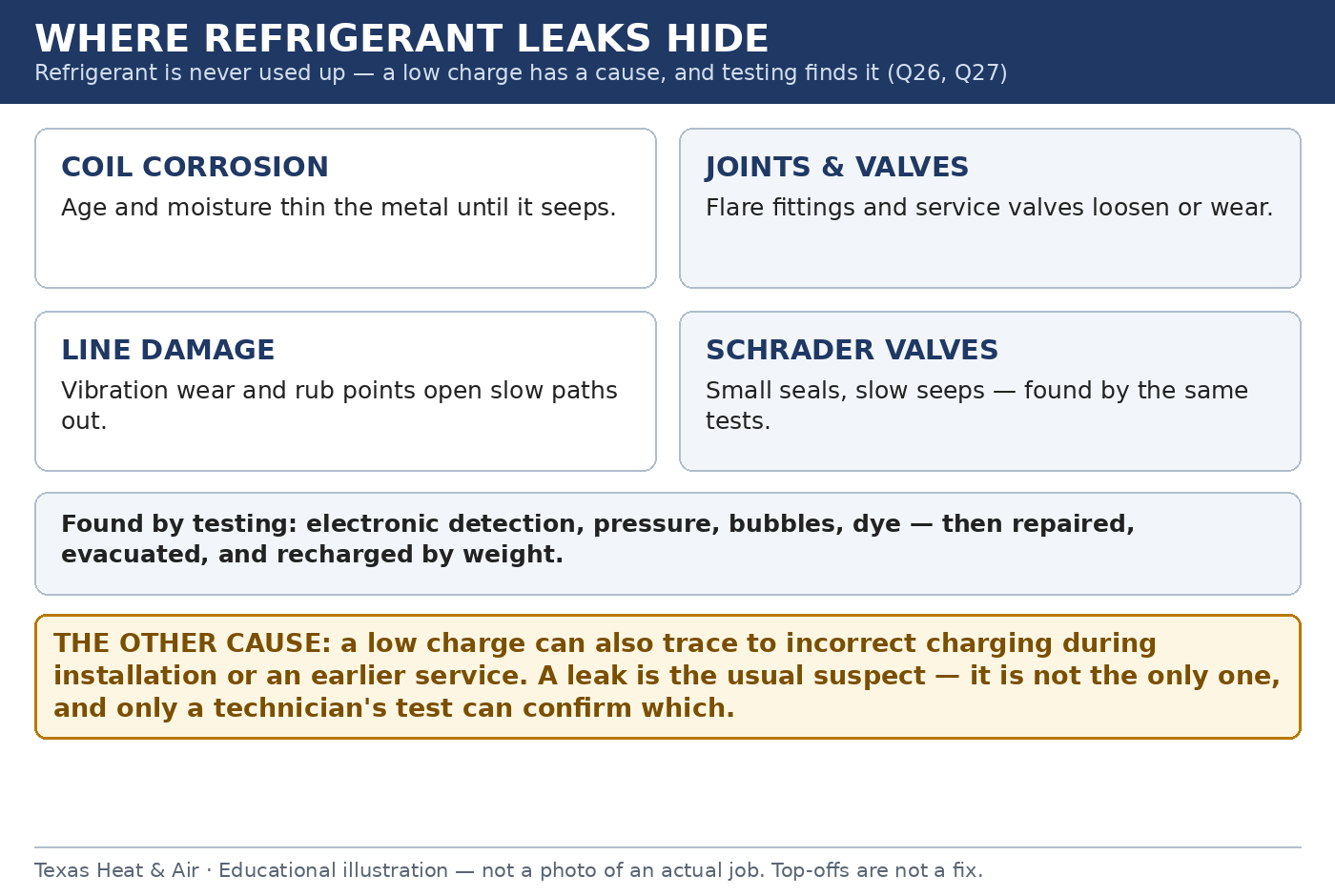
Visual explanation
The diagram above maps the four leak families: coil corrosion, joints and valves, line damage, and Schrader valve seeps. A Schrader valve is a small service valve. Its seal can seep slowly. The diagram teaches where leaks start. And that finding one is a testing job, not a guessing job.
What you can safely check
- Note the pattern: cooling fading over weeks, ice on the lines. Refrigerant added during a past visit. Write it down for the technician.
- Listen for a hiss near the lines with a sudden loss of cooling. That can mean an active, larger leak — turn the system off and call promptly.
- Keep your service records. A note that refrigerant was added last summer, or the summer before, is pattern evidence.
- Do not touch refrigerant lines, fittings, or service valves, and never try to add refrigerant yourself. Federal law reserves refrigerant handling to certified technicians.
What might be causing this
Start with the fact that reframes everything: refrigerant. The fluid that carries heat through the system — is not fuel. Your system does not burn it, consume it, or use it up. The same refrigerant circulates through a sealed loop for the life of the system. So a system that is low on refrigerant is a system with a hole, a seep. A charging mistake in its past. "It just needed topping off" is never the whole story (Q27).
Where do the holes come from?
- Coil corrosion — the most common cause on aging systems.The indoor coil is thin copper and aluminum. Over the years it reacts with household air, moisture. Trace chemicals from cleaners and paints. Pinholes form — slow, invisible leaks that drain the charge over time. Because the metal around a corrosion leak is usually the same age and condition, a corroded coil often becomes a coil-replacement conversation, not a patch.
- Vibration wear.The compressor is the pump that circulates the refrigerant. Its constant motion can rub lines against each other or against the cabinet until a spot wears through. These leaks tend to be single, findable, and repairable.
- Connections and service valves.Joints and seals can seep as they age. A joint poorly made at installation can leak slowly for years.
- Physical damage.A lawn tool strike, storm debris. A line nicked during other work makes its own sudden leak.
What a leak does, beyond losing charge: cooling capacity fades over weeks, the system runs longer to do less. The coil becomes prone to freezing (Q19). The compressor depends on circulating refrigerant for its own cooling. A system low on charge gives it less, so a leak left alone can end in the most expensive repair in the system (Q23).
| Cause | Typical site | Speed |
|---|---|---|
| Coil corrosion (pinholes) | Indoor coil, aging systems | Slow, seasonal decline |
| Vibration wear | Lines rubbing at contact points | Slow |
| Loose or poorly made connections | Joints, service valves | Slow seep |
| Physical damage | Outdoor lines and coil | Sudden loss |
When to call a professional
Call when cooling fades over weeks, ice appears on the lines. A technician tells you the charge is low. Finding a leak is instrument work. Electronic detectors, pressure testing, coil inspection. And refrigerant itself may only be handled by technicians certified under EPA Section 608, the federal certification for refrigerant work. There is no homeowner version of any step in that sequence.
What happens next
The order never changes: find the leak, fix the leak, then recharge to the maker's specification. Recharging first is paying for refrigerant that is already on its way out. You receive a written diagnostic report and a written repair estimate that shows how the leak will be fixed. Not just refilled. And the work happens only after you approve it.
Texas Heat & Air next step
Told you are low on refrigerant? Ask for leak detection, not just a recharge. Call (682) 438-8127 and ask where the refrigerant went. And what the plan is to find out.
Related Questions
 How much does a refrigerant leak repair cost?Why is ice forming on my air conditioner?

Still Have Questions? Ask an HVAC Expert.
Couldn't find the answer you need? Tell us what's happening. Our team will review your question and contact you to help.
Ask Your Question →Sources
- https://www.epa.gov/hfcs/frequent-questions-phasedown-hydrofluorocarbons — refrigerant rules and certified-service requirements (U.S. EPA)
- https://www.epa.gov/section608/section-608-technician-certification-requirements — who may legally handle refrigerant (U.S. EPA)
- https://www.carrier.com/us/en/residential/hvac-resources/air-conditioners/ac-not-blowing-cold-air/ — low-refrigerant symptoms (Carrier)