
What are SEER and SEER2 ratings?
Cooling output per unit of electricity. And why SEER2 numbers read lower for the same machine after the 2023 test change. Plus why the highest rating isn't always the best buy.

SEER and SEER2 rate cooling efficiency. Cooling output divided by electricity used over a test season. SEER2 is the newer federal test, in use since January 1, 2023: the current rating for how efficiently a cooling system uses electricity across a season. It runs under conditions closer to real duct systems, so its numbers read slightly lower for the same machine. Higher means less electricity for the same cooling.
Before you call
When proposals land on your table, two quick checks protect you:
- Line up SEER2 ratings next to total installed prices. Efficiency only counts per dollar spent.
- If one quote shows SEER and another shows SEER2, ask for both in SEER2. Comparing across the two systems is comparing two different rulers.
How this works
Think miles per gallon, for AC units. The rating exists to make unlike machines comparable. Two systems can cool the same amount yet use very different amounts of electricity. The rating is the ratio. Cooling delivered per unit of power used, across a standard test season. A North Texas system runs for many hours a year, so even small rating gaps add up to real bill differences over a system's life.
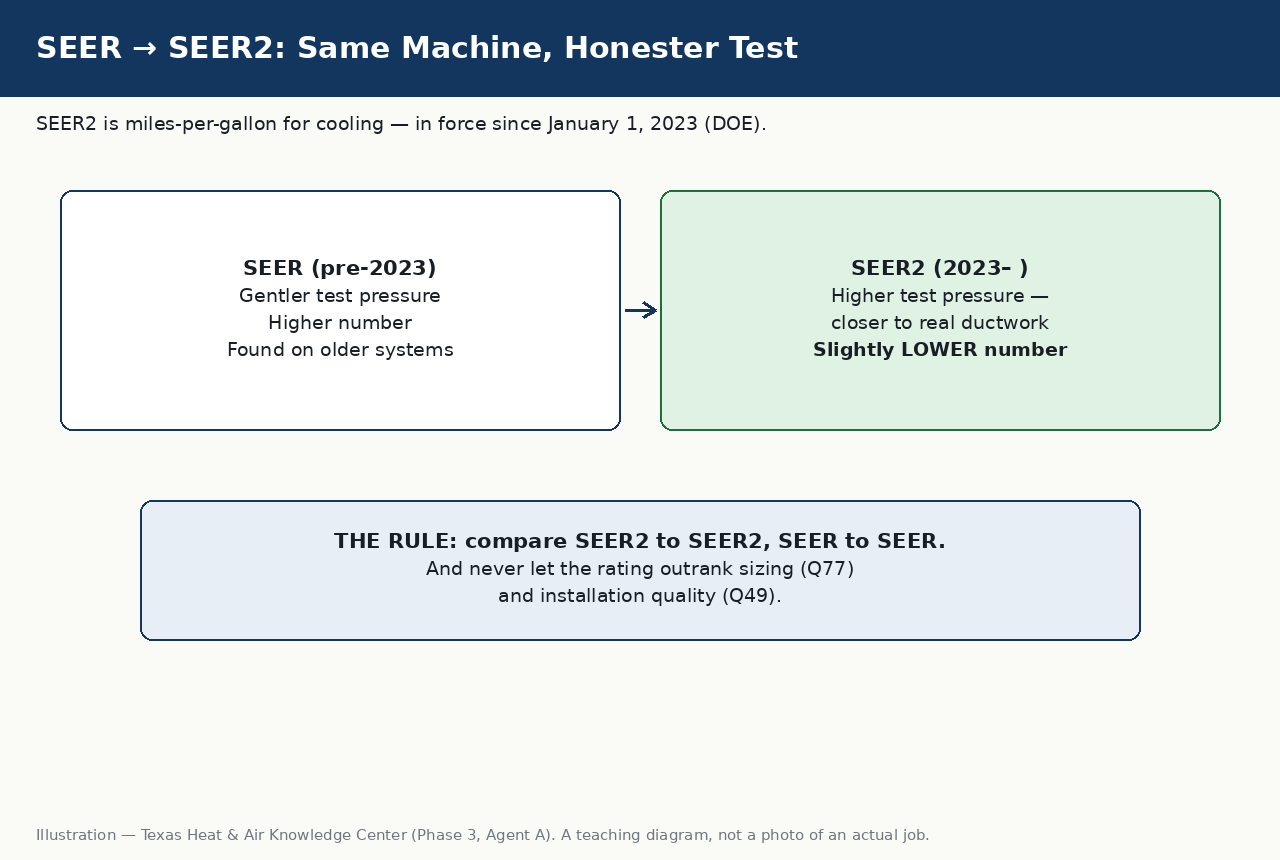
SEER2 is the same idea under a tougher, more honest test. Federal testing changed on January 1, 2023. The new procedure runs system at higher external static pressure. Static pressure is the resistance air meets as it moves through the filter, coil. Ducts — so ratings better reflect installed reality. The practical result confuses shoppers: SEER2 numbers read slightly lower than SEER numbers for the same machine. A unit rated 15.2 SEER2 performs about the same as one rated about 16 under the old SEER test. The machine did not get worse; the ruler got stricter. Treat that pairing as a rough guide, not an exact conversion. The two tests differ, so the safe rule is to compare SEER2 with SEER2 and SEER with SEER.
| SEER (pre-2023) | SEER2 (2023– ) | |
|---|---|---|
| Test pressure | Lower (gentler) | Higher — closer to real ducts |
| Same machine's number | Higher | Slightly lower |
| Found on | Older installed systems, old stock quotes | All new equipment |
| Rule | Only compare within a family | Only compare within a family |
Two warnings protect the rating's value. First, the rating is earned on a test bench. Your house is not a bench. Poor installation, bad ducts. Wrong sizing can waste the efficiency you paid for. A well-installed mid-tier system routinely beats a sloppy high-tier one. The rating is a property of the system. The efficiency you live with is a property of the installation.
Second, higher is not automatically better value. Each step up the rating ladder costs more and saves less than the step before it. Diminishing returns are built into the physics. In many homes, the same dollars do more work in duct sealing, insulation. Correct sizing than in the top rating tier. The right question is never "what's the highest SEER2?" It is "what does each tier save inmyhome, over the system's life, per dollar of price difference?" That is a payback question. Your contractor should answer it with your usage, not a brochure. And treat any guaranteed bill savings as fiction: ratings project; they do not promise.
When to call a professional
Bring mixed-rating proposals to one table and ask for the translation: both quotes restated in SEER2, with realistic savings and payback for your home. A pro answers with your run hours and your electric rate — not a national average.
What happens next
Ask Texas Heat & Air what an estimate for a replacement system costs before you book. Ask for tiers side by side, in SEER2, with the installed price attached to each. That is the form in which the rating becomes a decision instead of a slogan.
Texas Heat & Air next step
Comparing proposals with mixed rating systems? Bring both quotes — we will translate them onto one ruler: (682) 438-8127.
Related Questions
 What matters most when buying a new HVAC system?What does variable-speed HVAC mean?

Still Have Questions? Ask an HVAC Expert.
Couldn't find the answer you need? Tell us what's happening. Our team will review your question and contact you to help.
Ask Your Question →Sources
- https://www.energy.gov/femp/purchasing-energy-efficient-residential-central-air-conditioners — U.S. Department of Energy guidance. Supports the SEER/SEER2 definitions, the 2023 test change to higher static pressure. The approximate 15.2 SEER2 ≈ 16 SEER relationship.