
Furnaces, Heat Pumps, and Winter Heating in North Texas
How furnaces and heat pumps each make warm air, why heat-pump air feels gentle, what defrost and auxiliary heat really do. Which winter signs are normal — or not.

Furnaces and heat pumps make warm air in completely different ways. Most winter confusion comes from judging one machine by the other's behavior. Some service calls end with "it's working fine." Some real faults get ignored as "just how it is." This guide separates the two machines.
You will learn how a furnace's flame-and-heat-exchanger system differs from a heat pump's heat-moving system. You will learn why heat-pump air feels lukewarm even when it is heating correctly. You will learn what the defrost cycle is doing when your outdoor unit steams. And you will learn how auxiliary and emergency heat fit together.
You will also learn the winter safety system. A furnace that refuses to start is often protecting you. And three winter smells mean three different responses. The linked articles answer each winter question in depth. This guide gives you the framework that makes the answers make sense.
Key takeaways
- A furnace makes heat with a flame and delivers it hot. A heat pump moves heat that already exists outdoors and delivers it gently. The feel is different because the method is different.
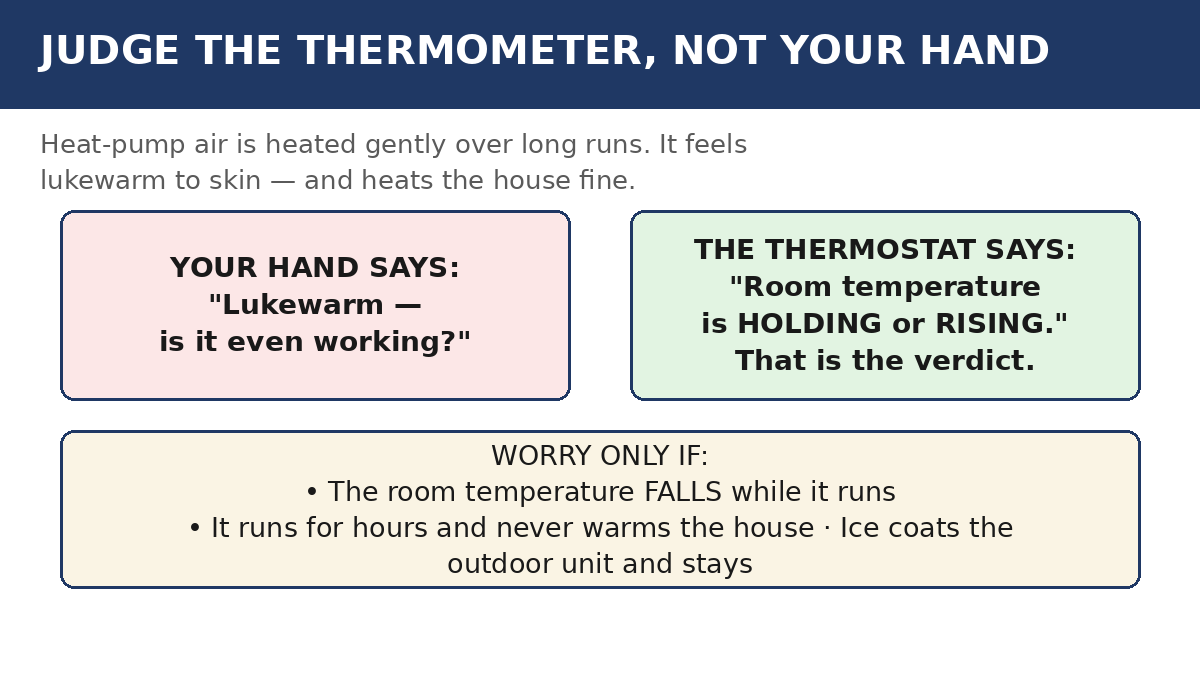
- Judge a heat pump by the thermostat trend over an hour — rising, holding, or falling. Never judge it by how the air feels on your hand.
- Light frost that comes and goes is normal. The defrost cycle melts it. Ice that stays, thickens, or stops the fan is a fault.
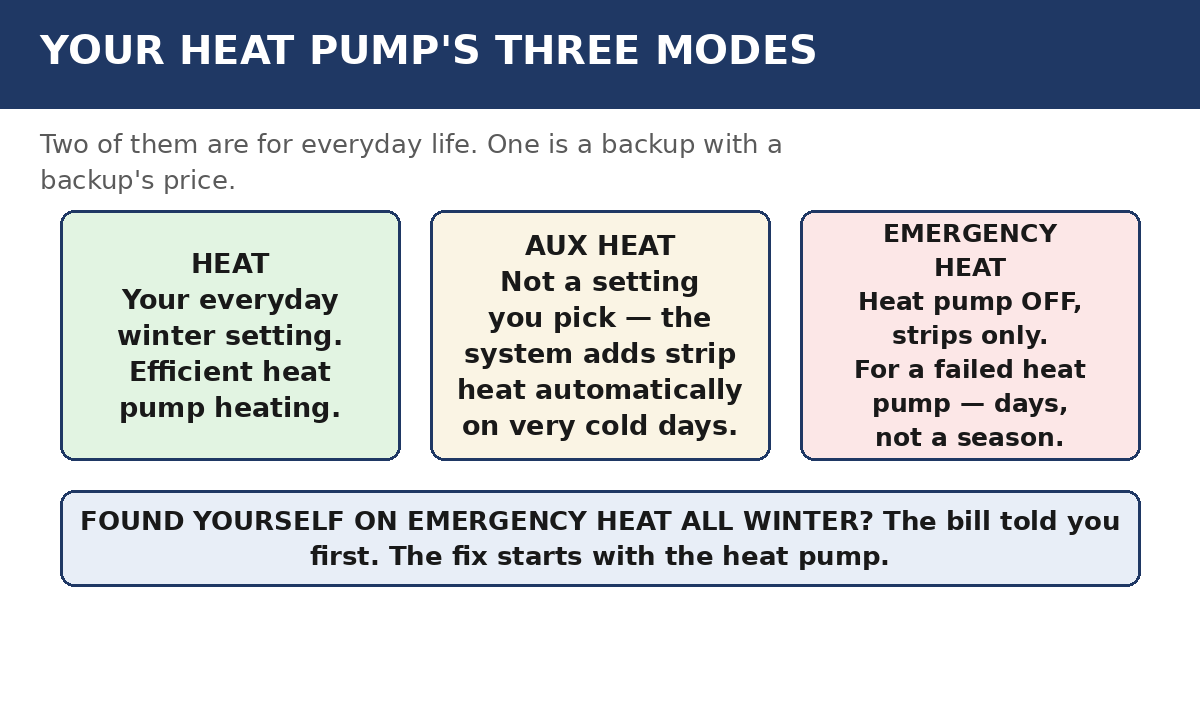
- Auxiliary heat is the automatic helper on the coldest days. Emergency Heat is a manual mode. It benches the heat pump and heats with backup alone — effective, expensive. Meant only for a failed heat pump.
- A furnace that will not start after basic checks is usually a safety system doing its job. Do not bypass safety switches or force restarts.
How it works
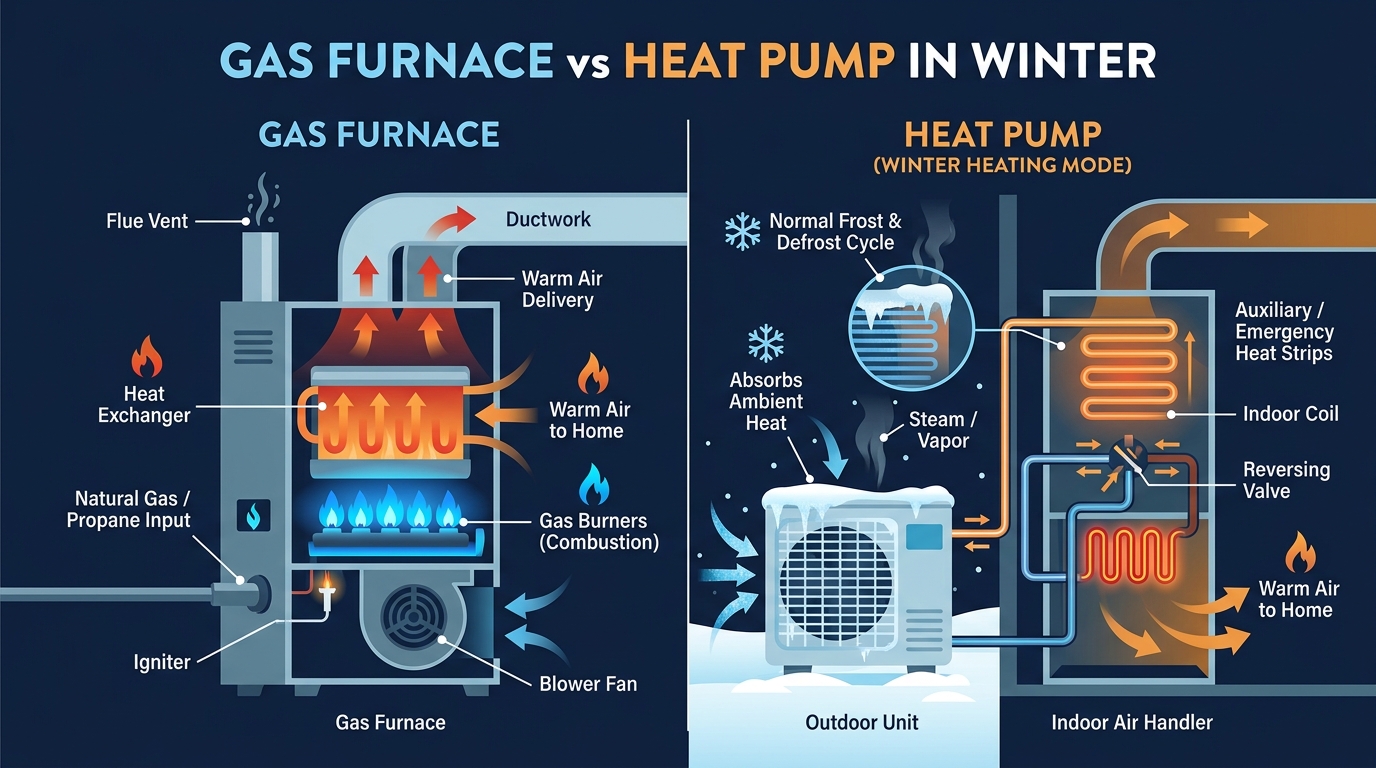
Method one: making heat.A gas furnace burns fuel in a controlled flame. The flame heats a metal heat exchanger. The heat exchanger is the metal chamber inside a gas furnace where fuel burns. Heat passes through its walls to the air blown into the home. While the exhaust gases stay sealed inside and are vented outside.
Your home's air, pushed by the blower, passes over that hot metal. It carries the heat through the ducts. Because the heat source is fire, the delivered air is genuinely hot. It arrives in strong, noticeable blasts.
Around that flame sits a safety system. Before ignition, controls check switches and sensors: venting clear, switches in their safe states. During use, a high-limit switch watches the furnace's inside temperature. A flame sensor confirms the flame is lit. If a check fails, the furnace shuts down or refuses to start. That refusal is the system working as designed. It is why gas heating system is not a do-it-yourself area.
Method two: moving heat.A heat pump is a system that moves heat instead of making it. Pulling heat out of the home in summer. Pulling heat in from outdoor air in winter. It is an AC that can run its loop in reverse. A part called a reversing valve switches the direction.
In winter it gathers heat from the outdoor air. Cold air still holds usable heat. The heat pump releases that heat indoors. Because the heat is gathered rather than created, the delivered air is only moderately warmer than the room. It can feel noticeably cool to skin, because your skin is warmer than the air stream. Even while the room steadily warms.
Heat pumps also tend to run longer, gentler cycles instead of short hot blasts. Both differences are physics, not weakness. The honest test is the thermostat. If the room reaches the set temperature and holds it, the heat pump is doing its job.
The defrost cycle.A defrost cycle is a short, normal cycle in which a heat pump briefly reverses itself to melt frost that has built up on its outdoor coil in cold weather. In heating mode, the outdoor coil runs colder than the outdoor air. Moisture freezes onto it — the same frost you scrape off a windshield.
Heat pumps expect this. From time to time, the system briefly reverses. It sends warm refrigerant to the outdoor coil and melts the frost. You may hear a whoosh. You may see steam rise off the unit. You may feel cooler air indoors for a few minutes. All of that is normal use.
Frost becomes a problem only when it stops clearing. Defrost controls or sensors can fail. The outdoor fan can die. Airflow can be blocked. Refrigerant can run low. Then ice begins to win.
Two kinds of backup.Most heat pump systems carry a second heat source, and it works two ways. Auxiliary heat is backup heat that turns on automatically to help a heat pump when outdoor air is too cold for the heat pump to keep up alone. During defrost cycles.
Emergency heat is different. It is a thermostat setting that switches the heat pump off and runs only the backup heat, for use when the heat pump itself has failed. Emergency heat exists for a broken heat pump: the house stays warm on backup alone until repairs are made.
The catch is efficiency. Resistance backup heat makes heat the costly way. A heat pump moves it instead. So weeks spent in emergency mode show up on the electric bill. It is a bridge to a repair, not a setting to live in.
The situations homeowners ask about
The air feels wrong: cold or lukewarm air
Start by asking which machine you have. The same vent tells two stories. On a furnace, air that never warms. Or a room temperature that keeps falling. Points to ignition, control, or fuel problems. Those are real faults.
On a heat pump, gentle air is the design. Startup and defrost are temporary exceptions: cooler air indoors for a few minutes is normal then. The deciding instrument is the thermostat, watched over 30 to 60 minutes. Rising or holding means the system is working, whatever your hand reports. Steadily falling means it is not, whatever the air feels like. The short answers: Q31 — Why is my heater blowing cold air? (/hvac-help/heater-blowing-cold-air/) · Q35 — Why does my heat pump blow lukewarm air? (/hvac-help/heat-pump-blowing-lukewarm-air/) · Q73 — What is the difference between an AC and a heat pump? (/hvac-help/ac-vs-heat-pump-difference/)
The furnace will not run — or will not stay running
Work the simple layer first. Thermostat set to HEAT, with the temperature raised. A filter that is not clogged. The breaker. And the furnace's power switch near the unit. It looks like a light switch and gets bumped more often than anyone admits. Note any error-code lights visible through the small viewing window, without opening the cabinet.
Past that layer, a furnace that stays off is reporting failed safety checks — ignition, venting, or switches. That is pro territory by design. The short answer: Q32 — Why won't my furnace turn on? (/hvac-help/furnace-will-not-turn-on/)
A furnace that runs a few minutes, stops. Repeats is usually overheating itself into a limit trip. Heat builds up because air is not carrying it away. The clogged filter is the classic cause. Closed vents, blocked returns, and a weak blower do the same.
A dirty flame sensor produces a similar pattern from the other direction. The furnace lights. It cannot confirm its own flame. It shuts down. Repeated short cycles deserve a diagnosis. The limit switch is reporting a reason. It keeps reporting until the reason is fixed. The short answer: Q33 — Why does my furnace shut off too soon? (/hvac-help/furnace-shuts-off-too-soon/)
Winter noises and first-run smells
Heating systems make honest working sounds: control clicks, a soft ignition whoosh, gentle duct pops as metal warms. Learn those. Then trust yourself when something differs.
Banging or booming at ignition can mean delayed ignition. Gas building up before it lights. That is a safety problem. Grinding and screeching are the familiar worn-bearing family. A new, severe, or worsening noise means heat off and a call. The short answer: Q34 — Why is my heater making a loud noise? (/hvac-help/heater-making-a-loud-noise/)
Smells follow the three-response pattern. The dusty, hot smell at the first firing of fall is settled dust burning off after months of sitting. It should fade within an hour or so. Brief ventilation is all it needs.
A strong, sharp, electric or plastic burning smell that persists means heat off and service. A rotten-egg smell means gas. Do not investigate. Do not flip switches. Do not use a phone inside. Get everyone out. Call 911 and the gas utility from outside.
Remember, too, that carbon monoxide has no smell at all. Carbon monoxide is a poisonous gas produced when fuel such as natural gas burns incompletely. It has no color and no smell, so you cannot detect it yourself. CO alarms are the protection in any home with fuel-burning system. The short answer: Q39. WHy does my heater smell when I first turn it on? (/hvac-help/heater-smell-first-turn-on/)
Frost, ice, and the outdoor unit
Judge frost by thickness and persistence. A light, even frost that appears and clears through the day is winter being winter. A unit encased in thick ice is past normal. So is ice that never clears between cycles. Ice locking the fan blade.
When frost stops clearing, something is failing: defrost controls or sensors, the outdoor fan, airflow, or refrigerant. Meltwater refreezing around the base can add to it. Heating output falls as ice insulates the coil. Backup heat silently carries more of the load at higher cost. So iced units get more expensive the longer they run.
Never chip ice with tools. Never pour hot water on the unit. Coil fins and refrigerant lines damage easily. The short answers: Q36 — Is frost on my heat pump normal in winter? (/hvac-help/frost-on-heat-pump-normal/) · Q37 — Why is my outdoor heat pump covered in ice? (/hvac-help/heat-pump-covered-in-ice/)
The thermostat's backup modes
Read the mode before you judge the bill. HEAT is normal: heat pump first, auxiliary help automatic. EM HEAT or EMERGENCY means backup-only, with the heat pump locked out.
That mode is correct in exactly one situation: the heat pump has failed. You are heating on backup until it is repaired. If you find the thermostat set there and nobody knows why, that is a service call by itself. So is relying on it for more than a short stretch. The expensive meter is running. The short answer: Q38 — What is emergency heat on my thermostat? (/hvac-help/what-is-emergency-heat/)
Diagrams and comparisons
F06-furnace-vs-heatpump.jpg— "How a gas furnace and a heat pump each make warm air in winter. And why heat-pump air feels cooler on the skin." The side-by-side is the guide's core lesson: flame and heat exchanger on one side, reversing valve and gathered heat on the other.
Furnace vs. heat pump, in one view.
| Gas furnace | Heat pump | |
|---|---|---|
| How heat is produced | Burns fuel; flame heats a heat exchanger | Moves existing heat from outdoor air indoors |
| How the air feels | Genuinely hot, in strong blasts | Warm but gentle; cooler than skin, over longer runs |
| The right test | Does the room reach and hold the set temperature? | The same — judge by the thermostat trend, not your hand |
| Normal winter behavior | Ignition whoosh, duct pops, short strong cycles | Long gentle cycles, periodic defrost (whoosh, steam, brief cooler air) |
| Backup heat | The furnace is the heat source | Auxiliary heat helps automatically; Emergency Heat mode is manual and backup-only |
b3-07-q35-thermostat-not-your-hand.png— "Judge the thermometer, not your hand." Why the feel test misleads on heat pumps. The three signs that do mean trouble: room temperature falling while it runs, hours of running without warming the house. Ice that coats the outdoor unit and stays.
b3-08-q38-thermostat-modes.png— "Thermostat modes in plain language. Including the expensive one." What Cool, Heat, Emergency Heat. Fan each do, so a mode left in the wrong place gets caught in a glance.
What you can safely do yourself
- Confirm the thermostat: set to HEAT, set temperature above the room temperature. Read the mode — HEAT is normal. EM HEAT means backup-only.
- Check the filter. Make sure supply vents are open and uncovered and the return vent is not blocked by furniture.
- Watch the thermostat trend over 30 to 60 minutes. Rising, holding. Falling is the real story of any heating complaint.
- Look at the breaker panel and the furnace power switch near the unit. Note error-code lights through the viewing window, without opening the cabinet.
- Watch frost over a few hours from a safe distance: does it clear during use? Keep leaves and debris away from the outdoor unit by hand. Let meltwater drain away from it.
- Never chip ice or pour hot water on the outdoor unit, never bypass a safety switch. Never force repeated restarts on a furnace that keeps shutting down.
- For any gas smell: no checks at all. Leave, then call 911 and the gas utility from outside.
What a technician checks
The winter workup follows the safety system. For a furnace that will not run: the ignition system, gas valve and supply, safety switches and sensors, control board error codes. Venting condition. For short cycling: airflow and blower performance, the high-limit switch, flame sensor condition, gas pressure and controls, and thermostat use. For noises: blower motor and bearings, ignition timing and burners, mounting hardware, and duct connections.
For heat pumps, the checks follow the moving-heat loop: refrigerant use, defrost controls and sensors, outdoor fan condition. Whether backup heat engages when it should. For an iced unit, drainage around the base joins that list. And for smell complaints on gas systems: heat exchanger and burner condition, electric parts for heat damage. Safe combustion and venting.
Ask Texas Heat & Air what you will get in writing, and what your approval covers, before you book.
Making the decision
One signal outranks every other winter observation: a room temperature that keeps falling. Whatever the air feels like, whatever the unit sounds like, a falling thermostat means the system is not heating. That is the call.
The second decision is about modes. Emergency heat is a bridge measured in days. Treat "we've been on EM HEAT for weeks" as an overdue repair, not a lifestyle.
The third comes at replacement time. Furnace versus heat pump is a real choice. It depends on your fuel options, your ducts. How your home handles the coldest nights. The comparison table above is the starting framework. A load-based recommendation from a technician who has seen the house is the finish.
North Texas notes
North Texas winters are short but not gentle: long mild stretches, broken up by sharp cold snaps that arrive fast. That pattern shapes the local failure calendar.
Systems sit idle through a long cooling season. So the first cold night produces the dusty first-run smell all over the region at once. It also exposes every weak igniter, tired sensor. Failed defrost control in a single weekend.
Heat pumps are common here precisely because most winter days are mild enough for them to shine. The cold snaps are when auxiliary heat earns its keep. They are also when a heat pump that "seemed fine" in November gets found out in January. Prepare in the mild weeks: filter fresh, thermostat modes understood, and the outdoor unit clear. Then the snap is weather, not an emergency.
Related resources
- Q31 — Why is my heater blowing cold air? (/hvac-help/heater-blowing-cold-air/)
- Q32 — Why won't my furnace turn on? (/hvac-help/furnace-will-not-turn-on/)
- Q33 — Why does my furnace shut off too soon? (/hvac-help/furnace-shuts-off-too-soon/)
- Q34 — Why is my heater making a loud noise? (/hvac-help/heater-making-a-loud-noise/)
- Q35 — Why does my heat pump blow lukewarm air? (/hvac-help/heat-pump-blowing-lukewarm-air/)
- Q36 — Is frost on my heat pump normal in winter? (/hvac-help/frost-on-heat-pump-normal/)
- Q37 — Why is my outdoor heat pump covered in ice? (/hvac-help/heat-pump-covered-in-ice/)
- Q38 — What is emergency heat on my thermostat? (/hvac-help/what-is-emergency-heat/)
- Q39 — Why does my heater smell when I first turn it on? (/hvac-help/heater-smell-first-turn-on/)
- Q73 — What is the difference between an AC and a heat pump? (/hvac-help/ac-vs-heat-pump-difference/)
- Guide 4 — Sounds, Smells, Water Leaks, and Frozen Coils (/hvac-help/guides/sounds-smells-leaks-frozen-coils/) — reading winter noises and smells as signals
- Guide 5 — Inside Your Air Conditioner: Parts, Electric Failures. What Stays Hands-Off (/hvac-help/guides/parts-and-electric-failures/) — the motors and electric parts behind heating failures
Texas Heat & Air next step
If your home is losing the thermostat test. Temperature falling, ice that will not clear, a furnace that will not stay lit. Call (682) 438-8127 and say so plainly. A home that cannot stay warm is urgent details. Ask Texas Heat & Air to confirm the diagnostic fee when you book. Texas Heat & Air serves Cleburne, Burleson, Granbury, and Fort Worth. Call (682) 438-8127 to confirm coverage for your address.

Understanding the system comes first: learn how the pieces work together, use the safe checks. Let a qualified technician confirm anything inside the system.
Related Homeowner Questions
 Why won't my furnace turn on?Why does my furnace shut off too soon?Why is my heater making a loud noise?Why does my heat pump blow lukewarm air?Is frost on my heat pump normal in winter?Why is my outdoor heat pump covered in ice?What is emergency heat on my thermostat?Why does my heater smell when I first turn it on?What is the difference between an AC and a heat pump?

Still Have Questions? Ask an HVAC Expert.
Couldn't find the answer you need? Tell us what's happening. Our team will review your question and contact you to help.
Ask Your Question →Sources
- https://www.carrier.com/us/en/residential/hvac-resources/what-is-auxiliary-heat/ — Carrier: auxiliary and emergency heat, and defrost use
- https://www.energystar.gov/saveathome/heating-cooling — ENERGY STAR: heating and cooling system use and maintenance context
- https://www.energystar.gov/saveathome/heating-cooling/maintenance-checklist — ENERGY STAR: seasonal maintenance, filters, and heating checks
- https://www.cpsc.gov/safety-education/safety-guides/carbon-monoxide/carbon-monoxide-fact-sheet — CPSC: carbon monoxide safety for fuel-burning system
- https://www.atmosenergy.com/accountcenter/gas/gasemergencyLanding.html — Atmos Energy: what to do for a gas emergency
- https://www.energy.gov/femp/purchasing-energy-efficient-residential-central-air-conditioners — U.S. DOE: central AC and heat pump system background