
What is emergency heat on my thermostat?
Emergency Heat locks out your heat pump and runs the costly backup heater alone. When that setting is the right bridge — and when it isn't.

Emergency Heat is a manual thermostat setting that locks the heat pump out entirely and heats with the backup heater alone — usually electric resistance heat. It works, but it costs far more per hour to run. It exists for one situation: the heat pump itself has failed and the house still needs heat.
What you can safely check
- Read the thermostat's mode right now, especially if your electric bills jumped without the weather explaining it: HEAT is normal. EM HEAT or EMERGENCY means backup-only.
- Check your system manual before changing settings you do not understand — thermostat models vary.
- If EM HEAT is on and nobody knows why, that fact alone is worth a call. Either the heat pump failed and nobody followed up. The setting is a mistake quietly taxing every hour.
How this works
A heat pump system usually has two heat sources living in one installation. The heat pump is the efficient one: it moves heat rather than making it. The backup heater is the strong, expensive one. Most often electric resistance elements, the same technology as a space heater. It is sized for the whole house.
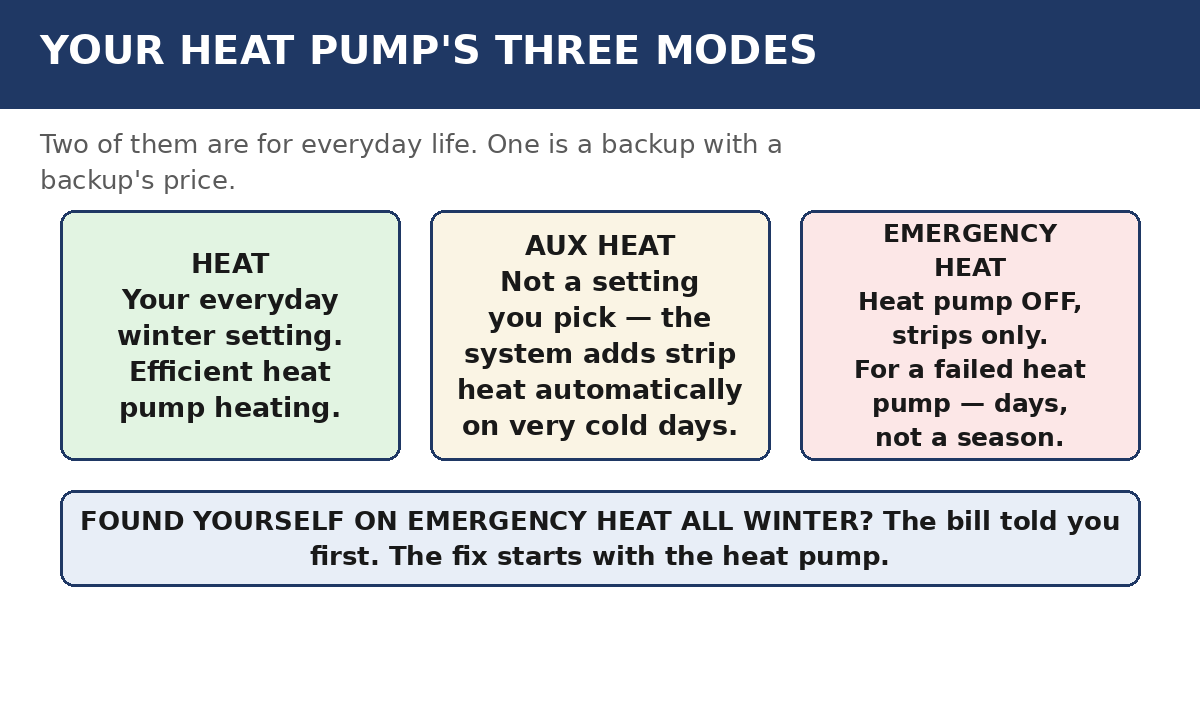
The names differ by who is in charge. When the thermostat brings the backup on by itself. To help on very cold days, or during a defrost cycle. That is called auxiliary heat. Auxiliary heat is backup heat that turns on automatically to help the heat pump when it cannot keep up alone. It is normal, brief, and managed by the system itself. Many thermostats report it with an "AUX" indicator. Emergency Heat is different. It is a thermostat setting that switches the heat pump off and runs only the backup heat. You switch it on yourself. Or a past homeowner did, or a setting got bumped. The heat pump is then locked out completely. The backup heater carries the whole house alone.
Its legitimate use is narrow and real. The heat pump has failed — iced solid (Q37), damaged, not running. And the house needs heat while you wait for repair. Emergency heat keeps pipes from freezing and people warm. It is a bridge, not a mode of living. The repair should be booked the same day you switch it on.
The catch is cost. Electric resistance heat turns electricity into heat one-for-one. A heat pump does better: it moves several units of heat for each unit of electricity it uses. So backup-only heating costs far more per hour. It is the most expensive heat your home can make. Leave the system on EMERGENCY HEAT for weeks by accident or habit. The difference arrives as a startling electric bill. The reverse error matters too. Do not use EM HEAT to "help" a working heat pump through a cold snap. In HEAT mode, the backup already helps on its own, at the moments it is needed. It does that without locking out the efficient machine.
The summary to keep: HEAT = the pump leads, the backup assists. AUX showing = the backup assisting, normal in cold weather. EM HEAT = the pump benched; for breakdowns only.
| HEAT mode | HEAT + AUX showing | EMERGENCY HEAT mode | |
|---|---|---|---|
| Heat pump | Runs; does the work | Runs; does most of the work | Locked out |
| Backup heat | Joins automatically when needed (auxiliary) | Assisting right now | Does all the work, all the time |
| Cost per hour | Normal — efficient | Higher while it shows | Far higher — resistance heat |
| Meant for | Everyday heating | Cold snaps, defrost, big set-point raises | Heat pump failed; bridge until repair |
When to call a professional
Call the same day you switch to emergency heat because the heat pump failed. And call if you find EM HEAT on with no failure anyone can explain. A technician will diagnose the heat pump itself: why it stopped, whether ice, controls. The refrigerant cycle are at fault. What the repair involves.
What happens next
On EM HEAT for a genuine failure? Book the diagnostic visit now. The meter is running on the most expensive heat your home can make. Ask Texas Heat & Air what you will get in writing, and what your approval covers, before you book. Found EM HEAT on by accident with a healthy pump? Switch back to HEAT and watch the next bill.
Texas Heat & Air next step
On EM HEAT for more than a short stretch. Or for no reason you know of? Call Texas Heat & Air at (682) 438-8127.
Related Questions
 Why is my heater blowing cold air?Why is my outdoor heat pump covered in ice?What is the difference between an AC and a heat pump?

Still Have Questions? Ask an HVAC Expert.
Couldn't find the answer you need? Tell us what's happening. Our team will review your question and contact you to help.
Ask Your Question →Sources
- https://www.carrier.com/us/en/residential/hvac-resources/what-is-auxiliary-heat/ — supports the auxiliary vs. emergency heat definitions, activation behavior, and the cost relationship
- https://www.energystar.gov/saveathome/heating-cooling — supports general system use context