
Why does my heat pump blow lukewarm air?
Heat pumps move heat instead of making it, so their air feels lukewarm even while heating correctly. The thermostat test settles it.

Usually, that is simply how heat pumps work. A heat pump moves heat instead of making it with a flame, so its air arrives warm, not hot. And against your skin it reads as lukewarm even while the system heats correctly. The true test is the thermostat: rising or holding means working.
What you can safely check
- Watch the thermostat trend for an hour. Rising, holding, or falling. Not the feel of the air on your hand.
- Confirm the thermostat is set to HEAT, not EMERGENCY HEAT (Q38), and check the filter. A clogged filter can push the system onto its backup heat.
- Raise the temperature in small steps of one or two degrees. Big jumps and deep night setbacks can call in the costly backup heat to recover. Small steps let the heat pump do the work itself.
- Look at the outdoor unit: heavy ice that never clears is a service issue (Q37).
How this works
This is the most common heat pump worry there is. Most of the time it is a false alarm. So take the mechanism seriously, because once it makes sense, the worry dissolves.
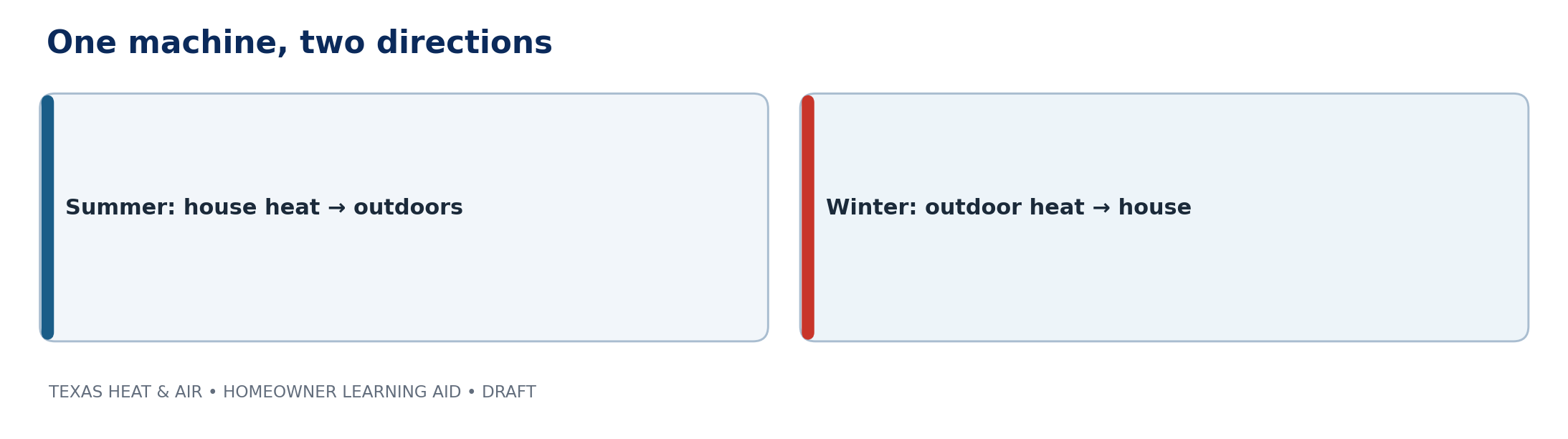
A gas furnace creates heat with fire and delivers a blast of genuinely hot air. A heat pump does something cleverer and gentler. It works like your refrigerator in reverse. Instead of making heat, it gathers heat from the outdoor air. Cold winter air still holds usable heat. The heat pump concentrates that heat and carries it inside. The air that comes out of your vents is the result: a long, gentle delivery of warmth, not a furnace's hot blast.
That delivery has a trap built into it. Your skin is warmer than the air a heat pump usually delivers. So air that is genuinely heating your home can feel lukewarm. Even cool — on your hand. Your hand measures the difference between the vent air and your skin. It reports that difference honestly. But it tells you nothing about whether the house is gaining heat.
The thermostat is the tool that answers the real question. Over an hour, is the room temperature rising toward your set point, or holding there? Then the heat pump is doing its job, no matter what your hand says. There is no one vent temperature that fits every system. The trend is the test.
On the coldest days, there is a second act. As outdoor temperatures fall, the outdoor air holds less heat to gather. The heat pump's capacity falls with it. That is physics, not failure. When the heat pump alone cannot keep up, backup heat joins in automatically. That automatic backup is called auxiliary heat. On many thermostats it shows as "AUX" (Q38). It also runs briefly during defrost. When the system reverses to melt frost off the outdoor unit and the vent air cools for a few minutes (Q36). Auxiliary heat is normal in cold snaps. It is also the expensive heat in the system, which is why the small-step advice above matters.
| Test | What it measures | Verdict it supports |
|---|---|---|
| Hand at the vent | Vent air vs. your skin temperature | None — it feels lukewarm either way |
| Thermostat over one hour | Whether the home is gaining heat | Rising/holding = working; falling = call |
When to call a professional
When lukewarm airisa problem, the thermostat says so: the room temperature steadily falls despite constant running, the system never gains ground, backup heat runs for hours in mild weather when the heat pump should manage on its own. The outdoor unit is encased in ice that never clears (Q36, Q37). A technician will check the heat pump cycle, airflow, controls, defrost use, and the backup heat source.
What happens next
If the trend is rising or holding, there is nothing to book. Your heat pump is fine. If it is falling, book a diagnostic visit. Ask Texas Heat & Air what you will get in writing, and what your approval covers, before you book. Report the trend when you call.
Texas Heat & Air next step
Thermostat rising or holding? Your heat pump is fine. Falling for an hour, or backup heat running for hours in mild weather? Call Texas Heat & Air at (682) 438-8127 and report the pattern.
Related Questions
 What is emergency heat on my thermostat?Is frost on my heat pump normal in winter?What is the difference between an AC and a heat pump?

Still Have Questions? Ask an HVAC Expert.
Couldn't find the answer you need? Tell us what's happening. Our team will review your question and contact you to help.
Ask Your Question →Sources
- https://www.carrier.com/us/en/residential/hvac-resources/what-is-auxiliary-heat/ — supports heat pump use and auxiliary heat behavior, including setback recovery
- https://www.energy.gov/energysaver/heat-pump-systems — supports how heat pump systems move heat in both directions
- https://www.energystar.gov/saveathome/heating-cooling — supports general system use context