
What should I do if I smell gas by my heater?
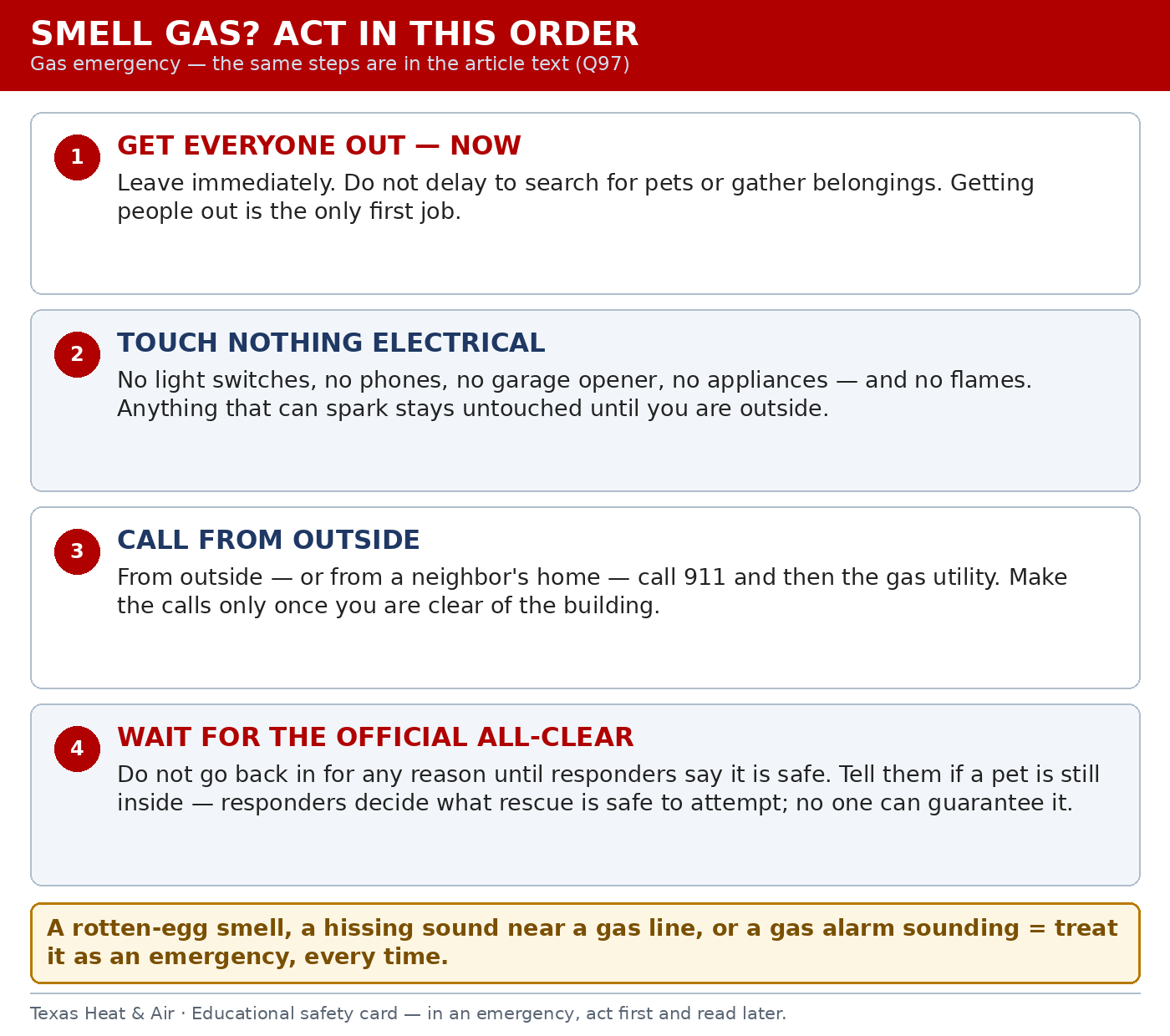
Smell gas? Leave right away — no switches, no phones inside, no investigating. Call 911 and the gas utility from outside. Re-enter only on the all-clear.

Leave the building right away. Do not try to find the leak, do not flip electric switches, do not light anything. Do not use a phone inside. Take everyone with you. From a safe distance outside. A neighbor's yard — call 911 and your gas utility. Re-enter only when authorities say it is safe.
Visual explanation
Proposed for Step 7: a plain procedure card carrying only the three steps — everyone out. Call 911 and the gas utility from outside; re-enter only on the all-clear. Nothing decorative belongs on this page; the text below must carry the sequence on its own, and it does.
What you can safely check
Nothing. There is no safe homeowner check for a gas smell — leavingisthe correct action. Do not stop to investigate "just to confirm," do not open windows on your way out. Do not touch the heater, its gas valve. Any appliance as you leave.
How this works
Natural gas is odorless on its own. The rotten-egg smell is added deliberately, as an alarm you can detect with no system. Treat it with the seriousness that design intends: a gas odor may mean a leak. Leaking gas can ignite or explode from a spark as small as the one inside a light switch, a phone being answered. A car started in an attached garage. That single fact generates the whole procedure. Every official source gives the same sequence, in the same order:
- Everyone out.Get everyone out of the building right away. If a pet happens to come with you, fine. But do not delay your exit to search for or round up animals. Do not stop for belongings. Leave doors as they are.
- Nothing electrical.No switches, no flashlights, no phones, no garage-door openers inside the building or on the porch.
- Call from distance."Outside" means well away from the building. A neighbor's yard or across the street, not your front step. Call 911 first, then the gas utility's emergency line. Atmos Energy serves much of this area. Its published emergency guidance matches this sequence. Describe what you smelled and where.
- Wait for the all-clear — and only the all-clear.If an animal was left inside, tell the responders it is still in the building. Never go back in for it yourself. Understand that no one can guarantee an animal rescue. Responders decide what is safe to attempt. Do not re-enter because the smell "seems gone" — your sense of smell tires quickly. Your nose is not an instrument. Firefighters and utility crews carry meters that measure what your nose cannot. They will test the air, shut off the gas at the meter if needed. Tell you when the building is safe.
When to call a professional
After responders clear the home, the heater becomes an HVAC question again — and a serious one. If the furnace or another gas appliance is implicated, it stays off until a licensed technician inspects the appliance and its connections and clears it. Gas work is licensed-pro territory, always. There is no homeowner chapter of this repair. Any article or video offering one should be closed. (Q63 covers the routine, preventive version of that inspection.)
What happens next
Responders find the source. Which may be the furnace, another appliance, a line. A problem outside the house entirely. And say when the house is safe. Only then does repair begin, under licensed work. And if the smell turns out to have been a false alarm, you have lost an hour and gained certainty: responders would rather answer ten false alarms than one late call.
One calm-day note, because this page is also read before it is needed: make sure everyone in the household, teenagers included, knows this sequence cold. The middle-of-the-night smell is not the moment to teach it.
Related Questions
 Why does my heater smell when I first turn it on?What happens during a heating inspection?

Still Have Questions? Ask an HVAC Expert.
Couldn't find the answer you need? Tell us what's happening. Our team will review your question and contact you to help.
Ask Your Question →Sources
- https://www.atmosenergy.com/accountcenter/gas/gasemergencyLanding.html — Atmos Energy's gas emergency guidance: the leave-first sequence this page follows.
- https://www.cpsc.gov/safety-education/safety-guides/carbon-monoxide/carbon-monoxide-fact-sheet — CPSC context on fuel-burning appliance safety (carbon monoxide itself is Q98).