What happens during a heating inspection?
Safety leads: ignition, burners, heat exchanger. Venting on gas furnaces. Refrigerant, defrost, and backup heat on heat pumps — plus a written report.

Safety leads the visit. On a gas furnace, the technician checks ignition, the burners, the flame sensor, safety limits. The heat exchanger and venting. The parts whose failure can produce carbon monoxide, a poisonous gas with no color and no smell. Heat pumps get refrigerant, defrost, and backup-heat checks instead. Both end with airflow checks and a written report of the findings.
Visual explanation
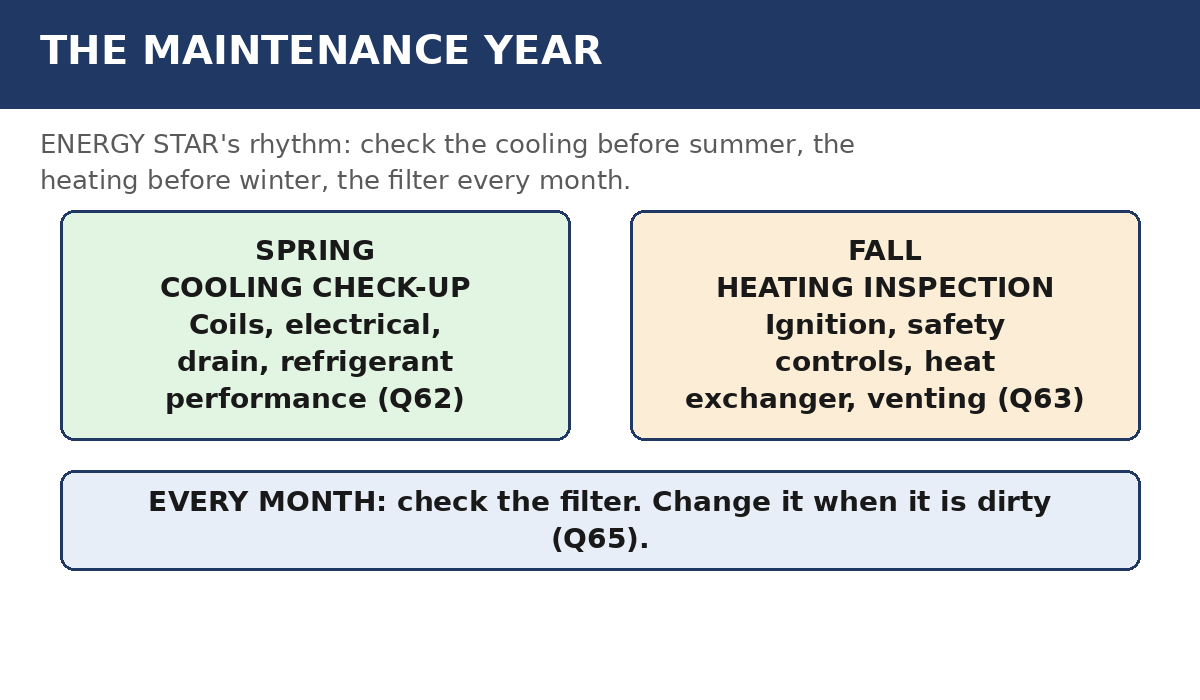
Caption: Twice-a-year care: the fall heating inspection is the second anchor visit of the year. Shared with Q61 rather than duplicated.The calendar teaches timing: this visit belongs in fall, before the first freeze turns a routine inspection into an emergency call.
What you can safely check
- Make a list beforehand: odd sounds, smells, weak heating, repeated shutoffs. Symptoms point the inspection the right way.
- Test your carbon monoxide alarms — that job is yours, and it matters (Q98).
- Never open the furnace cabinet to "pre-inspect" combustion parts yourself.
- Request prompt service — not a routine inspection — for repeated shutdowns, ignition problems. Any carbon monoxide alarm event.
What the visit includes
A heating inspection is the fall counterpart of the cooling tune-up (Q62). It is built on the same skeleton: your concerns and history, the thermostat (the wall control that reads the room temperature and tells the system when to start and stop), the filter, airflow and the blower (the fan that pushes air through the house), electric checks, safety controls, accessible ducts, delivered-heat temperatures, a full run cycle. A written System Health Report. Its center of gravity is different, though. Cooling visits chase performance. Heating visits lead with safety. Because heating system can fail in ways that include fire and carbon monoxide.
Texas Heat & Air's heating visits follow a matching owner-approved, maker-informed concept of 16 areas, adapted to your system.Like the cooling scope, it is PROPOSED — a concept, not a final item-by-item promise.
On agas furnace, the heat source gets the deepest attention. Ignition: does the burner light reliably and promptly? The burner itself, and the flame sensor. The part that proves the flame is really there. The safety limit switches, which shut the furnace down when it overheats. And above all, the heat exchanger and the flue. The heat exchanger is the metal chamber where fuel burns: heat passes through its walls to the air blown into your home. While the exhaust gases stay sealed inside. The flue is the vent path those gases take out of your home. A cracked exchanger or a blocked flue is how a furnace can produce carbon monoxide. Gas connections and combustion are verified, not assumed. Where the system and the maker's guidance call for them, gas-leak, combustion. Carbon monoxide safety tests are part of the visit.
Aheat pumpinspection swaps the combustion checks for its own heat-source checks. Refrigerant performance. The reversing valve and the defrost cycle. The short, normal cycle that melts frost off the outdoor coil — which winter depends on. And the backup heat. Backup heat has to work on the coldest night of the year, even though it may sit unused for months. So it is tested, not trusted. Electric furnaces get their heating elements and safety limits checked in the same spirit.
Both system types share the air path. Restricted airflow makes furnaces overheat and heat pumps underperform in equal measure, so the filter, blower. Vents are checked either way. The visit ends the way every visit in this library ends: findings explained in a written report. It says what passed, what to watch, and what needs repair. Any repair is quoted in writing and approved separately.
| Block | Gas furnace | Heat pump / electric |
|---|---|---|
| Always | Concerns, thermostat, filter, airflow and blower, electric, safety controls, ducts, delivered heat, run cycle, written report | Same |
| Heat source | Ignition, burners, flame sensor, heat exchanger, flue, gas/combustion/CO checks where appropriate | Refrigerant performance, reversing valve and defrost, backup heat (heat pump); elements and limits (electric) |
| The risk it retires | Carbon monoxide and fire risk | A cold-night failure with no backup heat |
When to call a professional
Repeated shutdowns, ignition problems, a burning smell. Any carbon monoxide alarm are not items to save for the fall inspection. They are service calls now. If a CO alarm sounds, get everyone out of the house first and call emergency services (Q98). The inspection can happen after the home is safe.
What happens next
Book the heating inspection in fall, before the first cold snap (Q61). Expect the safety checks first, a full run cycle. A written System Health Report at the end. Keep the report with your service records. Ask Texas Heat & Air what maintenance plan options are current. Get the full terms in writing before you enroll.
Texas Heat & Air next step
Fall is coming — book the heating inspection before the first freeze makes it urgent: (682) 438-8127.
Related Questions
 How often should I service my HVAC system?What if my carbon monoxide alarm sounds?

Still Have Questions? Ask an HVAC Expert.
Couldn't find the answer you need? Tell us what's happening. Our team will review your question and contact you to help.
Ask Your Question →Sources
- https://www.energystar.gov/saveathome/heating-cooling/maintenance-checklist — ENERGY STAR's maintenance checklist: heating check-up scope and safety emphasis.
- https://www.cpsc.gov/safety-education/safety-guides/carbon-monoxide/carbon-monoxide-fact-sheet — CPSC carbon monoxide fact sheet for fuel-burning system (URL to be re-verified visually before publication).