
HVAC Emergencies and Severe-Weather Safety: What to Do First
What to do first in an HVAC emergency: gas smells and CO alarms mean leave and call 911. Heat illness signs, cold-snap preparation. How after-hours service works.

The word "emergency" covers two very different situations. The most important skill in this guide is telling them apart.
One kind is anequipment emergency. The AC dies during a heat wave. The furnace quits on a Saturday night. It is miserable and urgent, and a service call solves it.
The other kind is adanger emergency: a gas smell, or a carbon monoxide alarm. Leaving the building and calling 911 solves that one. Treating it like an system problem, and trying to troubleshoot it, can get someone killed.
This guide gives the right first actions, in the right order, for both kinds. It covers the leave-first steps for gas and carbon monoxide. It covers how to protect people when the cooling fails in extreme heat. It covers how to prepare before a freeze, so the emergency never happens. And it explains honestly how after-hours service works when the problem is system, not danger.
The safety steps here follow published guidance from the CDC, the CPSC. The gas utility — the same order every official source gives.
Key takeaways- Gas smell or carbon monoxide alarm: get everyone out, call 911 from outside. Do not go back in until responders say it is safe. There is no safe check a homeowner can do for either one. - Do not delay your exit for animals or belongings. Get out, then tell responders that animals remain inside. - Heat illness is a medical emergency. It has clear warning signs. Confusion, collapse, or very hot skin means 911. Before any system check. - In very hot indoor air, a fan alone may not protect you. A cooled building is the reliable answer. - Most freeze emergencies can be prevented with one test run on a mild day, before the cold arrives.
How it works
Each danger in this guide works in a specific way. The right response follows directly from how it works. Learn how it works. You will not need to memorize steps under stress.
Why gas means leave.Natural gas has no smell on its own. The rotten-egg smell is added on purpose, as an alarm you can detect with no system. Leaking gas collects, and it can catch fire or explode. The spark that sets it off can be tiny: the arc inside a light switch, a phone being answered, a garage-door opener, a car started in an attached garage.
That is why the response is not "find the leak." It is this: touch nothing electric, get everyone out. Make your calls from well away from the building, where the air is clean.
Why a carbon monoxide alarm means leave.Carbon monoxide (CO) forms when fuel burns incompletely. For example, in a furnace with a cracked heat exchanger (the metal chamber where fuel burns), a blocked vent, or a faulty gas appliance. CO has no color and no smell, so the alarm is the only warning you will ever get.
Its early symptoms — headache, dizziness, nausea, confusion — look a lot like the flu. That is why people stay in poisoned homes. Firefighters carry meters that measure what your nose cannot. Treat every alarm as real: get out first, call 911 from outside. Go back in only when responders clear the building.
Why heat illness gets worse fast.Your body cools itself by sweating and by moving blood to the skin. In extreme heat, that system can fall behind. Even faster with high humidity. With certain medicines and health conditions.
First come heavy sweating, weakness, nausea, and dizziness. That is heat exhaustion. Then the cooling system fails outright: very high body temperature, hot skin that may be dry, confusion, collapse. That is heat stroke. Heat stroke can kill. It is a 911 emergency, not a wait-and-see.
A room fan helps in a warm room. But when indoor air gets very hot, the CDC warns that a fan alone may not prevent heat illness. Blowing very hot air across the body can add heat instead of removing it. Cooled air is the fix — wherever you have to go to find it.
Why furnaces fail on the first cold night.Heating system sits idle all summer. Weak parts — a worn igniter, a dirty filter, a failing control — often survive the idle months but not the first real demand. Cold snaps also arrive fast in North Texas. They arrive for everyone at once. That is why the test run before the cold (below) matters more than any emergency call.
The situations homeowners ask about
"I smell gas by my heater."
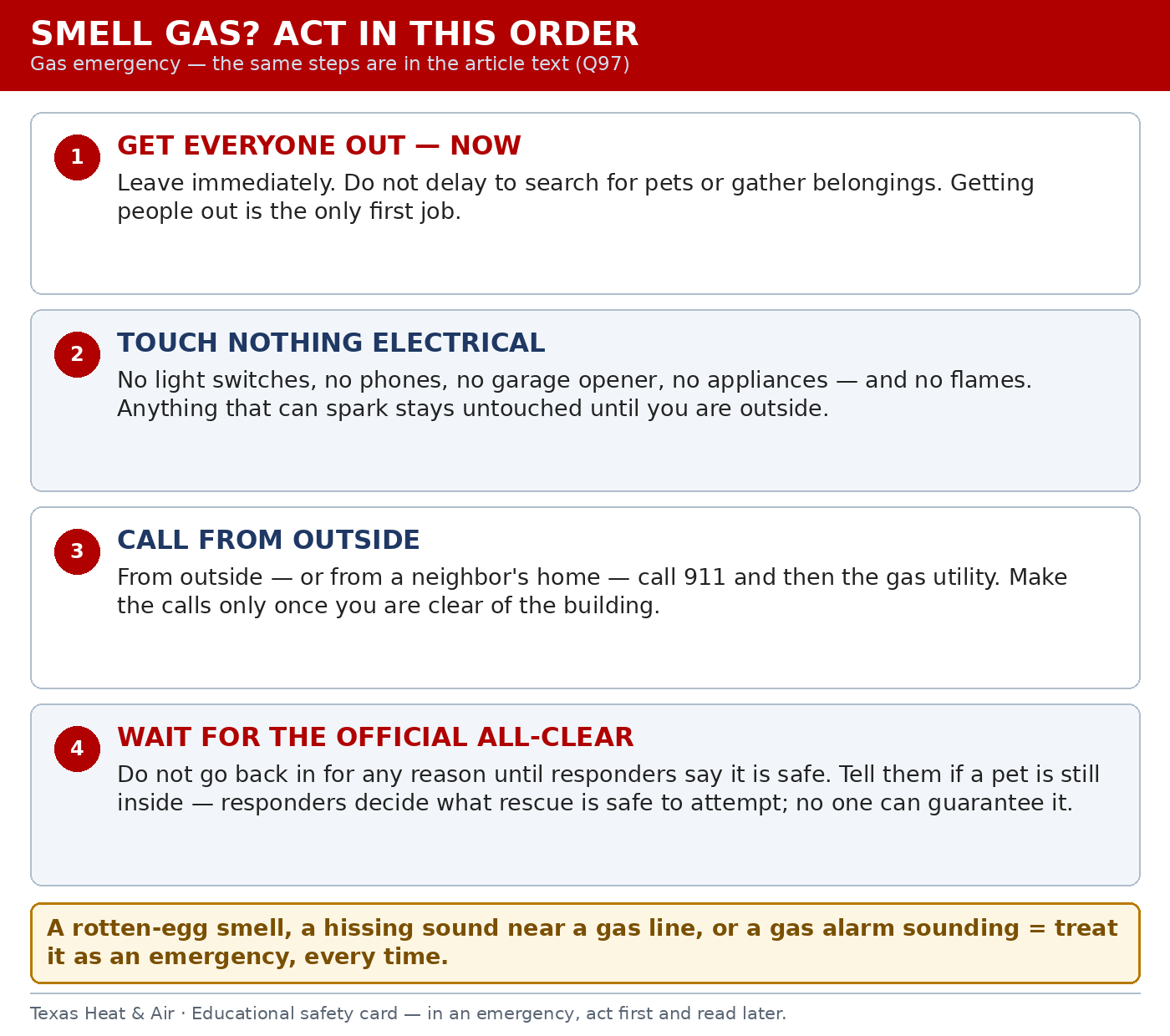
Leave the building right away. Do not try to find the leak, do not flip electric switches, do not light anything. Do not use a phone inside. Do not open windows on your way out. Do not stop to investigate "just to confirm."
About animals:do not delay your exit searching for a pet. Get out at once. Bring animals only if they come with you right away. Never go back inside for one. Never let an animal slow the evacuation. Once you are safely outside, tell emergency responders that animals remain inside; they will take that into account. No one can promise an animal will be rescued. Your job is to get every person out and let responders work.
From a safe distance outside. A neighbor's yard or across the street, not your porch — call 911. Then call your gas utility's emergency line. Atmos Energy serves much of this area. Its published guidance follows this same order. Describe what you smelled and where.
Crews will test the air. If needed, they will shut off the gas at the meter. They will tell you when the building is safe. Do not go back in because the smell "seems gone." Your sense of smell tires quickly. Your nose is not an instrument.
Only after the all-clear does the heater become a repair question. And gas work is always licensed-pro work.
The short answer: Q97. WHat should I do if I smell gas by my heater? (/hvac-help/what-to-do-if-you-smell-gas-by-your-heater/)
"My carbon monoxide alarm is sounding."
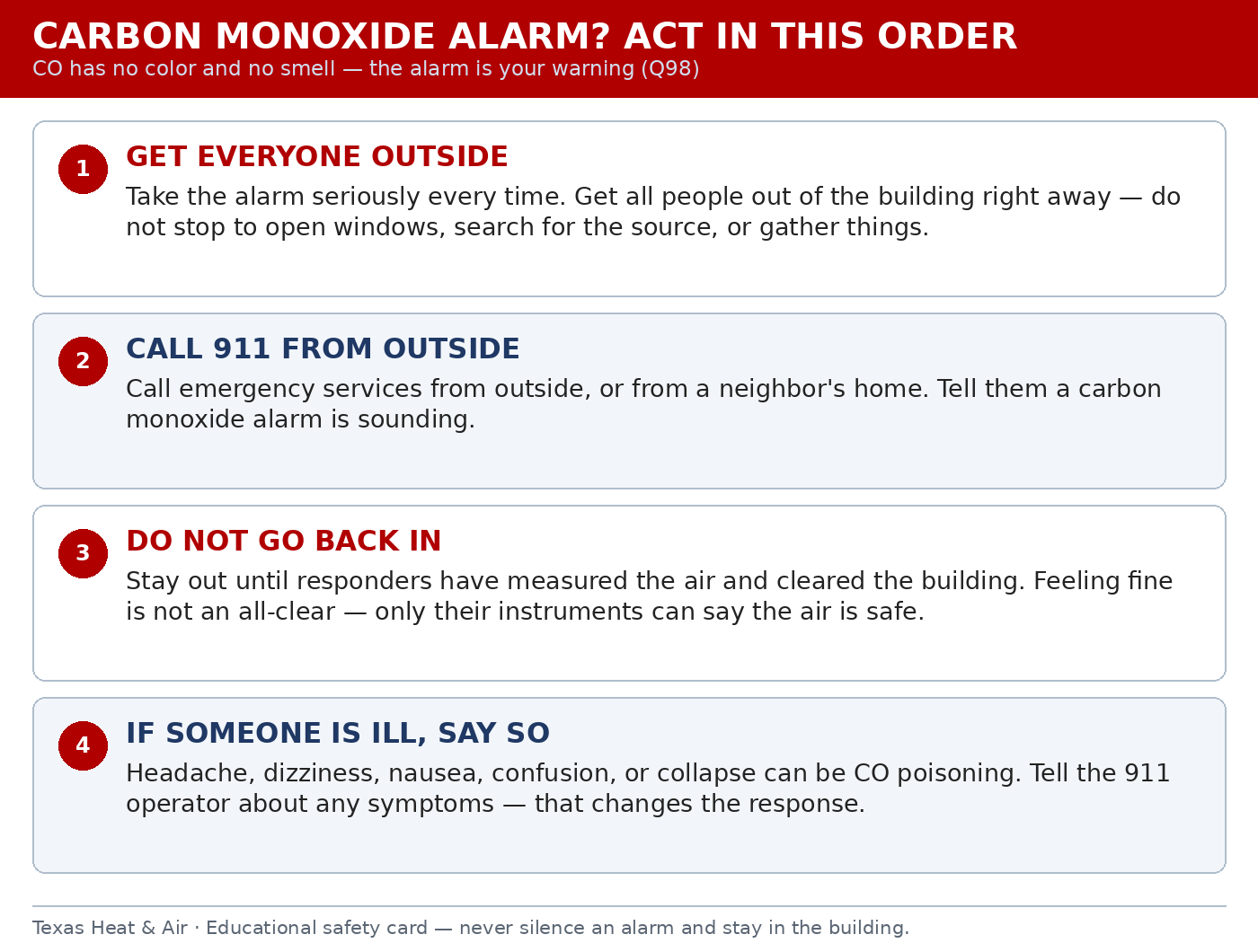
Get everyone — including pets — outside into fresh air right away. Do not search for the source, do not open windows first. Do not wait to see if the alarm stops. Call 911 or the fire department from outside or from a neighbor's home. Say if anyone has symptoms. Headache, dizziness, nausea, confusion — because that changes the response. Do not go back in until responders measure the level and say it is safe.
Prevention comes down to two habits. First, alarms: install CO alarms near sleeping areas and on every level of the home. Test them monthly. Replace batteries and aging units on schedule — the sensors wear out. Second, inspections: yearly service for fuel-burning system checks exactly the parts that produce CO when they fail.
And one rule prevents a tragedy that repeats every year: during an outage, never run a generator, grill. Vehicle in or near the home to stay warm.
The short answer: Q98 — What if my carbon monoxide alarm sounds? (/hvac-help/what-if-my-carbon-monoxide-alarm-sounds/)
"The AC died in a heat wave."
Treat it as a health situation first and an system problem second. Drink water often — do not wait until you are thirsty. Rest, close blinds on sunny windows, avoid the oven, and use the lowest, shadiest rooms. Check on family, neighbors, and pets. Older adults, infants, people with chronic conditions. Anyone on medications that affect heat tolerance are at risk first. Never leave children or pets in a vehicle, for any length of time.
Know the two levels of trouble. Heat exhaustion: heavy sweating, weakness, nausea, headache, dizziness. Respond with rest, cooling, and fluids, and watch for worsening. Heat stroke: very high body temperature, hot skin that may be dry, confusion, slurred speech, or collapse. Call 911 right away, move the person to a cooler place. Cool them with wet cloths or a cool bath. Do not give a heat-stroke victim anything to drink.
If indoor temperatures keep rising, move to a cooled building. A relative's home, a library, a mall, or a public cooling center. Dialing 2-1-1 in Texas can help locate one during heat events. Do this before troubleshooting, not after. Only once everyone is safe do the small system checks make sense. Thermostat set to COOL, filter not clogged, breaker not tripped (reset once only). And if cooling does not return, stop there.
The short answer: Q96. WHat should I do if the AC breaks during extreme heat? (/hvac-help/ac-breakdown-extreme-heat/)
"A cold snap is coming."
Almost everything about a freeze emergency is decided before the freeze. On a mild day, switch the thermostat to HEAT and let the system run 15 to 20 minutes: confirm warm air flows and the room temperature rises. Replace a dirty filter, and keep supply vents open and returns unblocked. Clear leaves and debris from around the outdoor unit by hand, so it can draw air and drain meltwater. Test your carbon monoxide alarms if you have fuel-burning system. Know where your home's water shutoff is. A burst pipe during a snap causes more damage than the cold itself.
If your home has a heat pump. A system that moves heat instead of making it. Expect longer run times in cold weather. You may also see occasional clouds of steam while it melts frost off its outdoor coil. Both are normal.
If the test run shows weak heat, odd smells beyond the brief first-run dust smell, or repeated shutoffs, book a heating inspection before the weather turns. Wait, and you will be in line with every other failed system in the county.
The short answer: Q40. HOw do I prepare my HVAC system for a North Texas cold snap? (/hvac-help/prepare-hvac-for-north-texas-cold-snap/)
"It's 9 p.m. on a Saturday. What happens now?"
If the situation is one of the danger emergencies above, the answer is 911 — not a service call.
If it is an system failure, here is the honest picture. Call (682) 438-8127 to ask about current hours and the soonest opening. Call Texas Heat & Air at (682) 438-8127 to ask about the soonest opening and what after-hours help is available. Availability is never guaranteed, and no arrival time is promised.
Ask Texas Heat & Air to confirm the diagnostic fee when you book. It is charged separately from any repair. As always, you receive a written diagnostic report and a written repair estimate. No repair begins until you approve it.
Routine work — tune-ups, repairs that are not urgent, quotes — is booked into regular availability. When you call, describe the problem. Say plainly if anyone in the home is vulnerable to the heat or cold. That details shapes how your call is prioritized.
The short answer: Q5 — Is emergency service available after hours? (/hvac-help/after-hours-emergency-hvac-service/) and Q6 — Do you service homes on weekends and holidays? (/hvac-help/weekend-and-holiday-hvac-service/)
Diagrams and comparisons
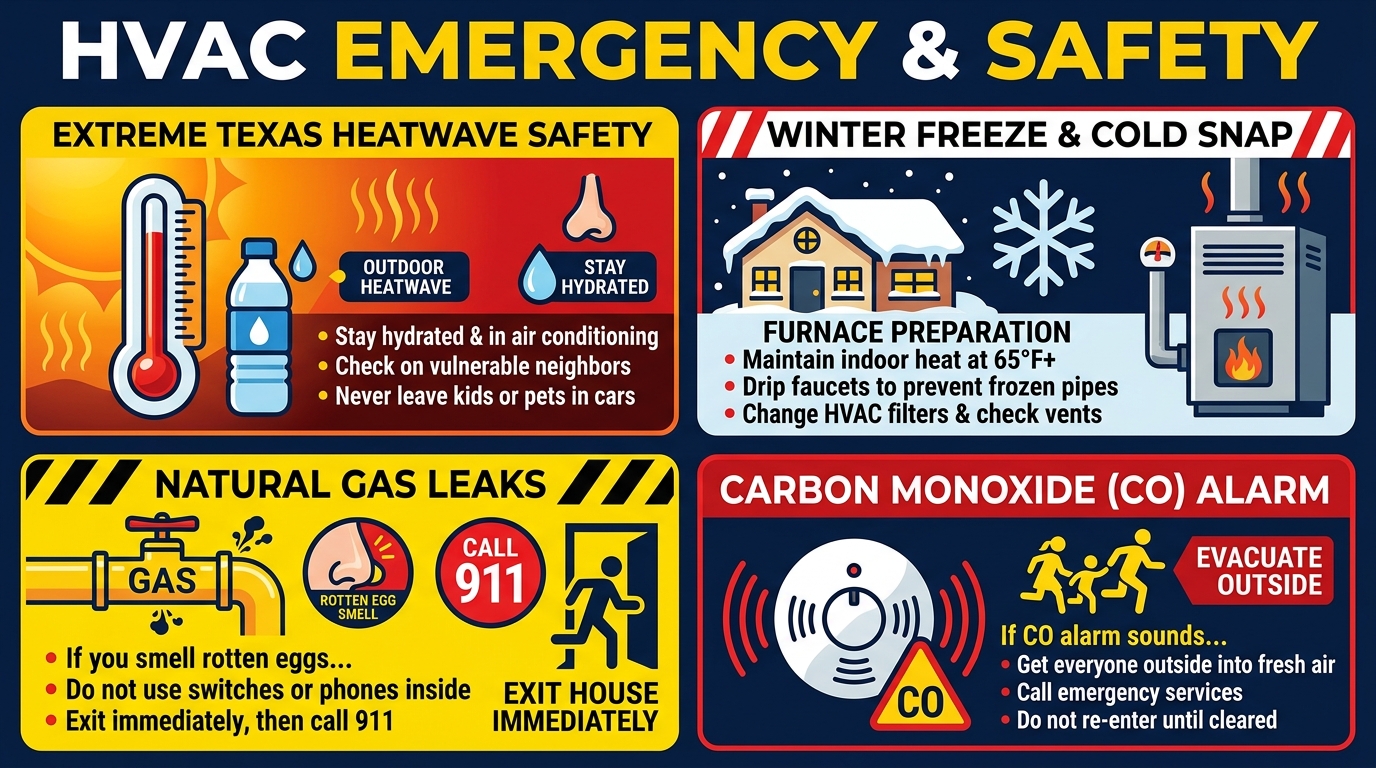
F02-emergency-safety.jpg— Emergency and severe-weather safety: heat illness prevention, freeze preparation. The correct responses to a gas smell or a carbon monoxide alarm. It teaches the four situations in this guide, each with its correct first response.
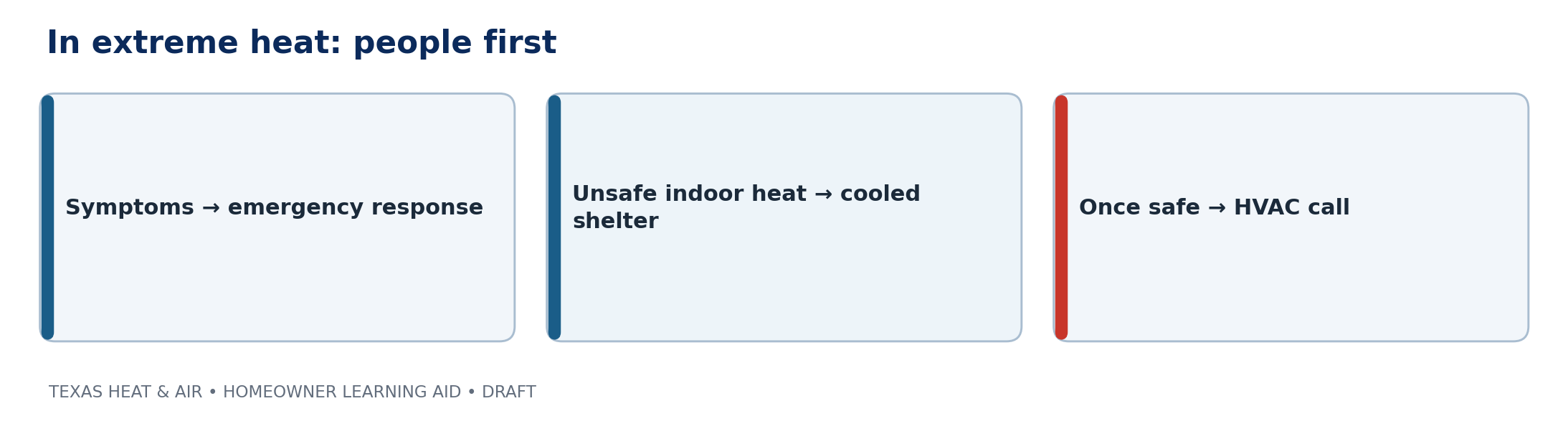
Q096_ac-breakdown-extreme-heat.svg— In extreme heat: people first. Symptoms lead to emergency response, unsafe indoor heat leads to cooled shelter. Only once safe do you make the HVAC call. It teaches the order of operations when the cooling fails in dangerous heat.
The most important comparison in this guide fits in one table:
| What you observe | Kind of emergency | First action |
|---|---|---|
| Rotten-egg gas smell | Danger | Everyone out; no switches or phones inside; 911 and the gas utility from outside |
| Carbon monoxide alarm sounding | Danger | Everyone out into fresh air; 911 from outside; no re-entry until cleared |
| Smoke, flames, or a burning electric smell | Danger | Everyone out; 911 from outside |
| Confusion, collapse, or very hot skin in a hot house | Medical danger | 911 now; move the person somewhere cooler; cool with wet cloths |
| No cooling during a heat wave, nobody ill | Equipment | Protect people from heat first, then quick checks, then call for service |
| No heat on a cold night | Equipment | Call about emergency availability; protect pipes and people while you wait |
| Weak cooling, odd noise, small leak, system short cycling | Not an emergency | Book a regular diagnostic visit |
What you can safely do yourself
During a danger emergency: only leave and call.There is no safe homeowner check for a gas smell or a sounding CO alarm.
Before emergencies — the habits that prevent them:- Test CO alarms monthly. Replace batteries and expired units on schedule. - Run the mild-day heating test before cold weather (15–20 minutes; warm air, rising temperature). - Keep a fresh filter in the system and vents and returns unblocked. - Know where your water shutoff is. How to use it. - Clear loose debris from around the outdoor unit by hand. - Know where you would go: a cooled building in a heat wave, a warm one in a deep freeze. In Texas, 2-1-1 can help find cooling centers during heat events. - Keep 911 and your gas utility's emergency number where the whole household can find them. And make sure everyone at home, teenagers included, knows the gas and CO sequences before the night they need them.
When the failure is system only, and everyone is safe:note the symptoms and thermostat settings, so you can describe them clearly. Check the thermostat and the filter, and look at the breaker once. Do not open system. Do not try to restart a system that smells of burning or gas.
What a technician checks
A technician enters the story only after responders clear a danger emergency. Or right away, when the problem was never dangerous.
After a gas all-clear, a licensed technician inspects the appliance involved and its gas connections. The appliance stays off until it is cleared. After a CO event, the inspection looks for the source in the fuel-burning system: the heat exchanger, burners, and venting.
For an ordinary failure, the visit is the standard diagnostic. The technician confirms the symptom, tests the related parts, explains the finding. Gives a written estimate before any repair.
Deciding what to do next
Use one sorting question:is anyone in danger right now?If yes — a gas smell, a CO alarm, smoke. A person showing heat-stroke signs — the next step is out of the building and 911. Nothing in this guide outranks that.
If no one is in danger, the question becomes how fast the situation is getting worse. A house heating up, with a vulnerable person inside, argues for the after-hours call tonight. If the wait will be long, make the cooled-building decision in parallel. A repair visit is never worth a heat emergency. A cold house on a mild night, with pipes protected and people warm enough under blankets, can reasonably wait for a morning call. Either way, you lose nothing by calling early and describing the situation plainly. Honest answers from you help the office put the calls in the right order.
North Texas notes
This region tests both ends of the thermometer. Long heat waves push indoor temperatures up within hours. Sudden freezes arrive after warm weeks and catch idle heating systems off guard. Atmos Energy gives much of this area's natural gas service. Its emergency guidance is what this guide follows.
Two habits match this climate. Run the mild-day heating test in the fall. And treat the first heat-wave breakdown as a health problem, not a comfort problem. Because here, that is what it is.
Related resources
- Q5 — Is emergency service available after hours? (/hvac-help/after-hours-emergency-hvac-service/)
- Q6 — Do you service homes on weekends and holidays? (/hvac-help/weekend-and-holiday-hvac-service/)
- Q40 — How do I prepare my HVAC system for a North Texas cold snap? (/hvac-help/prepare-hvac-for-north-texas-cold-snap/)
- Q96 — What should I do if the AC breaks during extreme heat? (/hvac-help/ac-breakdown-extreme-heat/)
- Q97 — What should I do if you smell gas by your heater? (/hvac-help/what-to-do-if-you-smell-gas-by-your-heater/)
- Q98 — What if my carbon monoxide alarm sounds? (/hvac-help/what-if-my-carbon-monoxide-alarm-sounds/)
- Guide 1 — Booking an HVAC Service Visit: Scheduling, Dispatch. How to Prepare (/hvac-help/guides/scheduling-and-dispatch/) — the non-emergency process, start to finish.
Texas Heat & Air next step
When the problem is system. Not danger. Call (682) 438-8127 to discuss emergency service availability.

Understanding the system comes first: learn how the pieces work together, use the safe checks. Let a qualified technician confirm anything inside the system.
Related Homeowner Questions
 Do you service homes on weekends and holidays?How do I prepare my HVAC system for a North Texas cold snap?What should I do if the AC breaks during extreme heat?What should I do if I smell gas by my heater?What if my carbon monoxide alarm sounds?

Still Have Questions? Ask an HVAC Expert.
Couldn't find the answer you need? Tell us what's happening. Our team will review your question and contact you to help.
Ask Your Question →Sources
- https://www.cdc.gov/extreme-heat/prevention/ — CDC guidance on preventing heat-related illness: signs of heat exhaustion and heat stroke, cooling strategy. The fan caution (accessed October 13, 2026).
- https://www.cpsc.gov/safety-education/safety-guides/carbon-monoxide/carbon-monoxide-fact-sheet — CPSC Carbon Monoxide Fact Sheet: alarm response, placement. Fuel-burning appliance safety (accessed October 13, 2026).
- https://www.atmosenergy.com/accountcenter/gas/gasemergencyLanding.html — Atmos Energy gas emergency guidance: the leave-first sequence this guide follows (accessed October 13, 2026).
- https://www.ready.gov/heat — Ready.gov on heat preparedness and cooling centers (accessed October 13, 2026).
- Source note: the company-specific details in this article are awaiting confirmation from Texas Heat & Air.