
What if my carbon monoxide alarm sounds?
Treat every CO alarm as real: everyone out into fresh air, 911 from outside, no re-entry until responders measure and clear. Plus placement and prevention.

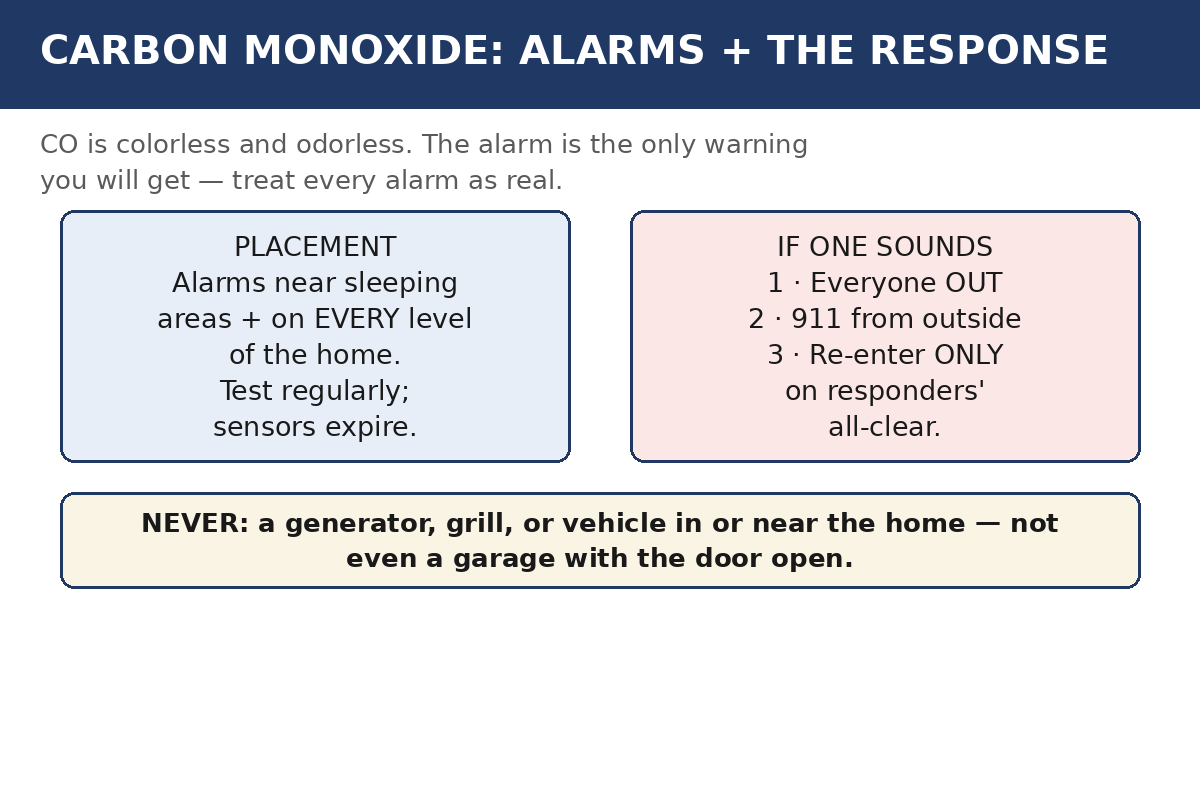
Get everyone, including pets, outside into fresh air right away. Do not search for the source. Do not open windows first. Do not wait to see if it stops. Call 911 or the fire department from outside. Do not go back in until responders say it is safe. They will measure the level.
What you can safely check
During an alarm: nothing. Out first — the checks below are for calm days.
- Test CO alarms often with their test button, and note their age: sensors expire, and an expired alarm is furniture. The replacement date is printed on the unit.
- Never unplug a sounding alarm, pull its battery. Move it somewhere it bothers you less. A sounding alarm with no obvious source is still details. CO can build up from system that cycles, like a furnace that runs at night, and fade by morning.
- Teach the household the pair:smell gas (Q97) — out, then 911. CO alarm — out, then 911.Different dangers, same first step, on purpose.
How this works
Carbon monoxide is a poisonous gas produced when fuel, such as natural gas, burns incompletely. It has no color and no smell, so you cannot detect it yourself. A cracked furnace heat exchanger. The metal chamber inside a gas furnace where fuel burns. A blocked vent. A malfunctioning gas appliance can all produce it.
That creates the trap this page exists to disarm: the alarm is theonlywarning you will get. You cannot smell-check an alarm. Worse, the symptoms of CO poisoning imitate the flu: headache, dizziness, weakness, nausea, upset stomach, chest pain, confusion. Households have talked themselves out of evacuating because of that resemblance. The CPSC's instruction is absolute. This page repeats it without softening: treat every alarm as real.
So: out. Everyone, pets included, into fresh air. Not after a search for the source. Not after opening windows "to air it out." Not after waiting to see whether the alarm resets. From outside or a neighbor's home, call 911 or the fire department. Say if anyone has symptoms. That changes how urgent the response is, and its medical side. Firefighters carry the instruments that measure CO in the air. Their reading, not the alarm's silence, decides re-entry.
Prevention lives in two habits.Alarms:install CO detectors outside each sleeping area and on every level of the home. Test them often and replace them on schedule. Homes with fuel-burning appliances, fireplaces, or attached garages have the exposure. The alarm is the cheapest life-safety device in the building.Maintenance:get regular heating inspections for fuel-burning system (Q63). Those inspections exist largely to catch exchanger and venting problems before they produce CO.
And the outage rule, repeated because it keeps killing people: never run a generator, grill. Vehicle in or near the home. Not in the garage with the door open. Not on a covered porch. Distance is the only safe configuration.
When to call a professional
After responders clear the home, the source hunt belongs to pros. A technician inspects the fuel-burning system. Heat exchanger, burners, venting. For exactly the failures that produce CO. Do not run the furnace again until it has been inspected. An alarm that "went away" because the furnace cycled off has told you nothing about the next cycle. Repeated alarms demand that inspection before the household sleeps easy again.
What happens next
Responders measure, clear the home, and find what they can. Then the system involved gets its post-alarm inspection (Q63 is the routine version; this one is urgent). It returns to service only when a technician clears it. If your alarms are old or untested, checking the date and pressing the test button today is the calm-day version of this whole page.
Related Questions
 What happens during a heating inspection?Why does my heater smell when I first turn it on?

Still Have Questions? Ask an HVAC Expert.
Couldn't find the answer you need? Tell us what's happening. Our team will review your question and contact you to help.
Ask Your Question →Sources
- https://www.cpsc.gov/safety-education/safety-guides/carbon-monoxide/carbon-monoxide-fact-sheet — CPSC: CO properties, alarm response (evacuate, call from outside, no re-entry until cleared), alarm placement, and generator warnings.