
What happens during an AC tune-up?
An AC tune-up is a structured health check. Airflow, coils, electric parts, drainage, cooling performance. Ending in a written report.

A cooling tune-up is a structured health check of the whole system: your concerns and the thermostat first, then airflow, the indoor and outdoor coils, electric parts, the condensate drain, refrigerant performance. A full run test. It should end with a written report of what was found. Repairs are quoted and approved separately.
Visual explanation
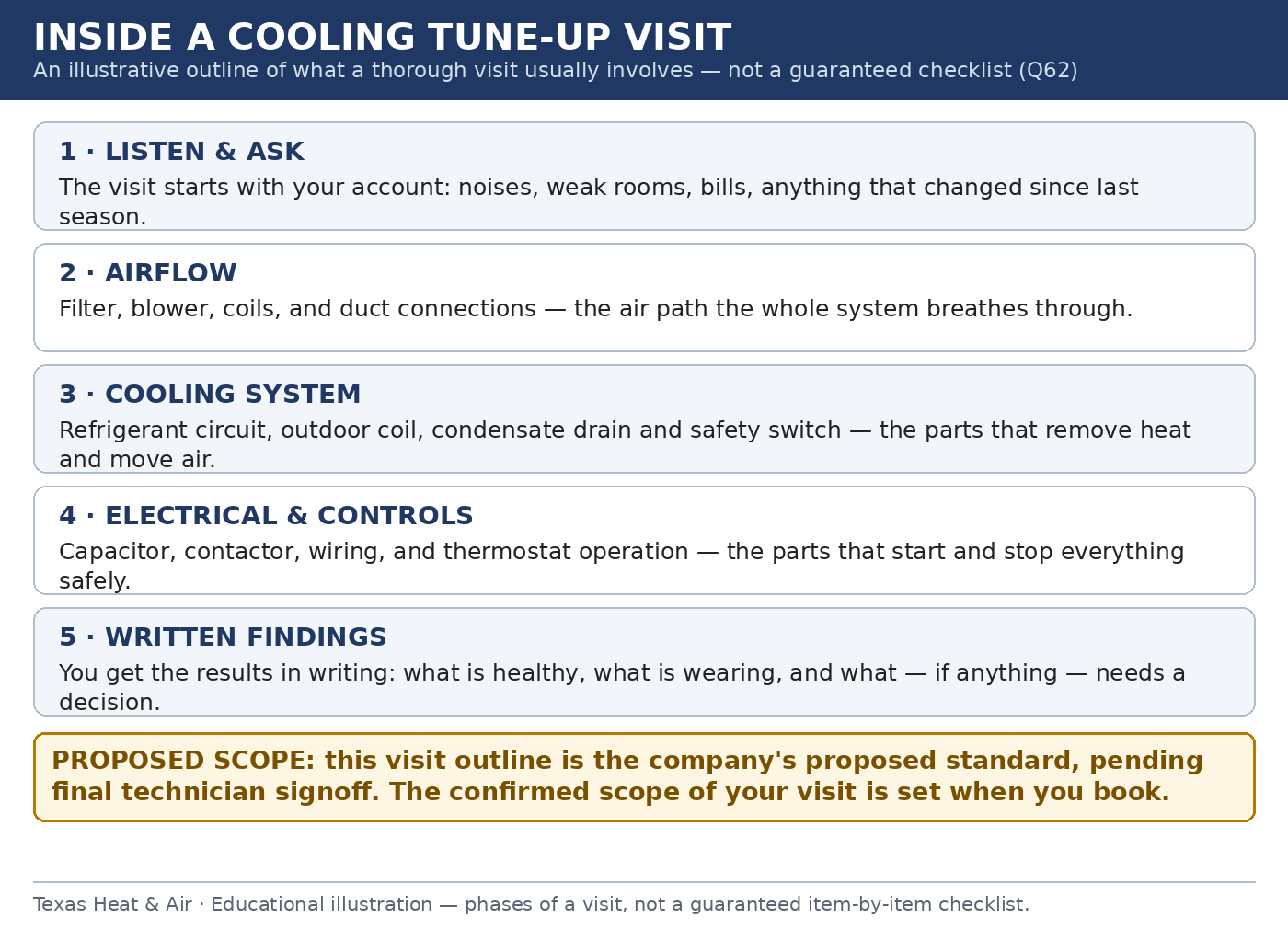
Caption: AC tune-up: a clear sequence. Listen, airflow, cooling system, electric and drain checks, written findings. The detailed visit scope behind this sequence is the proposed visit scope.The diagram teaches the shape of the visit: it begins with listening to you, moves through the air, cooling, electric. Water systems, and finishes with findings in writing.
What you can safely check
- Before the visit, write down symptoms. Noises, weak rooms, water stains, bill changes. And have past service records handy if you keep them.
- Your own part of maintenance is the filter: check it monthly. Everything on the visit list itself involves electric testing, refrigerant measurement, or opening system — technician work.
- Never open panels or test the system's starting parts yourself. Some electric parts store a charge even with the power off.
- Approve any repair work separately from the tune-up, in writing.
What the visit includes
Think of a tune-up as a check-up, not a cleaning visit. Its job is to find small problems while they are still cheap. To confirm the system runs the way the maker intended. ENERGY STAR advises an annual pre-season check-up. Cooling in the spring, before contractors get swamped. And its published checklist is a fair yardstick for any company's visit.
Texas Heat & Air organizes its cooling visits around a maker-informed concept covering 16 areas — the proposed visit scope.It is described here as a concept, not a guaranteed point-by-point promise.
The visit runs in passes:
- Start and controls.Your concerns and the system's history come first. A tune-up that ignores the rattle you hear every afternoon has missed the point. Then the thermostat, the control that tells the system when to run, and the air filter.
- Air path.Supply and return air temperatures. The air going out to your rooms versus the air coming back. Are measured as one reading among several that show how the system is performing. The blower, the fan that pushes air through the house, is inspected. Airflow and accessible ducts are checked. Airflow problems alone can cut a system's efficiency by up to 15 percent.
- Heat path.The indoor coil, the part that pulls heat from indoor air, is inspected. The outdoor unit gets routine cleaning and its fan is checked. Refrigerant performance is evaluated the maker's way. Too much or too little refrigerant both make a system inefficient.
- Electrical.The parts that help motors start and switch power, plus wiring, voltage, current, the disconnect. Safety controls, are tested. Because weak electric parts are the classic cause of a no-cool call on the first 100-degree day.
- Water path.The condensate pan, drain line. Safety switch — the parts that carry away moisture and shut the system down before an overflow damages a ceiling.
- Finish.The compressor's start, run, and shutdown are observed, and everything is written into a System Health Report you keep.
Two honest limits. A tune-up is maintenance, not repair: if the technician finds a failing part, the repair is quoted separately, in writing. Nothing proceeds without your approval. And judge any company's tune-up, including this one, by whether you receive a written report with findings. Not a verbal "all good."
When to call a professional
A tune-up is preventive care for a system that is running. If the system is frozen, leaking near electric parts, or not cooling at all, say so when you book. You may need a diagnostic visit first. The tune-up can follow once the fault is found.
What happens next
Book the cooling visit before the heavy season (Q61). During the visit, expect the passes above and a written System Health Report at the end. Keep the report with your service records — it is the baseline the next visit. Any future warranty question, will be measured against. Ask Texas Heat & Air what maintenance plan options are current. Get the full terms in writing before you enroll.
Texas Heat & Air next step
Booking a tune-up? Call (682) 438-8127 and ask about the current checklist when you book. And expect the written report when the visit ends.
Related Questions
 What happens during a heating inspection?Can tune-ups prevent costly repairs?

Still Have Questions? Ask an HVAC Expert.
Couldn't find the answer you need? Tell us what's happening. Our team will review your question and contact you to help.
Ask Your Question →Sources
- https://www.energystar.gov/saveathome/heating-cooling/maintenance-checklist — ENERGY STAR's maintenance checklist: what a check-up should include, from thermostat settings and electric connections to coils, the condensate drain, refrigerant level. Blower airflow.