
Preventive Maintenance and the Home Comfort Maintenance Plan
Ask Texas Heat & Air what maintenance plan options are current. Get the full terms in writing before you enroll.

An HVAC system rarely fails all at once. It drifts. Coils coat with grime a little more each month. A drain grows a slime layer toward a clog. An electric part weakens a little more every hot afternoon. Preventive maintenance exists to catch that drift while it is still cheap. This guide explains how, in plain language: why the twice-a-year rhythm works, what happens at a cooling tune-up and a heating inspection, what skipping seasons really costs. How to judge a maintenance plan on its written terms.
Ask Texas Heat & Air what maintenance plan options are current. Get the full terms in writing before you enroll.
Key takeaways
- Cooling is checked once a year, ideally in spring; heating once a year, ideally in fall. Between visits, your one regular job is the filter — check it monthly.
- A maintenance visit finds and reports; it does not silently fix. Repairs are quoted in writing and approved by you separately.
- Skipping maintenance does not break a system tomorrow. It lets small, cheap findings compound into large, expensive ones.
- A plan is worth its price only if you will use the visits and benefits. Judge it by its written terms: visits, caps, exclusions, renewal, and cancellation.
- Ask Texas Heat & Air what maintenance plan options are current. Get the full terms in writing before you enroll.
How it works
Systems drift — and drift compounds
Five slow processes do most of the damage, and they feed each other.
Fouling.Dust and grime coat the indoor and outdoor coils. A coated coil moves heat poorly, so the system runs longer to do the same work. Longer runs mean more wear on everything else.
Airflow decline.A loading filter, a dirty blower. Dust in the ducts all narrow the path air travels. With too little air moving, cooling coils can get too cold and freeze. Furnaces can get too hot and shut down on safety limits. Low airflow is the single most common thread in preventable problems.
Water.Cooling wrings moisture out of indoor air. That water drains away through the condensate line. The pipe that carries the water away from the indoor unit. The drain sits damp all season and grows a slime layer. In time it clogs. Then the water goes somewhere it should not, like a ceiling or a closet.
Electrical fatigue.Starting parts weaken with heat and use. A capacitor is an electric part that stores a charge and helps a motor start and run. A contactor is a heavy-duty electric switch that turns the outdoor unit on when the thermostat calls. A weakening capacitor rarely announces itself. It just starts the motor a little harder each day, until one hot afternoon it cannot start it at all.
Sensor and safety drift.Flame sensors foul, safety switches age, and connections loosen. On heating system, the parts that drift include the ones standing guard against carbon monoxide. A poisonous gas with no color and no smell. That is why the fall visit leads with safety, not comfort.
Notice the loop: each process makes the system run longer. Longer run time speeds up all five. Maintenance is the scheduled break in that loop. It is timed just before the season that will stress the system hardest.
A visit finds. It does not silently fix.
One distinction prevents most misunderstandings about maintenance: an inspection and a repair are different products. A tune-up visit examines, measures, and cleans what the service includes. Then it reports. If the technician finds a weak part or a failing part, the repair is a separate step. Quoted in writing, approved by you. Priced on its own. That separation protects you twice. You never pay for work you did not agree to. And the visit's job stays honest, because its purpose is finding the truth about your system, not selling parts.
The written report is the visit's real product. Ask Texas Heat & Air what maintenance plan options are current. Get the full terms in writing before you enroll. It states what was checked, what condition it is in, what needs attention now. What can safely be watched. Kept over the years, those reports become your system's memory. They are the difference between guessing about a part's decline and watching it happen on paper.
The situations homeowners ask about
The rhythm: spring cooling, fall heating
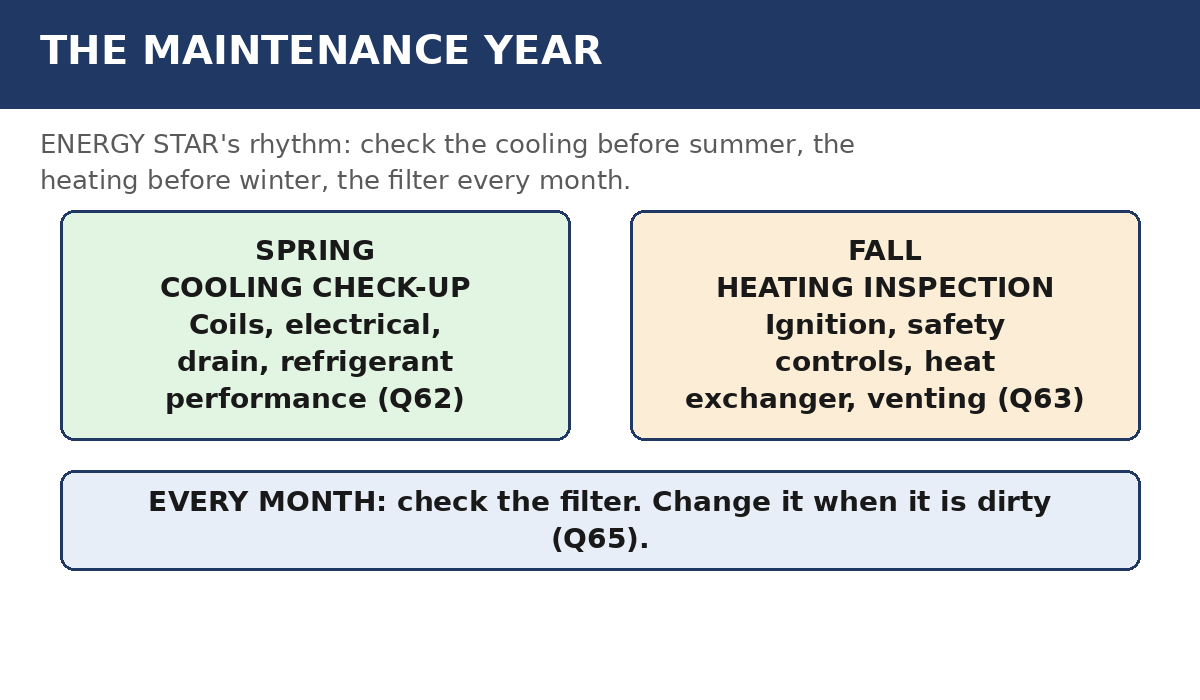
The schedule is simple: one cooling check a year before the heat, one heating check a year before the cold. ENERGY STAR recommends exactly this pre-season pattern. Timing matters because a weak capacitor found in April is an appointment. The same capacitor failing in July is an emergency. Between visits, the only recurring homeowner task is the filter. A monthly look, changed when it is dirty.
The short answer: Q61 — How often should I service my HVAC system? (/hvac-help/how-often-should-i-service-my-hvac-system/)
| Season | Visit | Why then |
|---|---|---|
| Spring | Cooling tune-up | Finds weak starting parts, dirty coils. Slow drains before the first 100-degree week |
| Fall | Heating inspection | Verifies safe ignition, combustion, and controls before the first cold snap |
| Every month | Your filter check | A loaded filter quietly strains everything the visits just checked |
Inside a cooling visit
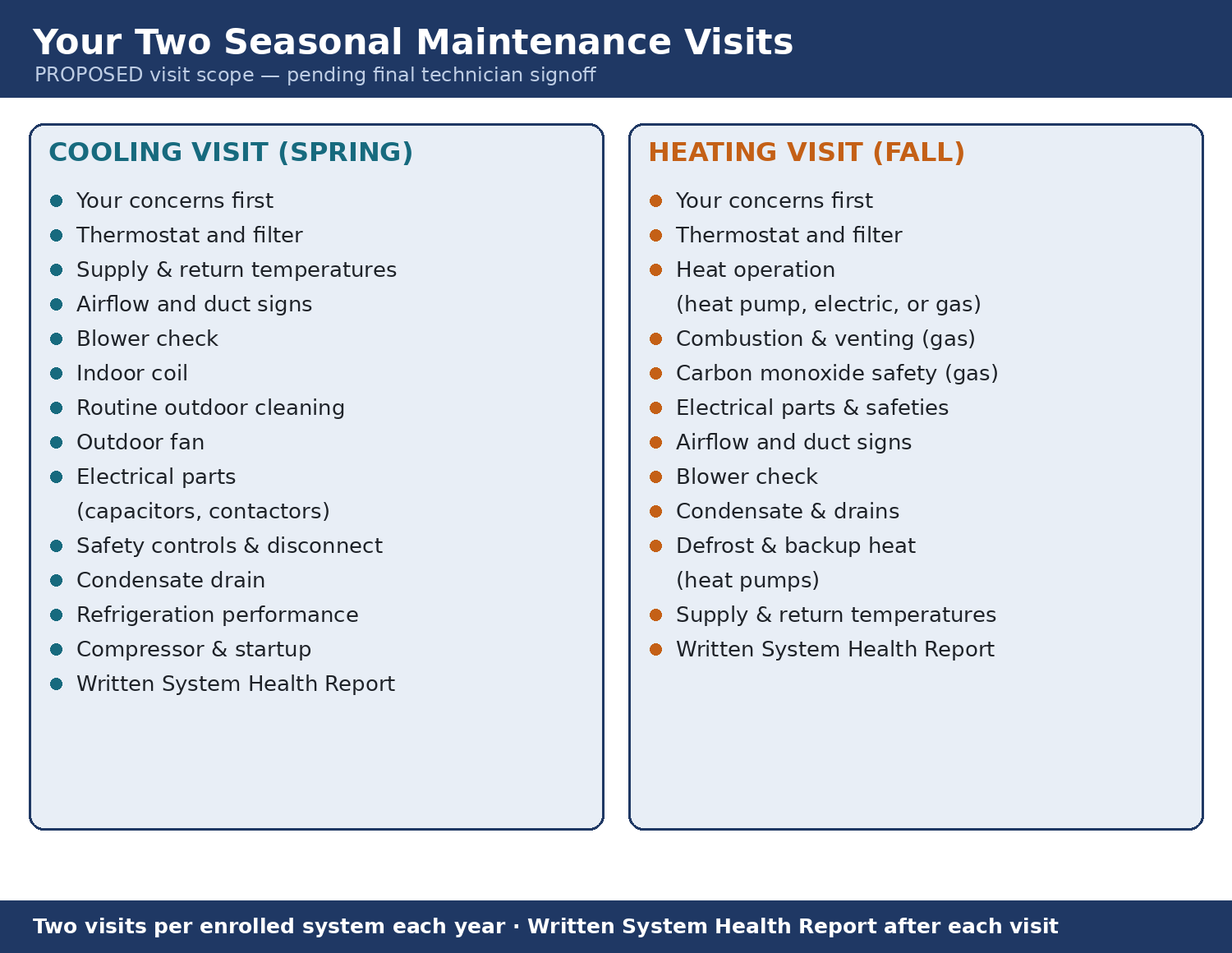
A cooling tune-up moves through the system in a sensible order. It starts with your concerns and the thermostat — does the system start, run. Shut off as it should, and does the thermostat read accurately? Then airflow and the filter. Then the heat-transfer path: the indoor coil, the outdoor unit and its fan, routine outdoor cleaning. Then the electric parts. Capacitors, contactors, safety controls, and the disconnect — tested rather than assumed. Then water: the condensate drain. Then measured performance: supply and return temperatures read in context, refrigeration performance. How the compressor starts and runs. Ask Texas Heat & Air what maintenance plan options are current. Get the full terms in writing before you enroll.
Texas Heat & Air organizes its cooling visits around a proposed scope covering those areas. Treat the list educationally: it is what a thorough cooling visit examines, wherever you have it done. It is the standard to ask any provider about when you book.
The short answer: Q62 — What happens during an AC tune-up? (/hvac-help/what-happens-during-ac-tune-up/)
Inside a heating visit
Safety leads this visit. On a gas furnace, the technician verifies ignition, burner use, the flame sensor, safety limit switches. The heat exchanger and venting. The heat exchanger is the metal chamber where the fuel burns. These are the parts whose failure can produce carbon monoxide. Gas connections and combustion are verified, not assumed. A heat pump gets a different set of checks, because it heats differently: refrigerant use, the defrost cycle. The backup heat. The backup heat must work on the coldest night, even though it sits idle most of the year. Electric heat is checked for proper element and control use. Both visit types share the airflow checks. Filter, blower, vents. Because restricted airflow makes furnaces overheat and heat pumps underperform. The proposed heating scope adapts the same areas to your system type, including combustion, venting. Carbon monoxide safety where fuel is burned.
The short answer: Q63 — What happens during a heating inspection? (/hvac-help/what-happens-during-a-heating-inspection/)
The cost of skipping
Nothing breaks the day you skip a tune-up, which is what makes skipping tempting. The cost arrives as a pattern, not an event. Coils coat and run times stretch, so bills creep up. The drain's slime layer grows toward a clog and a leak. A capacitor weakens toward the hottest afternoon of the year. A flame sensor fouls until heating cycles start failing. Every one of those is a small finding on a maintenance visit. Left alone, each becomes a service call, water damage. A no-cool weekend on its own schedule. Skipping also has a paperwork cost: makers can need reasonable care. Missing service records can complicate a warranty claim. You do not need a perfect record. You need a regular one.
The short answer: Q66 — What happens if you skip HVAC maintenance? (/hvac-help/what-happens-if-you-skip-hvac-maintenance/)
Can a tune-up actually prevent an expensive repair?
Often, yes — and the mechanism is plain. Many expensive failures begin as cheap findings. A drain cleared during a visit never overflows into a ceiling. A capacitor testing weak in spring gets replaced on a schedule instead of failing in a heat wave. When it can take a fan motor with it. A loose connection, tightened, never arcs and burns a control board. A dirty coil, cleaned, stops straining the compressor on every cycle. What a tune-up cannot do is repeal age: compressors and motors wear out even on well-kept systems. No plan can promise a failure-free system. Judge a visit by whether you receive real findings. Measurements and a plain report of condition. Not by whether it was sold as insurance against all breakdowns.
The short answer: Q67 — Can tune-ups prevent costly repairs? (/hvac-help/can-tune-ups-prevent-costly-repairs/)
Is a maintenance plan worth it? Run the test on any plan
A plan is a bundle, and bundles reward a little math. Add up the value of what you would genuinely use: the visits themselves, any scheduling priority, any repair discount. Extras like written reports and filter handling. Compare that total to the plan's price. A plan wins when you would otherwise skip or forget visits. The structure itself is part of the value. It loses when its visits duplicate what you would buy anyway at the same price with nothing added.
Before signing anything, ask five questions. How many visits, for which system, and in which seasons? What exactly counts as a "system" for pricing? Do discounts have caps or exclusions — and do they stack? What are the term, renewal, and cancellation rules, in writing? And what is not included? The next section answers all five for Texas Heat & Air's plan, in full, so you can run the test on real numbers.
The short answer: Q68 — Is an HVAC maintenance plan worth it? (/hvac-help/is-an-hvac-maintenance-plan-worth-it/)
Ask Texas Heat & Air what maintenance plan options are current, and get the full terms in writing before you enroll.
Ask Texas Heat & Air what maintenance plan options are current. Get the full terms in writing before you enroll. There is no online checkout.
What a system means.One complete paired heating and cooling system. The indoor and outdoor parts together — counts as one system. Ask Texas Heat & Air what maintenance plan options are current. Get the full terms in writing before you enroll.
Price.Costs vary by home, system, and repair. Ask Texas Heat & Air for a written estimate before work begins.
What each system receives.Ask Texas Heat & Air what maintenance plan options are current. Get the full terms in writing before you enroll. Ask Texas Heat & Air what filter help is included during a visit, what stocked filters cost, and what happens to unused visits at the end of a term.
Scheduling priority.Ask Texas Heat & Air what maintenance plan options are current. Get the full terms in writing before you enroll. Life-safety emergencies are always triaged first, ahead of membership status. Priority is not a guaranteed response or arrival time.
Repair benefit.Costs vary by home, system, and repair. Ask Texas Heat & Air for a written estimate before work begins. Ask Texas Heat & Air what the repair benefit covers, whether it applies to the diagnostic fee, and whether it can be combined with other offers.
Replacement benefit.Ask Texas Heat & Air what maintenance plan options are current. Get the full terms in writing before you enroll. Ask Texas Heat & Air whether this benefit can be combined with other promotions.
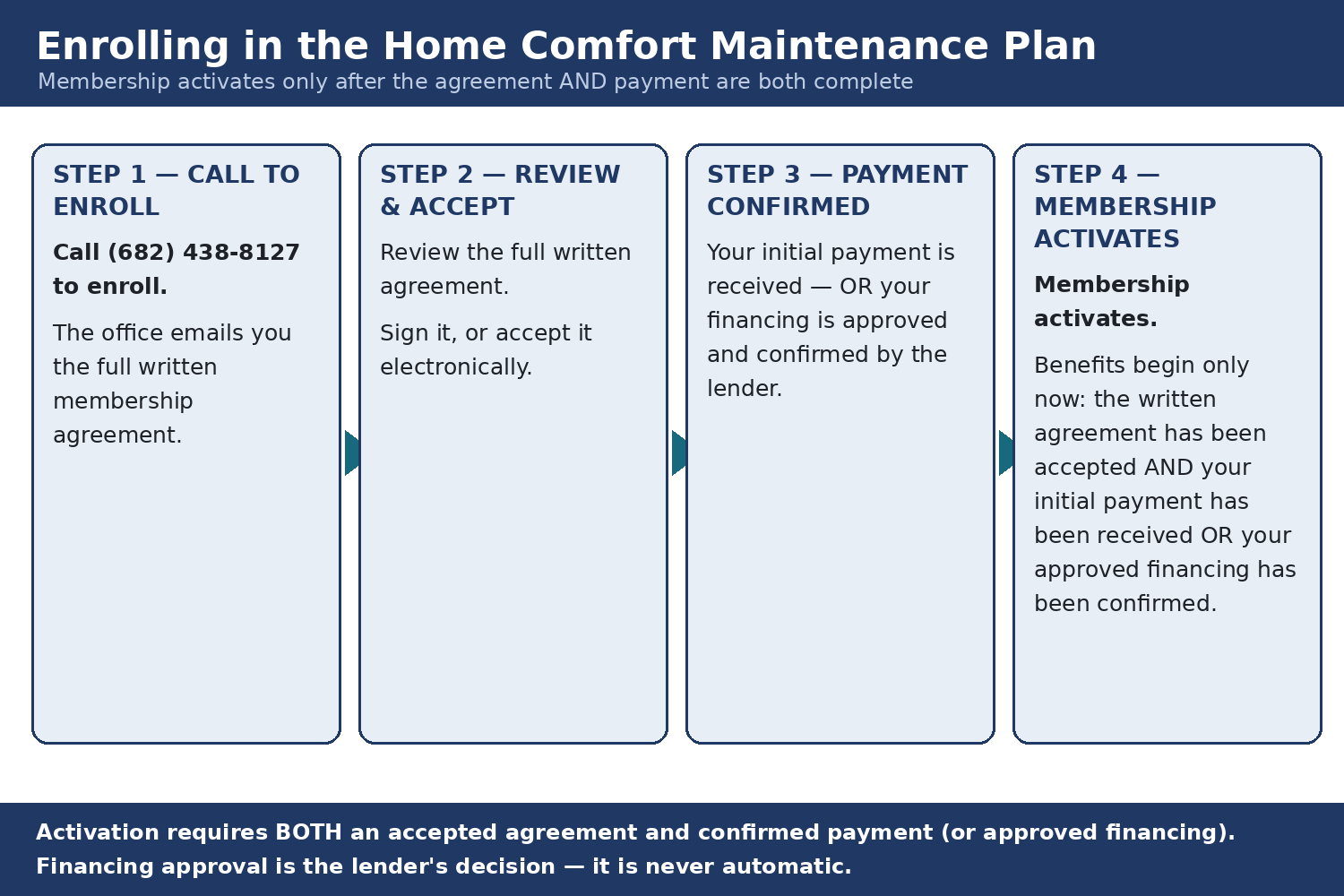
Ask Texas Heat & Air what maintenance plan options are current. Get the full terms in writing before you enroll. Financing, where used, is subject to lender approval and is never automatic or guaranteed. Your signed terms are stored, and you receive a customer copy.
Commitment and renewal.Ask Texas Heat & Air what the plan term, payment schedule, renewal, and cancellation terms are, and get them in writing before you enroll. Ask Texas Heat & Air what maintenance plan options are current. Get the full terms in writing before you enroll. Ask Texas Heat & Air how renewal works and what notice you will receive before a term renews.
Cancellation.Ask Texas Heat & Air how cancellation works, what happens to payments you have made and to unused visits, and what confirmation you will receive — and get the terms in writing before you enroll.
What the plan is not.Ask Texas Heat & Air what maintenance plan options are current. Get the full terms in writing before you enroll.
The short answer: Q69 — What does a Texas Heat & Air maintenance plan include? (/hvac-help/home-comfort-maintenance-plan/)
Diagrams and comparisons
F10R-maintenance-visits.png—Ask Texas Heat & Air what maintenance plan options are current. Get the full terms in writing before you enroll.The diagram's teaching point is that the two visits are matched to their seasons: the cooling visit centers on airflow, coils, electric starting parts, drainage. Measured refrigeration performance, while the heating visit adds combustion, venting. Carbon monoxide safety on fuel-burning system.
Ask Texas Heat & Air what maintenance plan options are current. Get the full terms in writing before you enroll.—Ask Texas Heat & Air what maintenance plan options are current. Get the full terms in writing before you enroll.The flow exists to prevent the most common membership misunderstanding. That a phone call or a financing application alone starts the plan. Neither does. Ask Texas Heat & Air what maintenance plan options are current. Get the full terms in writing before you enroll.
b3-12-q61-twice-a-year-calendar.png—Twice-a-year care: cooling checked in spring, heating checked in fall, filters monthly between visits.The calendar shows the whole rhythm on one page: two pro visits a year, each timed before its hard season, with your monthly filter check in between.
The table below compares the three ways homeowners buy this care:
| Book visits as needed | Maintenance plan | |
|---|---|---|
| Visits | When you remember to book | Ask Texas Heat & Air what maintenance plan options are current. Get the full terms in writing before you enroll. |
| Findings | Written report after a diagnostic or service visit | Ask Texas Heat & Air what maintenance plan options are current. Get the full terms in writing before you enroll. |
| Repair pricing | Standard pricing | Ask Texas Heat & Air to confirm the diagnostic fee when you book. |
| Replacement pricing | written estimate | Costs vary by home, system, and repair. Ask Texas Heat & Air for a written estimate before work begins. |
| Scheduling | Standard | Ask Texas Heat & Air what scheduling priority, if any, a plan includes; life-safety triage always first |
| Commitment | None | Ask Texas Heat & Air what maintenance plan options are current. Get the full terms in writing before you enroll. |
What you can safely do yourself
- Check your filter every month and change it when it is dirty. The single highest-value homeowner task in this guide.
- Keep supply vents open and return vents uncovered by furniture.
- Keep the area around the outdoor unit clear of leaves, grass, and stored items.
- Write down symptoms between visits. New noises, weak rooms, water near the unit, rising bills. And hand the list to the technician. Symptoms point the visit the right way.
- Ask Texas Heat & Air what maintenance plan options are current. Get the full terms in writing before you enroll. Records are what turn a warranty question into a simple lookup.
- Ask Texas Heat & Air what maintenance plan options are current. Get the full terms in writing before you enroll.
What a technician checks
A maintenance visit is measurement, not impression. Depending on the season, the technician verifies thermostat use and inspects and tests electric connections and starting parts. The technician checks coils and airflow, and clears and tests the condensate drain. The technician also reads operating temperatures and refrigeration performance against how the system should behave. On heating system, the safety checks come first: ignition, burners, flame sensing, and limit switches. On fuel-burning systems, the heat exchanger and venting are checked too. They are what keep carbon monoxide out of your air. Findings are separated into three honest piles: fine, watch, and repair. Any repair is quoted in writing for your approval, never folded silently into the visit.
Making the decision
Work through it in this order. First, decide whether you will keep a twice-a-year rhythm on your own. If yes, book spring and fall visits as needed and keep records. If experience says you will forget. And most people do. A plan's reminders and structure are part of what you are buying. Second, price the visits you would use against the plan price. Weigh the repair and replacement benefits realistically: a repair benefit you never claim is worth nothing. One repair in a year can return much of a year's plan price. Third, count your systems honestly: a two-system home pays the first-system price once. The lower extra-system price for the second. Ask Texas Heat & Air what maintenance plan options are current. Get the full terms in writing before you enroll. The plan in this guide publishes all of those terms above, precisely so this decision can be made from the document, not from a sales conversation.
North Texas notes
North Texas systems work a long cooling season. Many more runtime hours per year than the same system in a milder climate. That is why drift builds up faster here. Why the spring visit matters so much. A weak starting part found in April is a scheduled repair. In a July heat wave. When every company in the Metroplex is booked out, it is a miserable wait. The fall visit earns its keep differently: North Texas cold arrives in snaps, not seasons. The first hard freeze is the worst time to learn that backup heat or a flame sensor has quietly failed.
Related resources
- Q61 — How often should I service my HVAC system? (/hvac-help/how-often-should-i-service-my-hvac-system/)
- Q62 — What happens during an AC tune-up? (/hvac-help/what-happens-during-ac-tune-up/)
- Q63 — What happens during a heating inspection? (/hvac-help/what-happens-during-a-heating-inspection/)
- Q66 — What happens if you skip HVAC maintenance? (/hvac-help/what-happens-if-you-skip-hvac-maintenance/)
- Q67 — Can tune-ups prevent costly repairs? (/hvac-help/can-tune-ups-prevent-costly-repairs/)
- Q68 — Is an HVAC maintenance plan worth it? (/hvac-help/is-an-hvac-maintenance-plan-worth-it/)
- Q69 — What does a Texas Heat & Air maintenance plan include? (/hvac-help/home-comfort-maintenance-plan/)
- Guide 11 — Air Filters, Indoor Air Quality, and Safe Homeowner Maintenance (/hvac-help/guides/filters-and-indoor-air-quality/)
Texas Heat & Air next step
Ask Texas Heat & Air what maintenance plan options are current. Get the full terms in writing before you enroll.

Understanding the system comes first: learn how the pieces work together, use the safe checks. Let a qualified technician confirm anything inside the system.
Related Homeowner Questions
 What happens during an AC tune-up?What happens during a heating inspection?What happens if I skip HVAC maintenance?Can tune-ups prevent costly repairs?Is an HVAC maintenance plan worth it?What does a Texas Heat & Air maintenance plan include?

Still Have Questions? Ask an HVAC Expert.
Couldn't find the answer you need? Tell us what's happening. Our team will review your question and contact you to help.
Ask Your Question →Sources
- https://www.energystar.gov/saveathome/heating-cooling/maintenance-checklist — ENERGY STAR's maintenance checklist: the pre-season check-up pattern, monthly filter checks. What a check-up should include
- https://www.cpsc.gov/safety-education/safety-guides/carbon-monoxide/carbon-monoxide-fact-sheet — CPSC carbon monoxide fact sheet: why fuel-burning system needs combustion and venting checks
- Source note: the company-specific details in this article are awaiting confirmation from Texas Heat & Air.