
Refrigerants, Leak Detection, and the New Environmental Rules
Ask Texas Heat & Air about the training and credentials of the technician coming to your home.

Refrigerant is the fluid sealed inside your system's loop. It carries heat — taking it in indoors and letting it go outdoors in summer. You never see it. But it is the part of your cooling system that homeowners are most often misled about. When something goes wrong with it, the sales pitches start: a "top-off" you do not need, a vague leak quote. A warning that new government rules force you to replace a working AC.
This guide tells the whole subject as one connected story. You will learn how refrigerant moves heat in a sealed loop. You will learn why a low charge points to a leak or a charging mistake. And why only testing can tell which. You will learn where leaks start, how technicians find them. What a proper repair includes. And you will learn what the federal refrigerant phase-down does. And does not. Mean for the system already in your yard.
Key takeaways- Your system does not use up refrigerant. If the charge is low, refrigerant leaked out. The charge was wrong when it was put in. A technician has to test to confirm which. - A proper leak repair has three steps: find the leak, fix it, then restore the exact charge. A top-off alone rents you the same problem next season. - Refrigerant handling is certified-technician work by federal law. Your part is observation and records, not tools. - New federal rules govern new system. Your working R-410A system stays repairable for its useful life. - Refrigerants are not interchangeable. Treat any "conversion" pitch for your existing unit with deep skepticism.
How it works
The loop that never empties
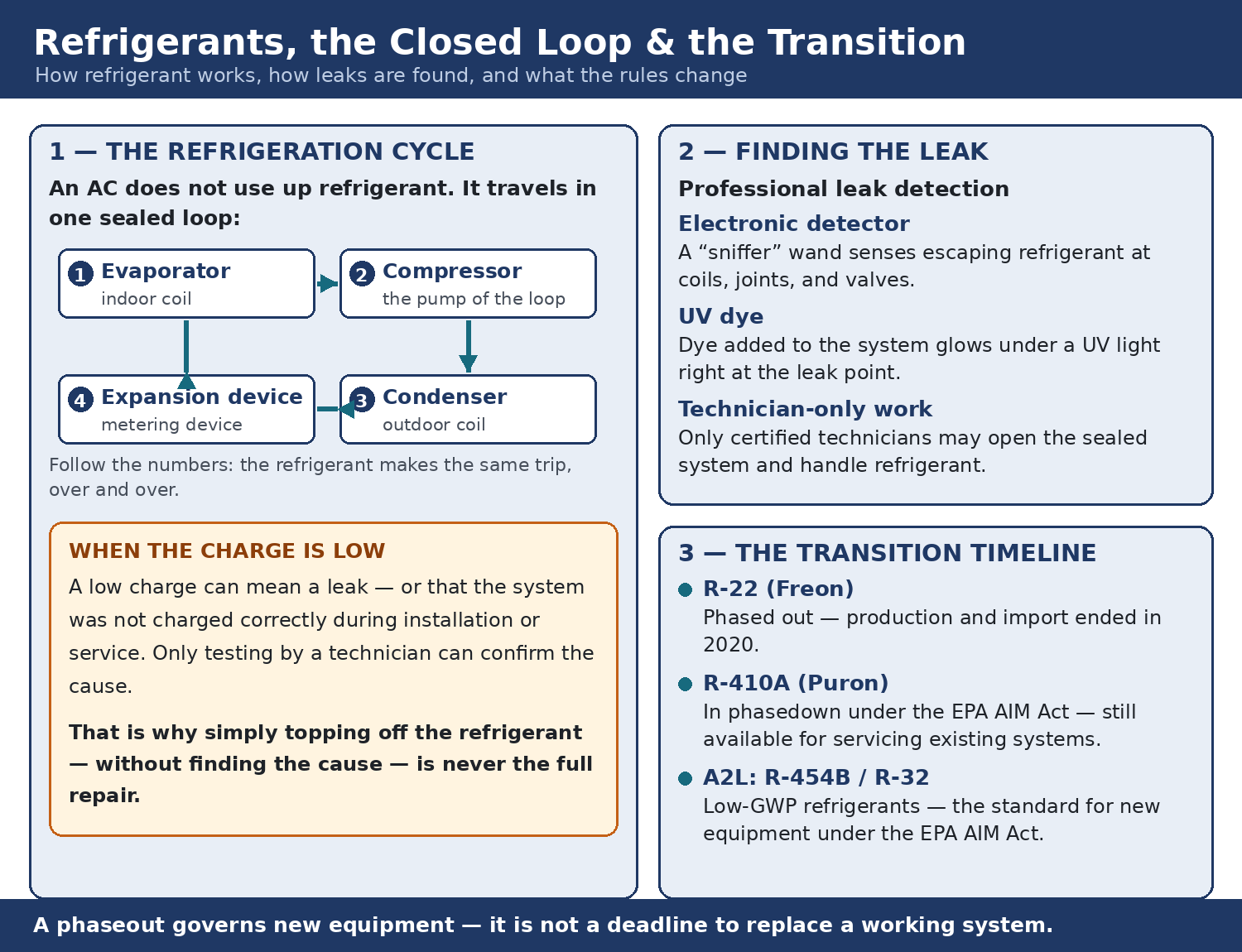
An AC does not make cold air. It moves heat. Refrigerant does the carrying, in a sealed copper loop with four stops:
- Indoor coil (evaporator coil).The evaporator coil is the indoor coil, where refrigerant absorbs heat from indoor air. The air blown into your rooms comes out cooler and drier. Here, liquid refrigerant takes in heat and turns into a gas.
- Compressor.The compressor is the pump in the outdoor unit. It squeezes the gas and sends it around the loop. Squeezing concentrates the heat the gas carries.
- Outdoor coil (condenser).The condenser is the outdoor coil, where hot refrigerant releases the heat it picked up indoors. The outdoor fan blows air across it. The gas turns back into a liquid.
- Expansion (metering) device.This small device lets the pressure drop. The liquid cools sharply. Then the cycle starts again.
The refrigerant itself is never used up. The same charge goes around the loop for the life of the system. That one fact explains most of this guide. If the charge is low, one of two things happened. Refrigerant leaked out. Or the right amount was never put in. At installation, or during a past repair. Only testing can tell you which one.
Why the exact charge matters
Each system is charged to the maker's specification. The exact amount it was built to hold. A technician measures the charge by weight. Readings of pressure and temperature confirm it. Too little refrigerant, and the coil cannot take in heat at full strength. Cooling fades. Run times stretch. The coil can freeze. Too much, and pressures climb while efficiency falls. There is no "close enough." Extra refrigerant does not help.
This is also why a recharge with no diagnosis is money spent blind. If refrigerant leaked out, the new charge follows it out.
Where leaks start, and why they grow
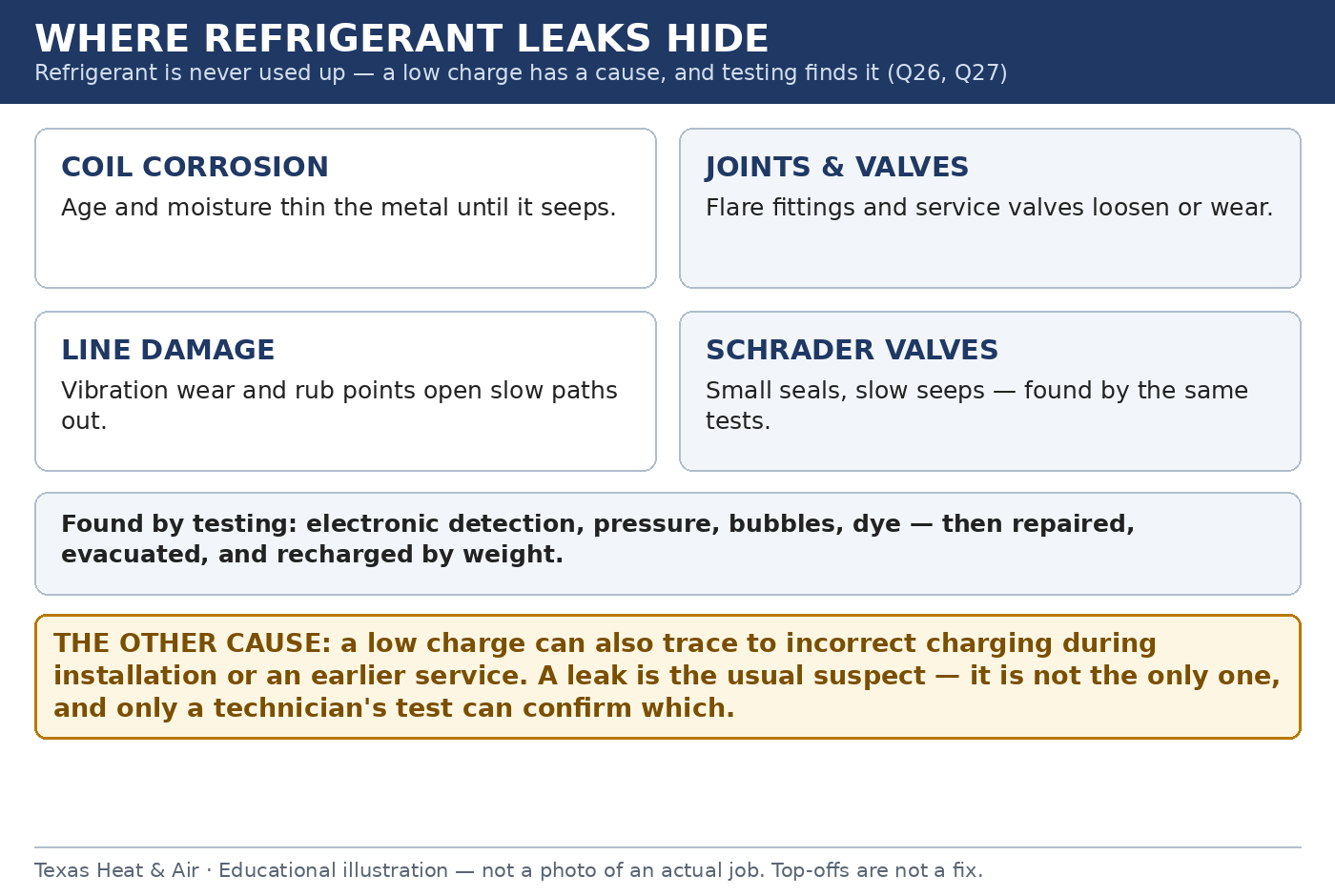
Leaks cluster in predictable places. On aging systems, the indoor coil is the most common site. Thin copper and aluminum react slowly with household air and moisture. Over years, tiny pinholes form. The process is called formicary corrosion. Vibration is the second family. The compressor's constant motion rubs lines against each other, or against the cabinet, until a spot wears through. Connections and service valves seep as their seals age. Physical damage finishes the list. A line nicked during other work, or a coil fin crushed.
A leak is not a fixed, stable problem. Escaping refrigerant carries a small amount of the system's lubricating oil out with it. A low charge makes the compressor run hotter and longer. Small leaks also tend to grow. That chain — leak, low charge, longer runs, compressor stress — is why "just add some every summer" quietly shortens a system's life. It never fixes anything.
How leaks are actually found
A leak you can hear hissing is the exception. Most leaks are slow and invisible. So technicians hunt with instruments. They wave electronic detectors — "sniffers" — along coils, joints, and valves. They use ultraviolet dye that glows at the leak point under a black light. They pressure-test the loop to prove whether it holds. The dye has a second advantage. It stays in the system. A leak too slow to find today can still show itself at a later visit, instead of starting the hunt over. Finding the leak is skilled work, and it comes before any repair exists. Skipping it gives the worst outcome in this category: fresh refrigerant pumped into a hole nobody found.
Three generations of refrigerant
- R-22(older systems, mostly before 2010): phased out. Production and import ended in 2020. What remains is reclaimed stock, which is why R-22 repairs keep getting more expensive.
- R-410A(most systems installed from the 2010s on): the current installed base. Under the federal AIM Act, its supply steps down over time. But it stays available for servicing existing system.
- A2L refrigerants such as R-454B and R-32(new system shipping now): much lower global-warming potential. "A2L" is a safety classification. It means mildly flammable. New system is built for it, with sensors and airflow requirements included.
Each generation runs at different pressures. Each uses different oils. Each is designed into the system built for it. That is why one refrigerant cannot be swapped into a system built for another.
The situations homeowners ask about
"The cooling fades a little more every summer"
A slow fade is the classic leak pattern. Cooling weakens over weeks. Ice forms on the refrigerant lines or the indoor coil. Run times grow longer for the same comfort. The cause is usually one of the four leak families above: coil corrosion, vibration wear, a seeping connection, or damage. The order of work matters: find it, fix it, then recharge. Reversing that order — recharge first, ask questions later — is how a homeowner ends up buying the same refrigerant every year.
The short answer: Q26 — What causes a refrigerant leak? (/hvac-help/what-causes-a-refrigerant-leak/)
"The technician says I'm low — for the second year in a row"
When a charge measures low, two explanations are honest. One: the system was undercharged at installation, or left short after a repair. That is plausible exactly once, right after the work. Its fingerprint is a system that never cooled quite right from that day on. Two: refrigerant is escaping through a leak. If your records show refrigerant added in back-to-back seasons, you already know which explanation fits. Keep those service records. A note that refrigerant was added last summer is real evidence. It changes the conversation from "another top-off" to "leak detection, please." The money argues the same way. A recharge is a buy you repeat, for refrigerant already on its way out. Detection is paid once, and it ends the cycle.
The short answer: Q27 — Does low refrigerant always mean a leak? (/hvac-help/does-low-refrigerant-always-mean-a-leak/)
"What am I actually paying for in a leak repair?"
There is no single price, because "leak repair" is three jobs wearing one name. Detection takes time and special instruments. The repair itself decides the range. Tightening or replacing a failed connection is a contained job. A corroded indoor coil can mean replacing the coil. A major repair that belongs in a repair-versus-replace conversation. Then the loop must be emptied of air and moisture and recharged to the maker's specification. Refrigerant is priced by type and amount — one reason older refrigerants cost more. What you should expect is a written estimate that lists the stages and explains how the leak will be fixed for good. A quote that offers only to "top it off" is not a repair quote at all.
The short answer: Q56 — How much does a refrigerant leak repair cost? (/hvac-help/refrigerant-leak-repair-cost/)
"Does my brand change any of this?"
Very little. Most home brands share the same core parts. Compressors, motors, capacitors (electric parts that help motors start and run), controls. Refrigerant circuits. The leak families in this guide are industry categories, not brand categories. Ask Texas Heat & Air which brands it services before you book. It does not claim authorized-dealer status for any of them. Brand and model do affect parts sourcing and maker warranty handling. So have both numbers from the system label ready when you call.
The short answer: Q79 — What system brands can Texas Heat & Air repair? (/hvac-help/what-system-brands-can-texas-heat-and-air-repair/)
"Someone told me the government is making me replace my AC"
That claim is a sales pitch wearing a regulation's clothing. The AIM Act phase-down sets what makers may build and sell going forward. It does not set a deadline for the system in your yard. The EPA's own guidance says existing R-410A system can keep being serviced. R-410A remains available for repairs. The honest long-term point is slower. Over many years, parts and refrigerant for older platforms grow scarcer and cost more. That trend is far advanced for R-22. It is only beginning for R-410A. The trend counts when a major repair is already on the table. It is never a reason to replace a working system today.
The short answer: Q80 — Do new refrigerant rules mean I must replace my AC? (/hvac-help/do-new-refrigerant-rules-mean-i-must-replace-my-ac/)
Diagrams and comparisons
Refrigerant basics in three panels: the sealed loop through all four parts — evaporator, compressor, condenser. Expansion (metering) device. How technicians detect leaks; and the change from R-22 to R-410A to low-GWP A2L refrigerants. This is the guide's map. Everything above is one of these three panels explained in words.
Where refrigerant leaks hide: coil corrosion, joints and valves, line damage from vibration wear, and Schrader valve seeps. A teaching diagram — not a photo of an actual job. It teaches the four leak families. That finding a leak is a testing job, not a guessing job.
| R-22 | R-410A | A2L (R-454B, R-32) | |
|---|---|---|---|
| Where you find it | Systems mostly installed before 2010 | Most systems installed from the 2010s on | New system shipping now |
| Regulatory status | Phased out; production/import ended 2020 | In federal phase-down; still available for service | The low-GWP replacement generation under the AIM Act |
| What it means for you | Repairs keep getting pricier as reclaimed supply shrinks | Keep repairing your system; no replacement deadline | Only relevant when you buy new system. It cannot be put into an older system |
What you can safely do yourself
- Watch the pattern.Cooling fading over weeks, ice on the lines. Longer run times are worth writing down, with dates.
- Keep service records.Every refrigerant addition, with the date and amount, is evidence. It helps separate a leak from a one-time undercharge.
- Read the outdoor unit's label.Your refrigerant type is printed on it. You can read it without opening any covers.
- Listen once, then call.A hiss near the lines, with a sudden loss of cooling, can mean an active leak. Turn the system off and call promptly.
- Do not touch refrigerant lines, fittings, or service valves. Never try to add refrigerant.By federal law, only technicians certified under EPA Section 608 may handle refrigerant. This is never homeowner work.
What a technician checks
- The actual charge, checked against the maker's specification.Pressure and temperature readings show whether the system is undercharged, correct, or overcharged — and by how much.
- Leak detection at the likely sites.Electronic detection along the indoor coil, connections, and service valves. Ultraviolet dye or pressure testing when the leak is hard to find. The goal is a located leak, not a suspicion.
- Coil condition.A corroded indoor coil is the most common leak source on aging systems. It drives the decision between repairing the coil and replacing it.
- The repair itself — then emptying and recharging the loop.Air and moisture come out first. Then the correct charge goes in, weighed to specification.
- A written diagnostic report and a written repair estimate.You approve them before any repair begins.
Making the decision
Three questions sort most refrigerant problems. First: has the leak beenfound? If not, detection is the buy — not refrigerant. Second: what failed — a connection, or the coil? A connection repair is usually straightforward. A coil replacement on an older system deserves a side-by-side comparison with a new system, with written numbers for both. Third: how old is the platform? The same coil repair means something different on a ten-year-old R-410A system, with years of service ahead, than on an R-22 system whose refrigerant gets scarcer every year. A top-off answers none of these questions. If a quote skips the detection step, or promises a refrigerant "conversion," get a second opinion before you spend anything.
North Texas notes
North Texas cooling seasons are long and hot. That changes how refrigerant problems show up. A system here can run for months at a stretch. A small leak that might take two seasons to matter in a mild climate can drain enough charge in one Texas summer to ice a coil during a July heat wave. Right when you can least afford the failure. High humidity also feeds the moisture side of coil corrosion. The practical lesson: in this region, a fading-cooling pattern in spring is worth acting on before peak season, not after it.
Related resources
- Q26 — What causes a refrigerant leak? (/hvac-help/what-causes-a-refrigerant-leak/)
- Q27 — Does low refrigerant always mean a leak? (/hvac-help/does-low-refrigerant-always-mean-a-leak/)
- Q56 — How much does a refrigerant leak repair cost? (/hvac-help/refrigerant-leak-repair-cost/)
- Q79 — What system brands can Texas Heat & Air repair? (/hvac-help/what-system-brands-can-texas-heat-and-air-repair/)
- Q80 — Do new refrigerant rules mean I must replace my AC? (/hvac-help/do-new-refrigerant-rules-mean-i-must-replace-my-ac/)
- Guide 3 — Why Your Air Conditioner Is Not Cooling (/hvac-help/guides/ac-not-cooling/) — low refrigerant is one branch of the not-cooling decision tree
- Guide 7 — Repair Versus Replace: Making a Smart HVAC Investment (/hvac-help/guides/repair-or-replace/) — for the coil-repair-versus-new-system comparison
Texas Heat & Air next step
If your system is fading, icing. Has needed refrigerant more than once, the next step is a diagnostic visit — not another top-off. Ask Texas Heat & Air to confirm the diagnostic fee when you book. You receive a written diagnostic report and a written repair estimate. No repair begins until you approve it. Call (682) 438-8127 with your brand and model number handy.

Understanding the system comes first: learn how the pieces work together, use the safe checks. Let a qualified technician confirm anything inside the system.
Related Homeowner Questions
 Does low refrigerant always mean there is a leak?How much does a refrigerant leak repair cost?What equipment brands can Texas Heat & Air repair?Do new refrigerant rules mean I must replace my AC?

Still Have Questions? Ask an HVAC Expert.
Couldn't find the answer you need? Tell us what's happening. Our team will review your question and contact you to help.
Ask Your Question →Sources
- https://www.epa.gov/hfcs/frequent-questions-phasedown-hydrofluorocarbons — U.S. EPA: the HFC phase-down governs new system; existing R-410A systems remain serviceable and refrigerant stays available for repairs
- https://www.epa.gov/section608/section-608-technician-certification-requirements — U.S. EPA: refrigerant handling is reserved to Section 608 certified technicians
- https://www.carrier.com/us/en/residential/hvac-resources/air-conditioners/ac-not-blowing-cold-air/ — Carrier: low-refrigerant symptoms and frozen-coil guidance
- https://www.energystar.gov/saveathome/heating-cooling — ENERGY STAR heating and cooling hub: system use and maintenance context