
Why does my AC drain keep clogging?
One clog is buildup; a clog every season is a line problem — slope, venting, or damage. What grows in that pipe, and what a lasting fix inspects.

The drain line carries away the water your AC pulls from the air. Dust, algae. Slime build up in that dark, wet pipe until water backs up. Tripping the safety switch or overflowing into your home. A drain that clogs every season usually has a line problem, not just buildup.
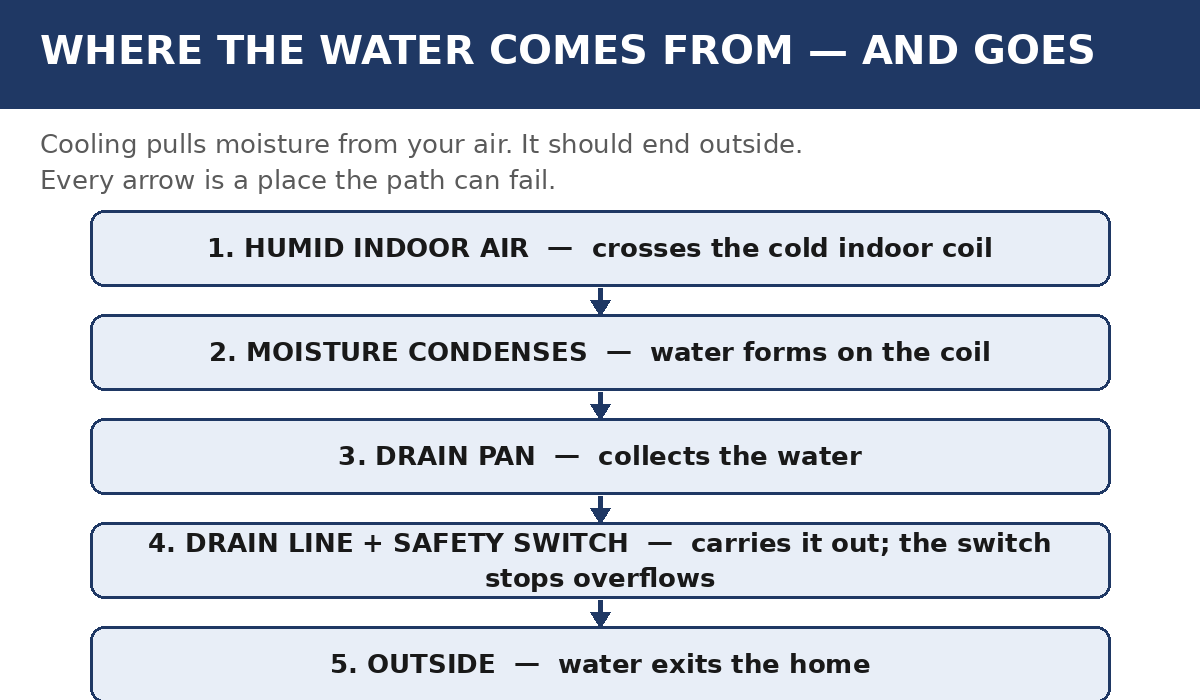
Visual explanation
The diagram above traces the water's path: coil, pan, drain line, outside. A clog can dam that path at the pan or anywhere along the line. And the safety switch in step 4 is what stands between a clog and your ceiling.
What you can safely check
- Know where your drain line exits outside. Check whether water drips from it while the system cools. A dry exit on a humid day is an early warning.
- Look for water near the indoor unit. A system that shut off suddenly in humid weather.
- Keep the area around the indoor unit dry. Protect anything stored below it.
- Change filters on schedule. The dust that ends up in the drain got into the system first.
- Do not open the cabinet. Do not pour chemicals or cleaners into the drain line unless your system's manual specifically tells you to. The wrong product can damage the pan and coil. The instructions differ by system.
- Never bypass the safety switch to get cooling back. The switch is the protection, not the problem.
What might be causing this
Every cooling hour, your indoor coil drips condensate. The moisture the system pulls from your air — into a pan. The pan drains through a pipe to outside or into a plumbing drain. That slow trickle of water, mixed with dust washed off the coil, is a near-perfect growth medium: dark, wet. Undisturbed. Algae and slime narrow the pipe a little more each season. Then, one hot week, the water has nowhere left to go.
North Texas makes it worse by volume alone. Long, humid cooling seasons produce a lot of condensate. And so a lot of the material that becomes a clog (Q18 covers the leak itself, when the water escapes).
When the line blocks, the water takes one of two paths. If your system has a float switch. A small float that shuts the system off when the water rises too high. It shuts the AC down before the overflow. That is why a "dead AC" is sometimes just a clogged drain doing its protective job (Q13). Without a working switch. Once the pan fills past it, the water goes over the edge: into the ceiling, closet, or floor below.
Clearing a clog is the easy half. The harder question is the one in this article's title: why does itkeepclogging?
- A line problem.A section that sags or runs uphill, so water pools instead of draining. A damaged or crushed section. A missing or blocked vent that lets air get trapped in the line and block the flow. A pan that never fully empties.
- A dust supply problem.An overdue or poorly fitting filter. Or duct leaks on the return side. Feeds the line extra debris to grow on.
A line that blocks once in five years is buildup. A line that blocks every season is telling you something about itself. Clearing treats the symptom. Correcting the line treats the cause.
| Pattern | Likely story | Fix |
|---|---|---|
| First clog in years | Ordinary buildup | Clear the line; check the switch |
| Clogs most seasons | Line slope, venting, or damage | Correct the line, not just clear it |
| System shuts off, pan full of water | Float switch doing its job (Q13) | Clear the drain; verify the switch works |
| Water damage despite a switch | Switch missing or failed | Replace the switch; assess the secondary pan |
When to call a professional
Call when you find water near the unit. When the system shuts off in humid weather. When the clog comes back season after season. Ask the question out loud when you book: "Is this buildup. Is something wrong with the line?" A good visit inspects slope, venting. Pan drainage — and checks that the float switch and any secondary pan are in place and working.
What happens next
The technician clears the line and inspects why it clogged, then gives you the findings in a written diagnostic report with a written repair estimate. No work happens until you approve it. If the line itself needs correction, the estimate should say so. A clearing alone, on a line with a slope problem, is a clog scheduled to return.
Texas Heat & Air next step
Second clog in as many seasons? Ask for the line itself to be inspected — call (682) 438-8127.
Related Questions
 Why won't my AC turn on?How often should I service my HVAC system?

Still Have Questions? Ask an HVAC Expert.
Couldn't find the answer you need? Tell us what's happening. Our team will review your question and contact you to help.
Ask Your Question →Sources
- https://www.energystar.gov/saveathome/heating-cooling/maintenance-checklist — condensate drain inspection and water-damage risk (ENERGY STAR)
- https://www.epa.gov/indoor-air-quality-iaq/should-you-have-air-ducts-your-home-cleaned — moisture guidance (U.S. EPA)