
Why won't my AC turn on?
A silent AC has lost its call for cooling, its power, or a safety switch's permission. The three checks that are safe to do yourself. And the line where diagnosis starts.

A completely silent AC has usually lost one of three things: the call for cooling from the thermostat, electric power. Permission from a safety switch. A clogged drain's float switch is a common one. Check the thermostat, and look at the breaker once. After that, it needs a diagnosis, not guesswork.
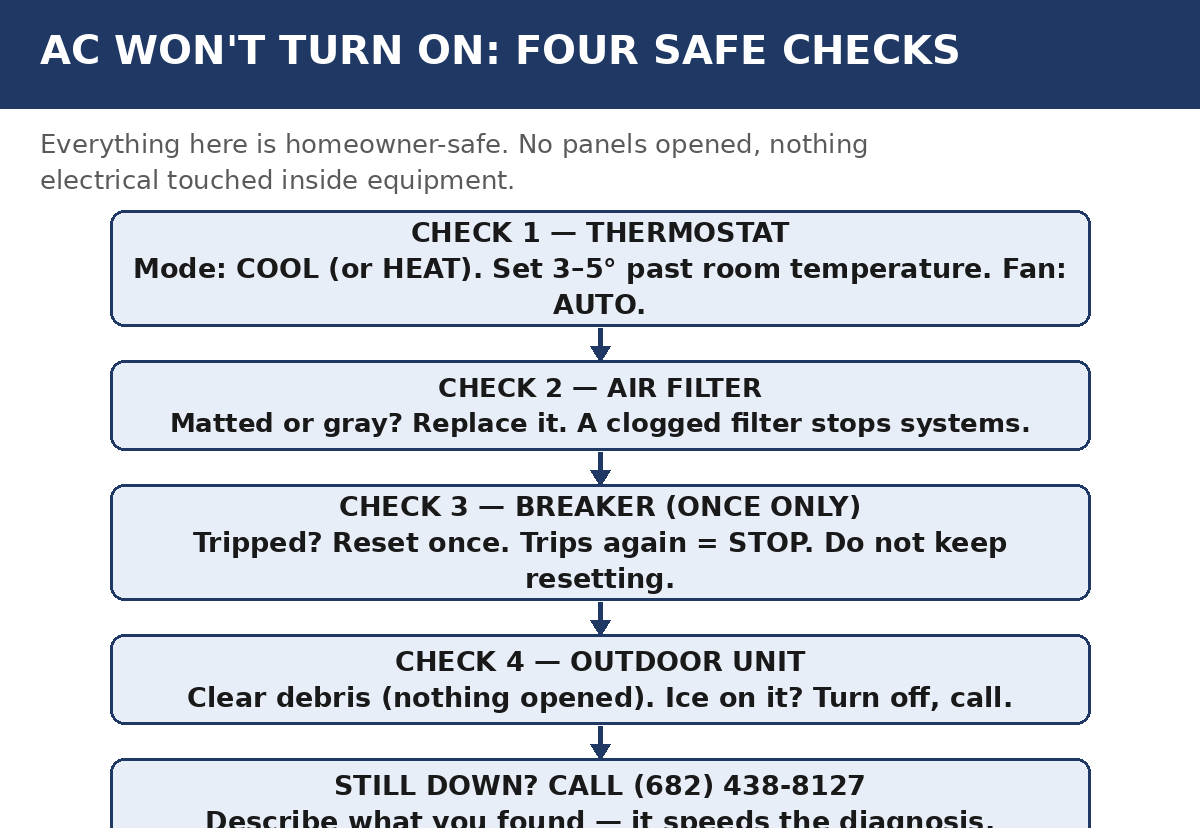
Visual explanation
The safe first-checks flowchart walks through the three checks in order. Thermostat first, then one look at the breaker. It also shows exactly where the safe checks stop and a technician takes over.
What you can safely check
- Thermostat: display on, COOL selected, set below room temperature; replace its batteries if it uses them.
- Breaker panel: one look; one reset at most. If it trips again, stop and call.
- Check for standing water in or under the indoor unit's drain pan. A sign the drain safety switch has shut the system down on purpose.
- Do not open the HVAC system itself. The safe checks are all outside the cabinet.
What might be causing this
An AC needs three things to start. A dead system has lost at least one of them. Walking through them in order is the whole method of this article.
First, the call. The thermostat — the wall control that reads the room temperature and tells the system when to start and stop — must be asking for cooling: set to COOL, set below the room temperature, with a live display. A blank display often means dead thermostat batteries. No power to the thermostat itself. Batteries are a homeowner fix, so try them before anything else. The indoor unit may also have a service switch nearby, like a light switch. It can get flipped by accident during cleaning. Check that too.
Second, power. Look at your home's breaker panel. If the AC's breaker has tripped, you may reset it once. But understand what a trip means: the breaker is a safety device reporting a fault, not a nuisance. If it trips again, stop. Resetting it again and again can damage system. It is a fire risk. A breaker that will not stay on is the diagnosis knocking. It needs a technician (Q29 explains trips in depth).
Third, permission. Modern systems carry safety switches that shut everything down to prevent a worse problem. The most common is the float switch in the condensate drain. The pipe that carries condensate water away from the indoor unit to a drain or outside the home. When the drain clogs and water backs up, the switch stops the system before water overflows into your ceiling or walls (Q18, Q28). It looks exactly like a breakdown. It is the protection working. The fix is clearing the drain, not forcing the system to run.
Beyond those three sit the starting parts. A capacitor is an electric part that stores a charge and helps a motor start and run. A contactor is a heavy-duty electric switch in the outdoor unit that turns the compressor and outdoor fan on when the thermostat calls for cooling. Both wear out in Texas heat. Either one can leave a system silent (Q21, Q22). Testing them means working inside a cabinet, where a capacitor can hold a dangerous charge even with the power off. That is the line: thermostat, batteries, one look at the breaker — then call.
One pattern is worth noting before you call. A system that tries to start. A click, a hum, then silence. Tells a different story from one that is stone dead. Tell the technician which one yours does. It shortens the diagnosis.
| Check | If you find this | Next step |
|---|---|---|
| Thermostat display | Blank | Replace batteries; if still blank, call |
| Thermostat settings | Not on COOL / set too high | Correct and wait a few minutes |
| Breaker | Tripped | Reset once only; a second trip means call |
| Drain area | Water in the pan / system shut off after a leak | Likely float switch — call (Q28) |
| All checks pass | Still silent | Diagnosis — starting parts or controls |
When to call a professional
Call when the three checks pass and the system is still silent. Right away if the breaker trips a second time. A technician tests the starting parts and controls inside the cabinet. Work that involves stored electric charge and is never a homeowner task.
What happens next
Tell the office what you found in the checks; it shortens the diagnosis. Ask Texas Heat & Air to confirm the diagnostic fee when you book. You receive a written diagnostic report and a written repair estimate. No repair begins until you approve it.
Texas Heat & Air next step
Checks done and still silent? Call (682) 438-8127 — and tell the office what you found; it shortens the diagnosis.
Related Questions
 What happens when an AC contactor fails?Why does my AC drain keep clogging?Why does my AC keep tripping the breaker?

Still Have Questions? Ask an HVAC Expert.
Couldn't find the answer you need? Tell us what's happening. Our team will review your question and contact you to help.
Ask Your Question →Sources
- https://www.carrier.com/us/en/residential/hvac-resources/air-conditioners/ac-not-blowing-cold-air/ — starting requirements, float switch, capacitor and contactor failures
- https://www.trane.com/residential/en/resources/troubleshooting/air-conditioners/ac-fan-not-working/ — fan and starting-part failure patterns