
Why Your Air Conditioner Is Not Cooling: A Homeowner's Diagnostic Guide
A running AC that does not cool is failing at one of two jobs. Moving air or moving heat. Learn the chain, the safe checks, and where diagnosis takes over.

An AC that runs but does not cool feels like a contradiction. The fan hums. Air moves. The thermostat says COOL — and the house stays hot.
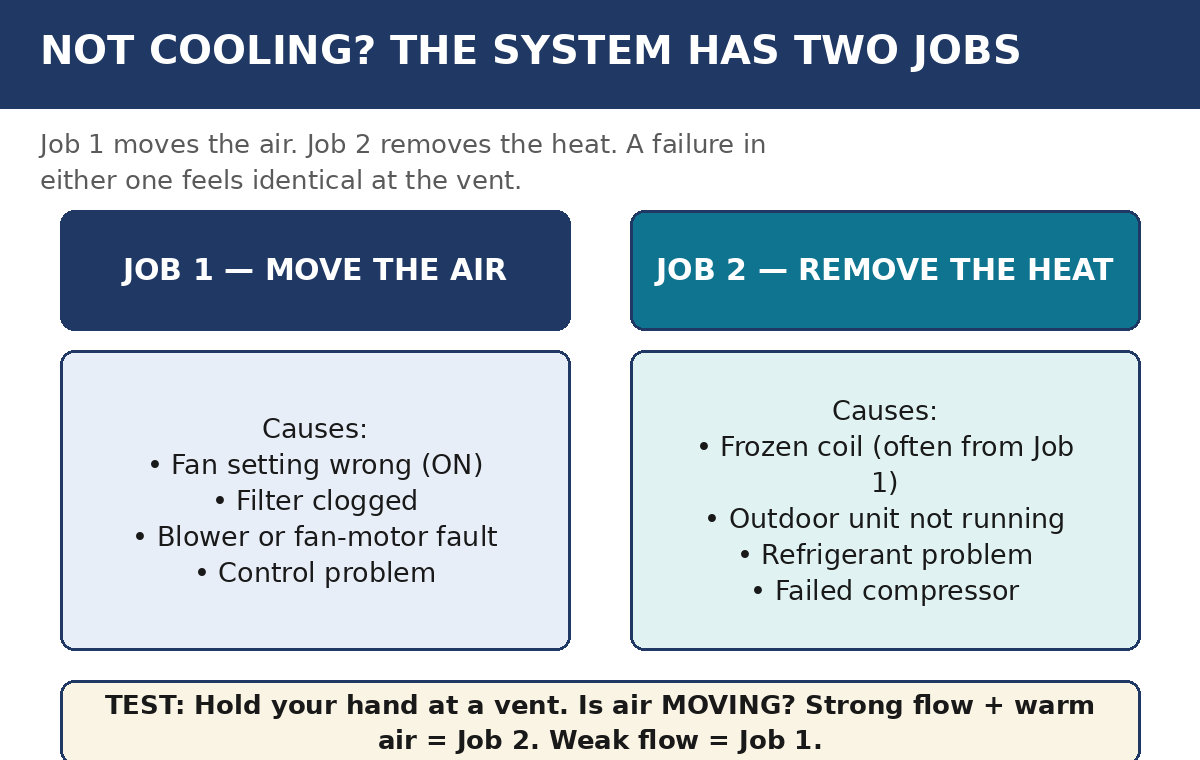
The confusion clears up once you see that cooling is not one job. It is a chain of jobs. The chain can break at any link while the others keep working. Air moving at the vents proves exactly one link: the blower, the motor that pushes air through the ducts. It says nothing about whether heat is being carried out of your house.
This guide teaches the chain — thermostat, airflow, the refrigerant cycle, and the electric controls. Then it shows how each common complaint is the same chain failing at a different link. The complaints: running without cooling. Warm air. A silent system. Short cycling. Nonstop running. A thermostat that says COOL to no effect. You will learn which checks are safe to do yourself, where checking must stop. Why a symptom alone can never name its own cause.
Key takeaways- Cooling takes two jobs working together: move air, and move heat. If either one fails, you get running system and warm rooms. - A running fan does not mean the system is cooling. It only means the blower works. - The same symptom can come from several different failures. Testing — not the symptom — decides which one you have. - Ice on the coil or the lines means switch cooling OFF and let it thaw. Running a frozen system makes the damage worse. - Long run times on a very hot day can be normal. A house that keeps losing ground is the real warning sign.
How it works
Follow one complete cooling cycle. Every failure in this guide will have a place to live.
The call.The thermostat is the wall control that reads the room temperature and tells the heating and cooling system when to start and stop. When cooling is needed, it sends one signal: start. That signal is all the thermostat contributes. It does not cool anything itself. A display that says COOL only means the order was placed.
The air job.The indoor blower pulls warm room air through the filter and across the indoor coil. That coil is the evaporator coil, where refrigerant absorbs heat from indoor air, so the air blown into the rooms comes out cooler and drier. For this to work, air must flow. A clogged filter, closed or blocked vents. A failing blower all starve the system.
The heat job.The indoor coil is cold because refrigerant inside it is absorbing heat from the air passing over it. Refrigerant is the fluid sealed inside the system's loop that carries heat. It carries that heat to the outdoor unit. There, the compressor does the squeezing. The compressor is the pump that squeezes and circulates the refrigerant around the sealed loop. And the outdoor fan releases the heat into the outside air. Cooled, dried air goes back into the rooms. The water the system removes from the air drains away through the condensate line.
Now the interactions — the part a single-question answer cannot show you:
- Starved airflow freezes the coil.A clogged filter blocks airflow. Less warm air reaches the cold coil. The coil gets cold enough for the moisture on it to freeze. The ice blocks airflow even more. Cooling gets worse the longer the system runs — a spiral that feeds itself. Ice is so both a symptom and a cause.
- The heat job fails quietly.If the outdoor fan stops, the outdoor coil gets buried in debris. The refrigerant charge runs low, heat has nowhere to go. The blower keeps delivering air — it just delivers it warm. Refrigerant is never "used up". A low charge means a leak or an error in charging during installation or service. Finding the cause is pro work.
- Safeties stop the chain on purpose.Some shutdowns are protections, not breakdowns. A float switch in the condensate drain shuts the system down when water backs up, preventing a ceiling full of water damage. A tripped breaker cuts power when something electric is wrong. These look like breakdowns; they are protections doing their jobs. The right response is to find outwhythey fired.
- Short cycling breaks a different promise.Short cycling is when a system turns on and off again and again in short bursts instead of running steady, longer cycles. Cooling also removes humidity, and that takes sustained run time. A system that starts and stops every few minutes never finishes either job: the temperature looks close, the house feels clammy. The repeated starts — the hardest moment in a motor's life — wear parts out early.
- Nonstop running is a balance question.A correctly sized system on a very hot day may run nearly all the time and still be perfectly healthy: it is keeping up, not racing ahead. The warning sign is losing ground. The indoor temperature climbs even though the system never stops. That points to lost capacity: dirt, duct leaks, low refrigerant, or aging system.
One measurement belongs here, because homeowners ask about it. Technicians measure the temperature of the air entering the system and the air leaving it, and compare the two. That difference is one clue among several — not a pass-or-fail test. The expected reading changes with the weather, indoor humidity, and the system's design. So no single "normal" number proves an AC healthy or broken on its own. Be wary of anyone who diagnoses your system from that one number.
The situations homeowners ask about
"It runs, but the house won't cool."
This is the two-jobs failure in its purest form. The air job works; the heat job does not. Or airflow is so restricted that very little heat gets picked up in the first place.
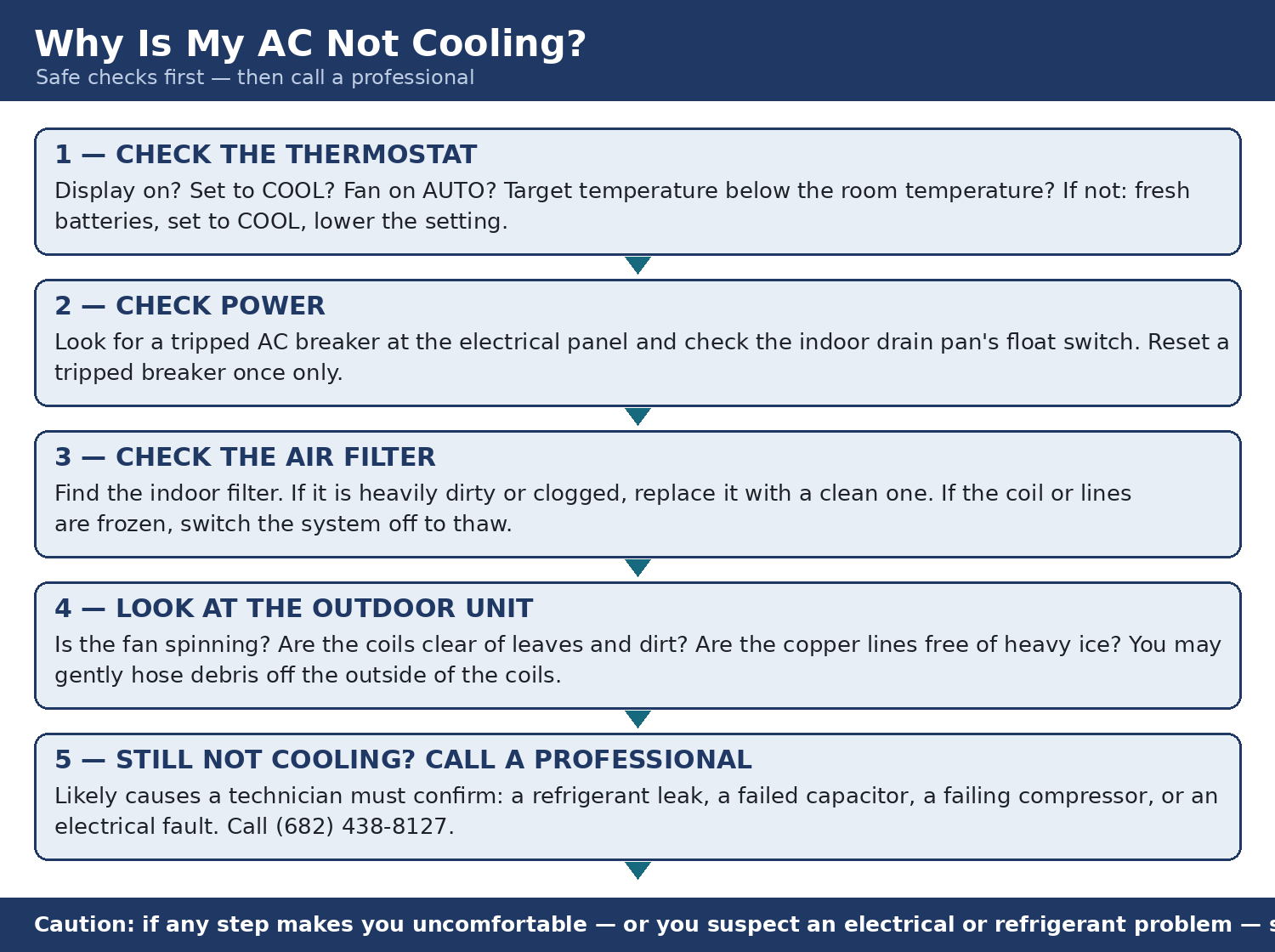
Run the safe sequence: thermostat set to COOL below the room temperature, filter clean, vents open, outdoor unit observed from a safe distance. If cooling does not return, stop and call. The same goes if you see ice on the coil or the copper lines. The outdoor unit is not running normally. Do not keep running a frozen system; the ice spiral deepens and the compressor is strained.
The short answer: Q11 — Why is my AC running but not cooling? (/hvac-help/ac-running-but-not-cooling/)
"The vents blow warm air."
Start with the impostors. If the thermostat is set to HEAT, or to FAN ONLY, the vents will move un-cooled air exactly as instructed. That is a settings problem, not a failure.
If the settings are right, warm air means the blower is working and the cooling side is not. The cause may be a badly clogged filter. It may be a frozen coil, which often cools briefly, then blows warmer as ice chokes the airflow. Or the outdoor unit may not be running at all while the indoor fan blows. Which points to an electric or control failure. Warm air is a symptom, not a diagnosis; several different failures produce it.
The short answer: Q12 — Why is my AC blowing warm air? (/hvac-help/ac-blowing-warm-air/)
"Nothing happens at all."
A silent system has lost one of three things it needs to start. It may have lost the call for cooling: a blank thermostat display can mean dead batteries. Lost power to the thermostat itself. It may have lost electric power: check the breaker once. And if it trips again, stop. Repeated trips mean an electric fault, not a stubborn breaker. Or it may have lost permission from a safety switch. The common one is the drain float switch, which shuts the system down when a clogged drain backs water up.
Starting parts wear out too, especially in Texas heat. A failed capacitor leaves the system silent; so does a failed contactor. A capacitor is an electric part that helps a motor start and run. A contactor is the heavy-duty electric switch that turns the outdoor unit on. Beyond the thermostat and one breaker check, this is diagnosis, not guesswork.
The short answer: Q13 — Why won't my AC turn on? (/hvac-help/ac-will-not-turn-on/)
"On, off, on, off — every few minutes."
That pattern is short cycling, and its causes span the whole chain. A clogged filter or blocked airflow can trip safety limits. A thermostat can be fooled by direct sun, a lamp, or another heat source. A system oversized for the house cools the air so fast it shuts off before removing humidity. And refrigerant or electric faults can make the system protect itself by shutting down.
Your checks are short: replace a dirty filter, make sure vents are open. Look at what is heating the thermostat. When you call, mention how long each run lasts. That detail genuinely helps the diagnosis.
The short answer: Q14 — Why does my AC keep turning on and off? (/hvac-help/ac-keeps-turning-on-and-off-short-cycling/)
"It never stops running."
On a 100-degree afternoon, near-constant running can be a healthy system doing exactly what it was sized to do. Use the trend test instead of the clock: is the indoor temperature holding, falling, or rising?
Holding, or slowly falling, on an extreme day — likely fine. Rising is not, and neither is a house that stays warm and damp on ordinary hot days. Then the system is losing capacity: to dirt, poor airflow, duct leaks dumping cooled air into a hot attic, low refrigerant, or wear.
Note the trend for an hour before you call. It is one of the most useful facts you can hand a technician.
The short answer: Q15 — Why does my AC run all the time? (/hvac-help/air-conditioner-runs-all-the-time/)
"The thermostat says COOL, but nothing cool comes out."
Think of the thermostat as a manager placing an order. The display says COOL because the order was placed — it cannot confirm anyone obeyed.
So find the silent link: Is air moving at the vents? Air moving but warm points at the cooling side (the warm-air situation above). No air at all points at the blower or its controls. An outdoor unit running but no cooling points at the refrigerant cycle.
And rule out the innocent explanation first: many thermostats wait several minutes after a setting change before starting the system, to protect the compressor. Give a changed setting five minutes before deciding anything is broken.
The short answer: Q30. WHy does my thermostat say COOL but no cool air comes out? (/hvac-help/thermostat-says-cool-but-no-cool-air/)
Diagrams and comparisons
F03R-cooling-flowchart.png— Safe first checks when an AC runs but does not cool. Thermostat, power, filter, outdoor unit. And when to stop and call a pro. This is the guide's decision tree: five steps in a fixed order, ending at a clear stop-and-call point.
b3-03-q11-two-jobs-cause-map.png— Two jobs, five failure families: the cause map for a system that runs without cooling. It teaches why one symptom cannot name its cause. Every failure on the map produces the same complaint.
The same five presentations, organized by the chain:
| What you observe | Link to suspect first | Safe check | Stop and call when |
|---|---|---|---|
| Runs, air moves, house won't cool | Heat job, or airflow | Settings, filter, vents, look at the outdoor unit | Ice appears, outdoor unit abnormal, or no improvement |
| Vents blow warm air | Settings, then cooling side | COOL selected (not HEAT or FAN ONLY); filter | Air stays warm after the checks |
| System completely silent | Call, power, or a safety switch | Thermostat display and batteries; breaker, once | It stays off, or the breaker trips again |
| Starts and stops every few minutes | Airflow, controls, or sizing | Filter; vents; what is heating the thermostat | The pattern continues, or comfort never arrives |
| Runs constantly, house loses ground | Capacity vs. load | Filter, vents, blinds; watch the temperature trend for an hour | Temperature keeps rising, or ice forms |
What you can safely do yourself
- Set the thermostat to COOL, fan on AUTO, with a target below the room temperature. Replace dead thermostat batteries. Give a changed setting five minutes — many systems delay on purpose.
- Check the filter and replace it if it is dirty. Make sure supply vents are open and not covered by furniture or rugs.
- Look at the breaker panel once. One reset is a check; repeated tripping is a fault — stop and call.
- Observe the outdoor unit from a safe distance: is the fan spinning, is the coil smothered in debris or vegetation?
- If you see ice on the coil or lines: switch cooling OFF and let it thaw fully before any restart. Do not chip at it, and do not keep running it.
- Note what you observe — run-cycle lengths, temperature trends, when the problem started. Notes are diagnostic gold.
Everything beyond this list. Opening panels, touching refrigerant lines or electric parts, working inside the system — is not homeowner work.
What a technician checks
A technician traces the same chain with instruments: airflow and filter condition, coil condition and freezing, refrigerant pressures and charge. Outdoor fan and compressor use. The technician also checks the electric controls and starting parts, such as the capacitor and contactor, plus the thermostat signals from the wall outward and the drain and float-switch condition. For cycling and capacity complaints, the check also covers whether the system size matches the home's cooling load.
Temperature readings of the entering and leaving air are part of that picture. They are read alongside everything else. Weather, humidity, and system design. Never as a lone verdict. The visit ends with a written diagnostic report and a written estimate. No repair begins until you approve it.
Making the decision
The stopping rule is simple: work the safe list once, in order. If cooling returns, you have learned something worth writing down.
If it does not, the next step is a diagnostic visit, not a second round of guessing. The same is true if ice, repeated breaker trips, harsh new noises. A silent outdoor unit appear at any point.
Ask Texas Heat & Air to confirm the diagnostic fee when you book. What it buys is the thing this guide has been pointing at throughout: a proven cause instead of a suspected one, in writing, with the repair priced before anyone starts. When you call, hand over your notes — symptom timing, cycle lengths, the temperature trend. They shorten the diagnosis.
North Texas notes
AC units here are sized for serious heat, which cuts both ways. On the hottest afternoons, a healthy system may run almost constantly and only just keep up. That is design, not failure.
The same climate is hard on system, though. Outdoor units bake. Starting parts age fast in the heat. A marginal system often shows itself on the first triple-digit stretch, not on a mild day. During those stretches, every company's schedule fills. So a system that is limping in June deserves a call in June. Not during the July heat wave.
Related resources
- Q11 — Why is my AC running but not cooling? (/hvac-help/ac-running-but-not-cooling/)
- Q12 — Why is my AC blowing warm air? (/hvac-help/ac-blowing-warm-air/)
- Q13 — Why won't my AC turn on? (/hvac-help/ac-will-not-turn-on/)
- Q14 — Why does my AC keep turning on and off? (/hvac-help/ac-keeps-turning-on-and-off-short-cycling/)
- Q15 — Why does my AC run all the time? (/hvac-help/air-conditioner-runs-all-the-time/)
- Q30 — Why does my thermostat say COOL but no cool air comes out? (/hvac-help/thermostat-says-cool-but-no-cool-air/)
- Guide 1 — Booking an HVAC Service Visit: Scheduling, Dispatch. How to Prepare (/hvac-help/guides/scheduling-and-dispatch/). What happens when you book the diagnostic this guide leads to.
- Guide 2 — HVAC Emergencies and Severe-Weather Safety: What to Do First (/hvac-help/guides/emergencies-and-weather-safety/) — when a cooling failure happens in dangerous heat, the health steps come before everything here.
Texas Heat & Air next step
Worked the safe checks and still not cooling? Ask Texas Heat & Air to confirm the diagnostic fee when you book. You will get the cause in writing, a written estimate, and the decision stays yours.

Understanding the system comes first: learn how the pieces work together, use the safe checks. Let a qualified technician confirm anything inside the system.
Related Homeowner Questions
 Why is my air conditioner blowing warm air?Why won't my AC turn on?Why does my AC keep turning on and off?Why does my air conditioner run all the time?Why does my thermostat say COOL but no cool air comes out?

Still Have Questions? Ask an HVAC Expert.
Couldn't find the answer you need? Tell us what's happening. Our team will review your question and contact you to help.
Ask Your Question →Sources
- https://www.carrier.com/us/en/residential/hvac-resources/air-conditioners/ac-not-blowing-cold-air/ — Carrier, "Why Your AC Is Not Blowing Cold Air": homeowner-level causes and checks for weak cooling (accessed October 13, 2026).
- https://www.energystar.gov/saveathome/heating-cooling — ENERGY STAR, Heating & Cooling hub: how systems operate and what maintenance covers (accessed October 13, 2026).
- https://www.trane.com/residential/en/resources/troubleshooting/air-conditioners/ac-fan-not-working/ — Trane, "AC Fan Not Working": troubleshooting and safe escalation for fan and starting problems (accessed October 13, 2026).
- Source note: the company-specific details in this article are awaiting confirmation from Texas Heat & Air.