
Why does my AC keep tripping the breaker?
A tripping breaker is a safety device reporting a fault. A straining compressor, a dying motor, damaged wiring. The trip patterns, and the one-reset rule.

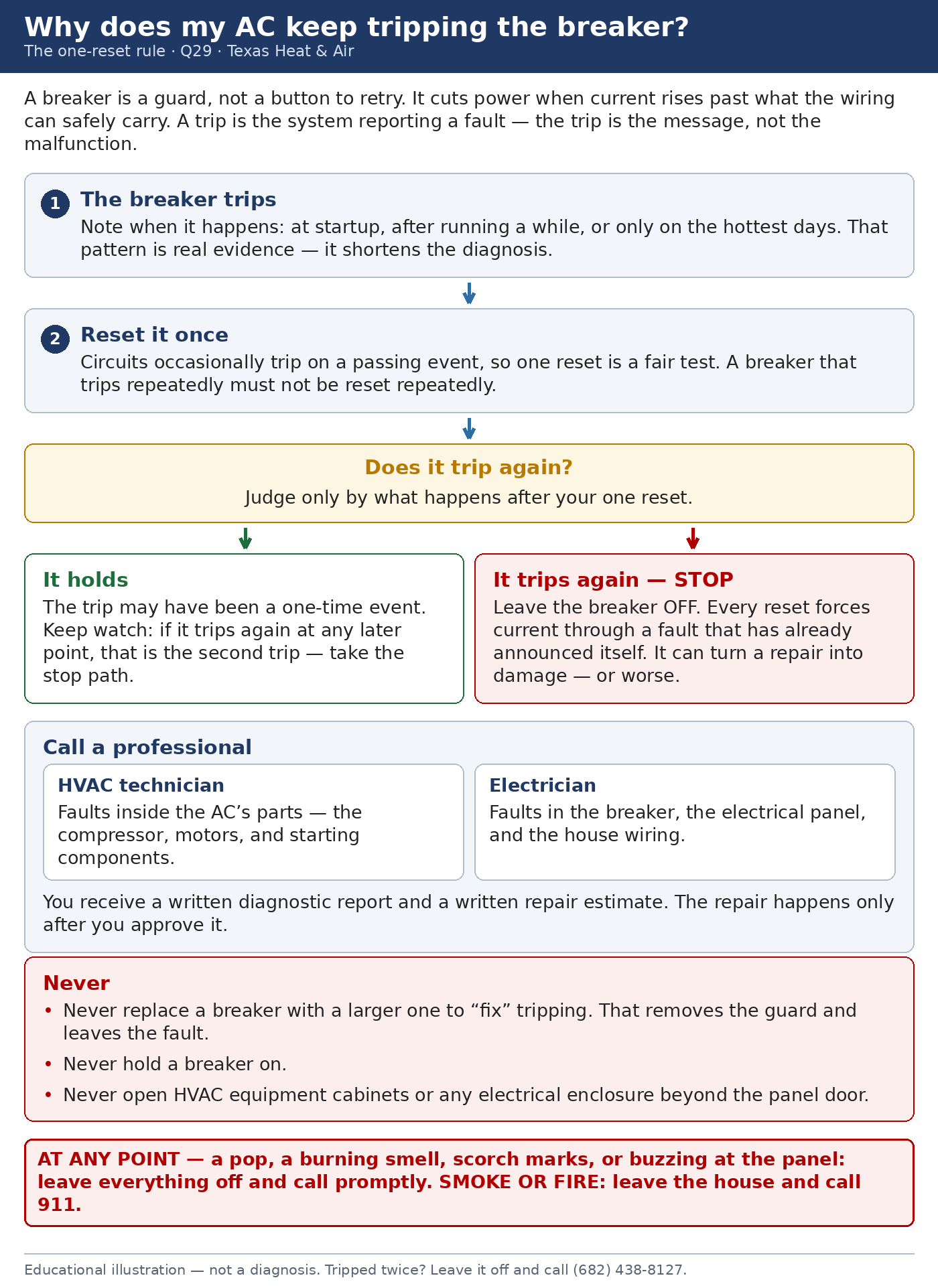
A breaker trips because the circuit is drawing too much current or has an electric fault. It is a safety device doing its job, not a button to retry. A failing compressor or fan motor, damaged wiring. A short can all cause it. A breaker that trips repeatedly must not be reset repeatedly.
What you can safely check
- Note which breaker tripped, and when it happens: at startup, after running a while, or only on the hottest days. That pattern is real evidence — it shortens the diagnosis.
- You may reset a tripped breakeronce. Circuits do occasionally trip on a passing event. If it trips again, stop. Leave it off and call.
- Scorch marks, a burning smell at the panel. Buzzing from the panel mean leave everything off and call promptly. Smoke or fire means leave the house and call 911.
- Never replace a breaker with a larger one to "fix" tripping. That removes the guard and leaves the fault.
- Do not open HVAC system or any electric enclosure beyond the panel door.
What might be causing this
Begin with what a breaker is. It is not a switch that gets tired. It is a guard that cuts power when current rises past what the wiring can safely carry. Before heat can damage insulation or start a fire. When your AC trips one, the system is reporting an electric fault. The trip is the message, not the malfunction.
The causes cluster around current draw:
- A straining motor.Motors draw their highest current at startup. As a compressor (the outdoor unit's pump) or a fan motor ages and struggles, that draw climbs past the limit. That is why trips often happen at the very moment the system starts.
- A failed starting part.A bad capacitor — the part that helps a motor start — can make a healthy motor strain and draw current like a dying one (Q21).
- Damaged or shorted wiring— wiring damaged so that electricity takes a shortcut it should not. Fault current flows directly, and the breaker ends it instantly.
- Heat that builds.A motor that overheats as it works. Failing bearings, a stopped outdoor fan. Draws more and more until the breaker calls the stop (Q24).
Every reset of a genuinely faulted circuit forces current through a fault that has already announced itself. It can turn a repair into damage — or worse. Off, noted, and called in: that is the whole homeowner protocol for this symptom.
| Pattern | Points toward |
|---|---|
| Trips instantly at startup | Short, seized or straining compressor or motor, failed starting part |
| Trips after running a while | Motor overheating as it works; rising amp draw |
| Trips only on the hottest afternoons | Marginal motor at maximum load — failing in slow motion |
| Trips with a burning smell | Stop everything; call promptly (Q20) |
When to call a professional
Call after the second trip. Or after the first, if there is a pop, a smell, or scorch marks. Who fixes it depends on where the fault lives: faults inside the AC's parts belong to an HVAC technician. Breaker, panel. House-wiring faults belong to an electrician. The technician measures the amp draw. How much electric current the system pulls — against the system's ratings. The technician also inspects the starting parts and the wiring. If the system checks out fine, the fault is likely in the circuit. If the circuit checks out, the fault is likely in the system.
What happens next
You receive a written diagnostic report and a written repair estimate. The repair happens only after you approve it. When you call, give the pattern you noted — startup, mid-run, hottest days, any smells. You have already started the diagnosis.
Texas Heat & Air next step
Tripped twice? Leave it off and call (682) 438-8127 — and tell us the pattern you noted.
Related Questions
 How can I tell if my compressor is failing?What are the signs of a failing AC capacitor?

Still Have Questions? Ask an HVAC Expert.
Couldn't find the answer you need? Tell us what's happening. Our team will review your question and contact you to help.
Ask Your Question →Sources
- https://www.trane.com/residential/en/resources/troubleshooting/air-conditioners/ac-fan-not-working/ — electric fault causes and meter-based diagnosis (Trane)
- https://www.carrier.com/us/en/residential/hvac-resources/air-conditioners/ac-parts/ — the part failures behind excess current draw (Carrier)