
Inside Your Air Conditioner: Components, Electrical Failures, and What Stays Hands-Off
Capacitors, contactors, compressors, fans, blowers. Breakers in plain language. What each part does, what its failure looks like, and why testing replaces guessing.

Most sudden AC failures trace back to a short list of hard-working parts. The list is short: a capacitor, a contactor, a compressor, two fan motors. The breaker that stands guard over all of them. This guide explains what each part does. It shows what each failure looks and sounds like from outside the cabinet. And it explains how a technician proves which part failed.
It also teaches the boundary — and the boundary is the point. Every part here lives behind panels. Each one is wired into a system that can hold a dangerous electric charge, even after the power is off. Your role is to watch carefully and describe what you see. That is genuinely valuable work, because good observations speed up diagnosis. Opening the cabinet is never your role.
A homeowner who understands what a capacitor does. And still never touches one. Has understood this guide completely.
Key takeaways
- Five parts — capacitor, contactor, compressor, outdoor fan motor, indoor blower motor — plus the breaker cause most sudden failures.
- Symptoms overlap. A hum can be a capacitor, a motor, or wiring. Testing names the part. Guessing replaces good parts and keeps the fault.
- A capacitor stores an electric charge after the power is disconnected. The inside of the cabinet is a technician's workspace, always.
- Some failures cascade. A dead outdoor fan can destroy the compressor. A stopped blower can freeze the coil. Switching off early is often the cheapest repair decision you make.
- A tripping breaker is a safety device reporting a fault. It is details, not a nuisance to reset.
How it works
Follow one cooling call through the system. Every part in this guide appears in order.
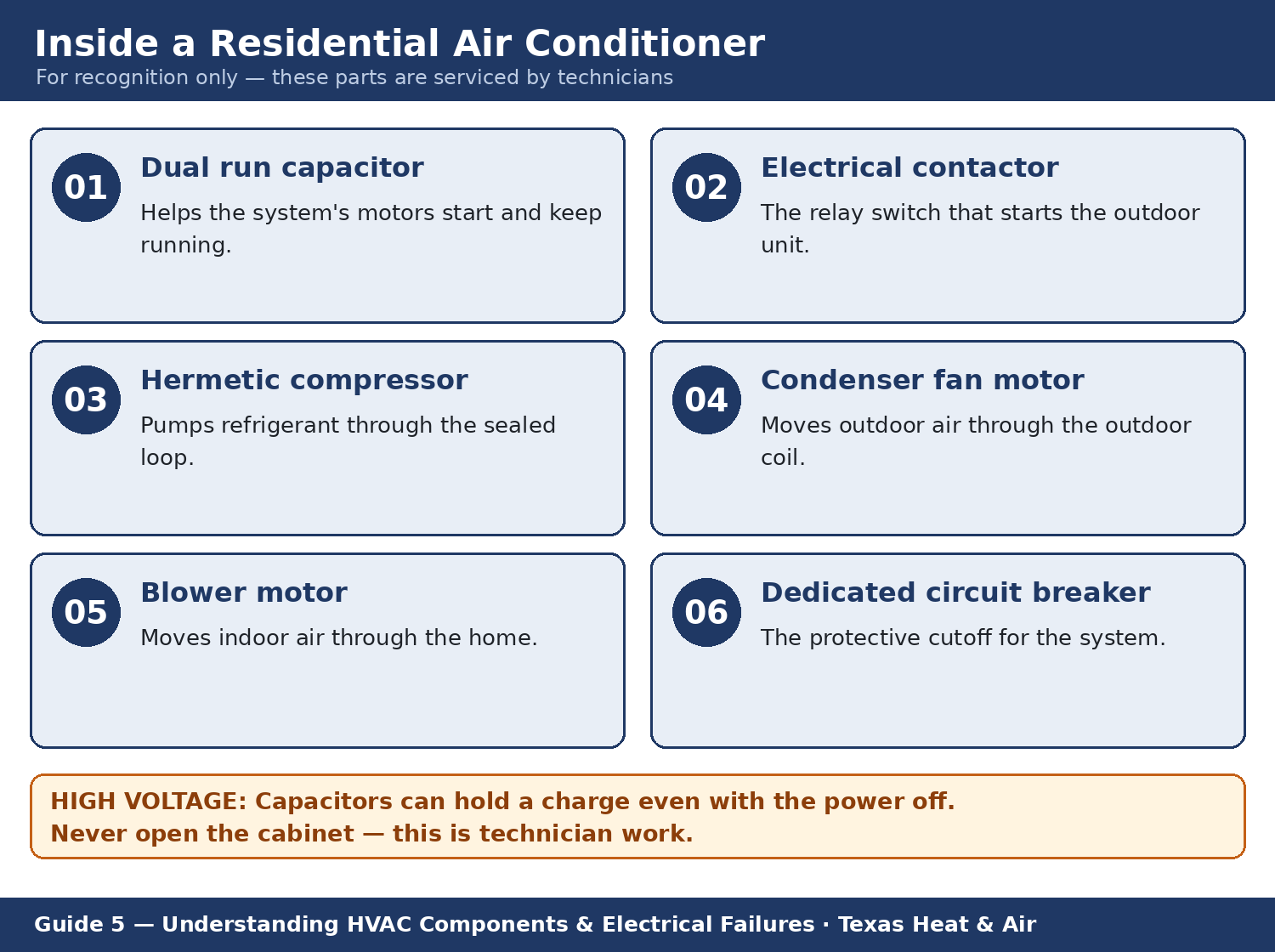
Your thermostat asks for cooling. The thermostat is the wall control that reads the room temperature and tells the heating and cooling system when to start and stop. That request reaches the outdoor unit's contactor. A contactor is a heavy-duty electric switch in the outdoor unit that turns the compressor and outdoor fan on when the thermostat calls for cooling. It snaps shut and sends power to the two big outdoor loads: the compressor and the outdoor fan motor.
Motors need a surge of help to start. That help comes from the capacitor. A capacitor is an electric part that stores a charge and helps a motor start and run. It gives the motor an extra push at startup and keeps it running smoothly.
The compressor is the pump in the outdoor unit. It squeezes and circulates the refrigerant around the sealed loop, so the system can move heat. Refrigerant is the fluid sealed inside the loop that carries heat. Absorbing it indoors and releasing it outdoors in summer. The outdoor fan blows air across the outdoor coil. The condenser, where hot refrigerant releases the heat it picked up indoors. So that heat can escape into the yard.
Inside, the blower motor does the indoor work. The blower motor is the motor in the indoor unit that pushes air across the coil and through the ducts to the rooms. Watching over the whole circuit is the breaker in your electric panel. It cuts the power if the circuit draws too much current.
This chain explains why failures look alike. A silent outdoor unit could mean three different things. The contactor may refuse to close. The capacitor may be unable to start the motors. Or the power may never arrive at all. A unit that hums but will not start could be any of the three. The symptom tells you where the chain broke. Only testing tells you which link.
Testing is the real subject of this guide. A technician does not judge a capacitor by looking at it. Its measured rating is compared against the value printed on its label. A motor is not condemned by its sound. Its current draw is compared against its rating. A compressor is not declared dead by behavior. Its electric readings and performance under load are measured. The cheaper look-alikes are ruled out first.
That discipline is what you are paying for in a diagnosis. It is why the sections below keep returning to one sentence: the sign points, the test proves.
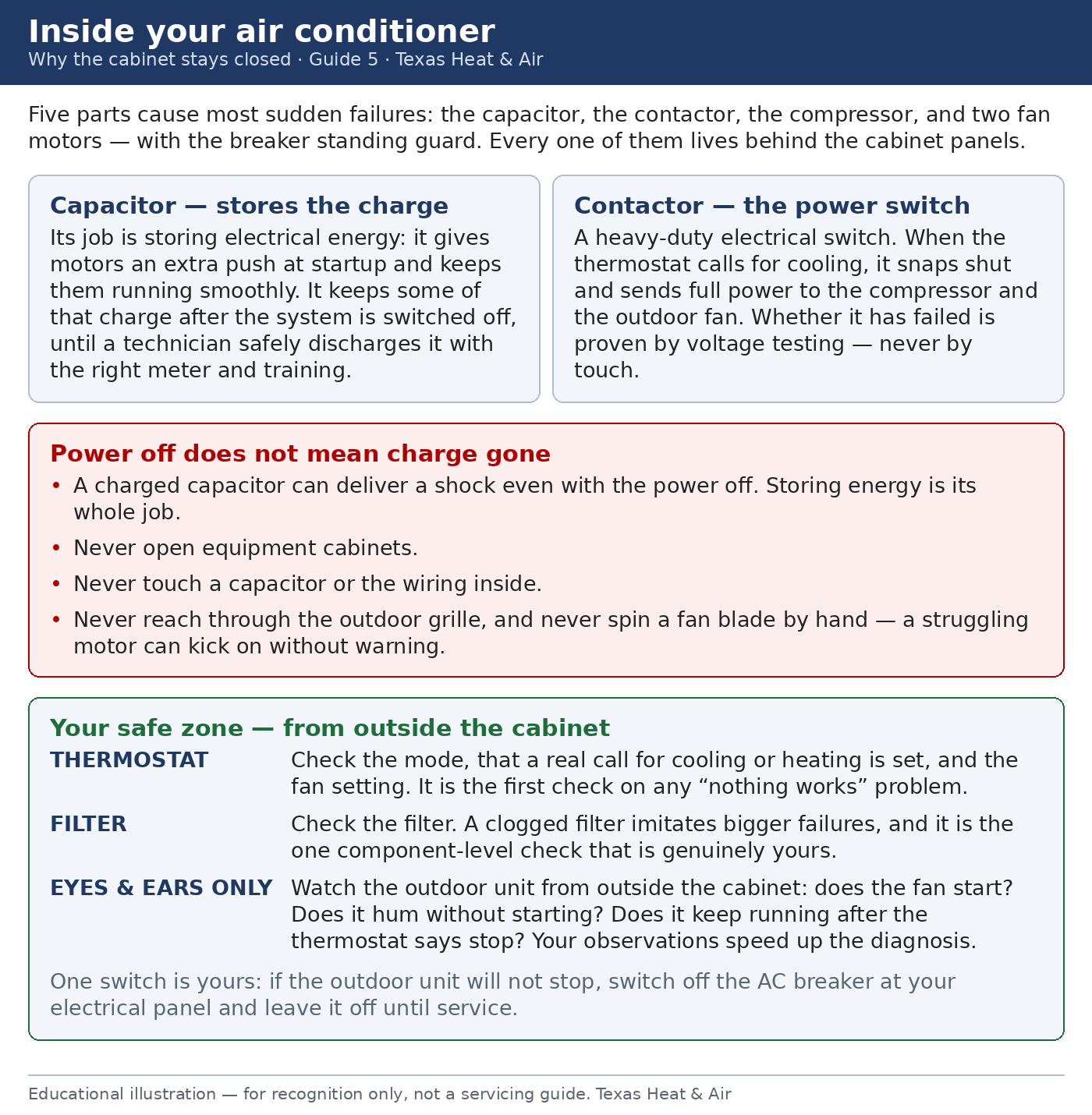
One more fact matters here. Storing electric energy is the capacitor's whole job. It keeps some of that charge after the system is switched off, until it is safely discharged by someone with the right meter and training. That stored charge is why "just take a look inside" is dangerous advice for this system. It is also why every observation in the next section happens from outside the cabinet.
The situations homeowners ask about
The start that fails: capacitor and contactor
The capacitor's warning signs are about behavior. The outdoor unit hums, but the fan does not spin. The system starts hard. It starts only sometimes. Or cooling quits on the hottest afternoon. When a weak capacitor is under the most stress.
Texas heat is hard on these parts. They are among the most common summer failures. But a failing motor or low voltage can imitate every one of those signs. That is why the capacitor is tested, not assumed. The short answer: Q21 — What are the signs of a failing AC capacitor? (/hvac-help/signs-of-a-failing-ac-capacitor/)
The contactor fails in two directions, and the direction is the clue. If it will not close, the outdoor unit sits silent while the indoor fan blows uncooled air. If its contacts wear and weld shut, the outdoor unit keeps running after the thermostat says stop. That is unsettling, and it is hard on the system.
Dirt and insects jam these switches too. Outdoor system lives a rough life. Either direction means electric testing. And if the unit will not stop, switch off the AC breaker at your panel and leave it off until service. That is the right move. The short answer: Q22 — What happens when an AC contactor fails? (/hvac-help/ac-contactor-failure/)
The expensive question: is it the compressor?
The compressor is the heart of the system. It is also its most expensive single part. So this is the diagnosis to get right.
A failing compressor may start hard. It may trip the breaker. It may make harsh new noises. Or it may run while cooling fades. The problem is that each of those signs has a cheaper impersonator. A weak capacitor causes hard starting. Low refrigerant causes weak cooling. Electric faults trip breakers.
Before you approve compressor work, it is reasonable to ask what tests were run. Ask about the electric readings. Ask whether the starting parts were checked. Ask about the refrigerant pressures, and whether the look-alikes were ruled out. For a repair of this size, asking for that evidence is not distrust. Getting a second opinion, if the evidence is not offered, is not distrust either. It is the normal consumer move. The short answer: Q23 — How can I tell if my compressor is failing? (/hvac-help/signs-your-compressor-is-failing/)
The air movers stop: outdoor fan and indoor blower
If the outdoor fan stops while the system calls for cooling, heat has nowhere to go. Pressure and temperature climb. Cooling collapses. The compressor strains. Running the system in this state can turn a fan repair into a compressor replacement.
The usual causes are the fan's capacitor, the motor itself, a control fault, a damaged blade. Lost power to the unit. Turn cooling off and call. Never reach through the grille. Never try to spin the blade by hand to help it start. A struggling motor can kick on without warning. The short answer: Q24 — Why has my outdoor AC fan stopped spinning? (/hvac-help/outdoor-ac-fan-stopped-spinning/)
The indoor blower failing produces a stranger picture. The outdoor unit runs, but no air moves at the vents. Without airflow, the indoor coil gets colder and colder until it can freeze over. In heating season, a furnace without a blower overheats and shuts itself down for safety.
Causes include the blower motor or its electronic control module. The control board may not be sending the signal. Power may be lost. And there is one free possibility to rule out first. If the thermostat's fan setting is AUTO and no heating or cooling is being called for, a quiet blower is simply normal. The short answer: Q25 — Why is the indoor blower not running? (/hvac-help/indoor-blower-not-running/)
The breaker keeps tripping
A breaker trips because the circuit drew too much current. Because there is an electric fault. It is a safety device doing its job — stopping wiring from overheating. So a repeatedly tripping breaker is a report, not an inconvenience.
Aging motors draw excess current as they struggle, especially at startup. Damaged wiring and failed starting parts do it too. The pattern is diagnostic gold. Tripping instantly at startup points one way. Tripping after running a while points another way. Tripping only on the hottest days points a third way.
Note the pattern. Turn the system off. Let a technician or electrician measure the cause. Never keep resetting a breaker that trips again. Never install a larger breaker to make the tripping stop. The short answer: Q29 — Why does my AC keep tripping the breaker? (/hvac-help/ac-keeps-tripping-the-breaker/)
Diagrams and comparisons
F05R-components.png— "The key electric and mechanical parts inside a residential AC. Shown for recognition, not for homeowner servicing." Use the diagram to place each part in the chain from the How it works section: contactor and capacitor at the outdoor unit's electric heart, compressor beneath, the two motors moving the air, the breaker standing guard at the panel.
Part-by-part comparison.What each part does, what you may notice when it fails. How the failure is confirmed. Notice that the last column never says "by looking."
| Part | Its job | What you may notice if it fails | How a technician confirms it |
|---|---|---|---|
| Capacitor | Gives motors a starting push and smooth running | Humming without starting; hard or inconsistent starts; sudden loss of cooling | Measured rating compared against its label |
| Contactor | Switch that sends power to the outdoor unit | Outdoor unit silent — or running after the thermostat says stop | Voltage in and out; contact and coil condition |
| Compressor | Pumps refrigerant to move heat out of the home | Weak cooling, hard starts, breaker trips, harsh new noises | Electric readings (windings, amp draw), pressures, performance under load — after ruling out cheaper causes |
| Outdoor fan motor | Blows air across the outdoor coil so heat can escape | Fan not turning while the system calls for cooling | Capacitor and motor testing, blade condition, power supply and controls |
| Blower motor | Pushes indoor air across the coil and through the ducts | Outdoor unit runs, but no air at the vents | Motor and control module, board signals, power supply |
| Breaker | Cuts power when the circuit draws too much current | Power loss to the system; trips at startup or mid-cycle | Amp draw against ratings, wiring condition, the breaker and circuit itself |
What you can safely do yourself
- Observe from outside the cabinet: does the outdoor fan start when cooling is called for? Does the unit hum without starting? Does the outdoor unit keep running after the thermostat is switched off?
- Check the thermostat first on any "nothing works" problem. Correct mode, a real call for heating or cooling. The fan setting.
- Check the filter. A clogged filter imitates bigger failures. It is the one part-level check that is genuinely yours.
- Note breaker patterns: which breaker. Whether it trips at startup, after running a while. Only on the hottest days.
- If the outdoor unit will not stop, switch off the AC breaker at your electric panel and leave it off until service.
- Never open system cabinets. Never touch a capacitor or wiring. Never reach through the outdoor grille or spin a fan blade by hand. Never replace a breaker with a larger one.
What a technician checks
Each part has its checkpoint. The checkpoints share a style: measure, compare against the part's rating. Rule out the look-alikes before replacing anything.
The capacitor's measured value is compared to its label. Motor condition, voltage, and the contactor are checked alongside it. The contactor's contacts, coil, and voltage in and out are tested.
The compressor gets the fullest workup: winding and amp-draw readings, starting parts, refrigerant pressures, and system performance. That is because its verdict is the expensive one. Fan and blower motors are tested with their control modules and power supplies. Blade condition is checked where a fan stopped.
For breaker trips, amp draw is compared against ratings across the compressor and motors. The wiring and the breaker themselves are inspected. Ask Texas Heat & Air what you will get in writing, and what your approval covers, before you book.
Making the decision
The consumer skill this guide teaches is asking one question well: "What test showed that?" A failed capacitor has a measured value that missed its rating. A failing compressor has readings. A diagnosis that cannot point to a measurement is an opinion. Opinions are what second opinions are for — especially on the largest repairs. The reverse is also true. When a technician shows you the measurement, you can approve the repair with confidence instead of suspicion.
Two decisions you make before any technician arrives matter just as much. Switch the system off when a fan stops, a breaker keeps tripping, or a motor strains. Running through those states is how moderate failures become compressor failures.
And resist the parts-guessing game. It may be offered by a neighbor, a video, or a hurried visitor. Swapping the cheapest suspected part first feels thrifty. It routinely costs more than one measured diagnosis.
North Texas notes
Heat is the local part killer. Capacitors age faster under sustained high temperatures. North Texas cooling seasons run long and hot. Attic-mounted indoor system bakes in heat that rises well past the outdoor temperature. Summer thunderstorms add power surges, which stress blower motor electronics and control boards.
None of that changes what you should do: observe, switch off, describe, and let testing decide. But it explains why these certain parts fail here in clusters during the first serious heat wave of the year. It also explains why a system that "was fine last summer" can present two tired parts at once.
Related resources
- Q21 — What are the signs of a failing AC capacitor? (/hvac-help/signs-of-a-failing-ac-capacitor/)
- Q22 — What happens when an AC contactor fails? (/hvac-help/ac-contactor-failure/)
- Q23 — How can I tell if my compressor is failing? (/hvac-help/signs-your-compressor-is-failing/)
- Q24 — Why has my outdoor AC fan stopped spinning? (/hvac-help/outdoor-ac-fan-stopped-spinning/)
- Q25 — Why is the indoor blower not running? (/hvac-help/indoor-blower-not-running/)
- Q29 — Why does my AC keep tripping the breaker? (/hvac-help/ac-keeps-tripping-the-breaker/)
- Guide 4 — Sounds, Smells, Water Leaks. Frozen Coils (/hvac-help/guides/sounds-smells-leaks-frozen-coils/) — the symptoms these parts produce, and how to read them
- Guide 3 — Why Your Air Conditioner Is Not Cooling (/hvac-help/guides/ac-not-cooling/) — where part failures fit into a no-cooling diagnosis
Texas Heat & Air next step
If your system matches a failure in this guide, call (682) 438-8127 and describe what you observed. The pattern you noticed is real diagnostic details. Ask Texas Heat & Air to confirm the diagnostic fee when you book. Texas Heat & Air serves Cleburne, Burleson, Granbury, and Fort Worth. Call (682) 438-8127 to confirm coverage for your address.

Understanding the system comes first: learn how the pieces work together, use the safe checks. Let a qualified technician confirm anything inside the system.
Related Homeowner Questions
 What happens when an AC contactor fails?How can I tell if my compressor is failing?Why has my outdoor AC fan stopped spinning?Why is the indoor blower not running?Why does my AC keep tripping the breaker?

Still Have Questions? Ask an HVAC Expert.
Couldn't find the answer you need? Tell us what's happening. Our team will review your question and contact you to help.
Ask Your Question →Sources
- https://www.trane.com/residential/en/resources/troubleshooting/air-conditioners/ac-fan-not-working/ — Trane: fan, motor, and starting-part troubleshooting behind the part sections
- https://www.carrier.com/us/en/residential/hvac-resources/air-conditioners/ac-parts/ — Carrier: the parts of an AC and what each one does
- https://www.energystar.gov/saveathome/heating-cooling — ENERGY STAR: heating and cooling system use and maintenance context