
Will a better HVAC filter clean my indoor air?
A better filter catches more particles from air that passes through the system. EPA's MERV 13 target, the airflow trade-off, and what no filter can fix.

A better filter catches more airborne particles. Pollen, dust, dander. From air that passes through the system. Ask Texas Heat & Air about the training and credentials of the technician coming to your home. But a filter only treats air that reaches it. It cannot fix moisture, gases, or pollution sources.
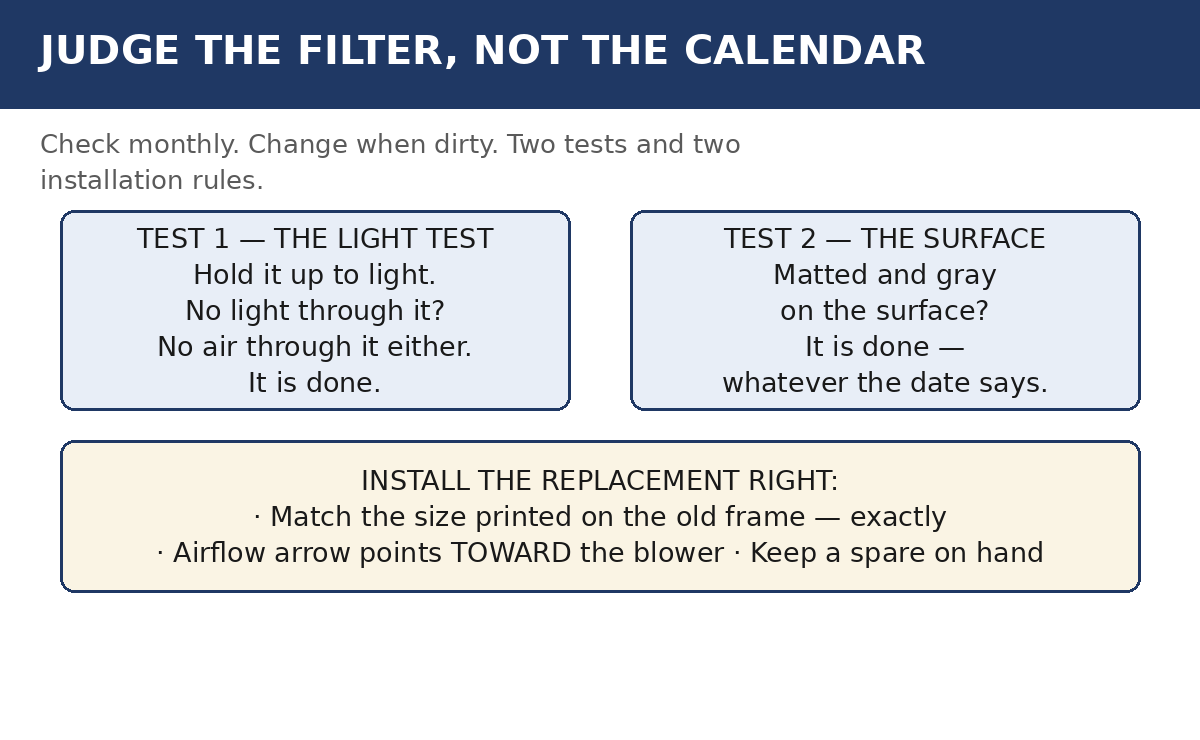
What you can safely check
- Check your current filter's size and MERV rating — both are printed on the frame. Check its fit, too: no gaps at the edges.
- Replace a loaded filter on schedule. A clogged high-rated filter restricts airflow worst of all (Q65).
- Ask a technician before upgrading MERV on older system or a system with weak airflow.
How this works
Filters are rated by MERV — short for Minimum Efficiency Reporting Value. It is a rating of how much dust and fine particles an air filter catches. Higher numbers catch smaller particles. The particles homeowners care about most. Pollen, dust, pet dander, mold spores. Sit squarely in the range a good filter handles.
So yes: within its lane, a better filter genuinely cleans the air that circulates through your duct system. For many homes, it is one of the most cost-effective air-quality steps available.
The lane has edges, and the EPA's own guidance draws them.
Edge one is airflow.A denser filter makes the blower work harder. In a system not designed for it, a high-MERV filter can restrict airflow enough to cause weak vents, frozen coils. Overheated furnaces (Q83). That is why the agency's advice is two-sided: aim for MERV 13,or the highest your system can safely use. The second half is not fine print. It is the difference between an upgrade and a self-inflicted fault.
One practical middle path: thicker media filters can catch more with less airflow resistance, because they offer more surface area. Worth asking about if your filter rack accepts them.
Edge two is fit.A filter that is the wrong size. Or seated with gaps at its edges. Lets air bypass it unfiltered. That is a hole shaped exactly like a filter (Q65). Rating without fit is just a number on a box.
Edge three is scope.The filter treats air thatreachesit, while it circulates. It does nothing for moisture and mold sources (Q87). Nothing for carbon monoxide — a poisonous gas with no color and no smell. Nothing for gases and odors.
The EPA frames indoor air quality as three strategies: control the sources, ventilate the right amount, and filter the air. Filtration is one leg, not the whole stool. Removing a source, where you can, is the stronger layer.
| Question | Answer |
|---|---|
| Target rating? | Ask Texas Heat & Air about the training and credentials of the technician coming to your home. |
| Main risk? | Airflow restriction on systems not designed for it |
| Fit requirement | Exact size, snug — bypass defeats rating |
| What it can't do | Moisture, carbon monoxide, gases, sources — see Q87 |
When to call a professional
Ask a technician before a MERV upgrade on older system. On a system that already has weak airflow. At a visit, the technician can judge the system's airflow capacity. They can check the filter rack's condition and fit. And they can confirm the chosen filter still lets the system breathe.
What happens next
The unglamorous verdict: for most homes, the best air-cleaning move is the right filter, fitting snugly, suited to the system's airflow, changed on time (Q65). Exotic filtration on a neglected schedule loses to an ordinary filter maintained well. Start there before pricing anything fancier.
Texas Heat & Air next step
Thinking of a MERV upgrade on an older system? Ask about your airflow first. Call Texas Heat & Air at (682) 438-8127 and have your current filter's size and rating ready.
Related Questions
 Why does my home feel damp when the AC is on?Why is there dust around my air vents?Does every home need duct cleaning?

Still Have Questions? Ask an HVAC Expert.
Couldn't find the answer you need? Tell us what's happening. Our team will review your question and contact you to help.
Ask Your Question →Sources
- https://www.epa.gov/indoor-air-quality-iaq/guide-air-cleaners-home — U.S. EPA, "Guide to Air Cleaners in the Home": MERV guidance and the capabilities and limits of filters and air cleaners (accessed October 13, 2026)