
Air Filters, Indoor Air Quality, and Safe Homeowner Maintenance
How HVAC filters really work: the MERV-versus-airflow tradeoff, why fit matters as much as rating, what filters cannot fix. Why dust gathers at vents.

Your air filter is the one part of the HVAC system you maintain yourself. And the one part that quietly protects everything else. It is also the part surrounded by the most misleading marketing in the industry. Filters are sold by a single number, MERV, as if higher were simply better. It is not. Every filter sits in the middle of a tradeoff: catching particles versus letting air through. The right answer depends on your system's strength, your filter's fit. How faithfully you change it.
This guide teaches the tradeoff itself. You will learn how air moves through a filter. What restriction does to the system downstream. You will learn what MERV numbers measure. You will learn why a filter can only treat the air that reaches it. And you will learn how to follow dust at your vents back to its real source. Sometimes that source is the ducts, sometimes the filter fit. And often it is just the house being a house.
Key takeaways
- A filter's job is double: catch particles and let air pass. Every gain in one is paid for in the other.
- MERV measures particle capture. It does not measure how hard your blower must work — that cost is real. It is yours to check before upgrading.
- Fit beats rating. Air takes the easiest path, so a high-MERV filter with gaps at its edges filters less than a modest filter that seals.
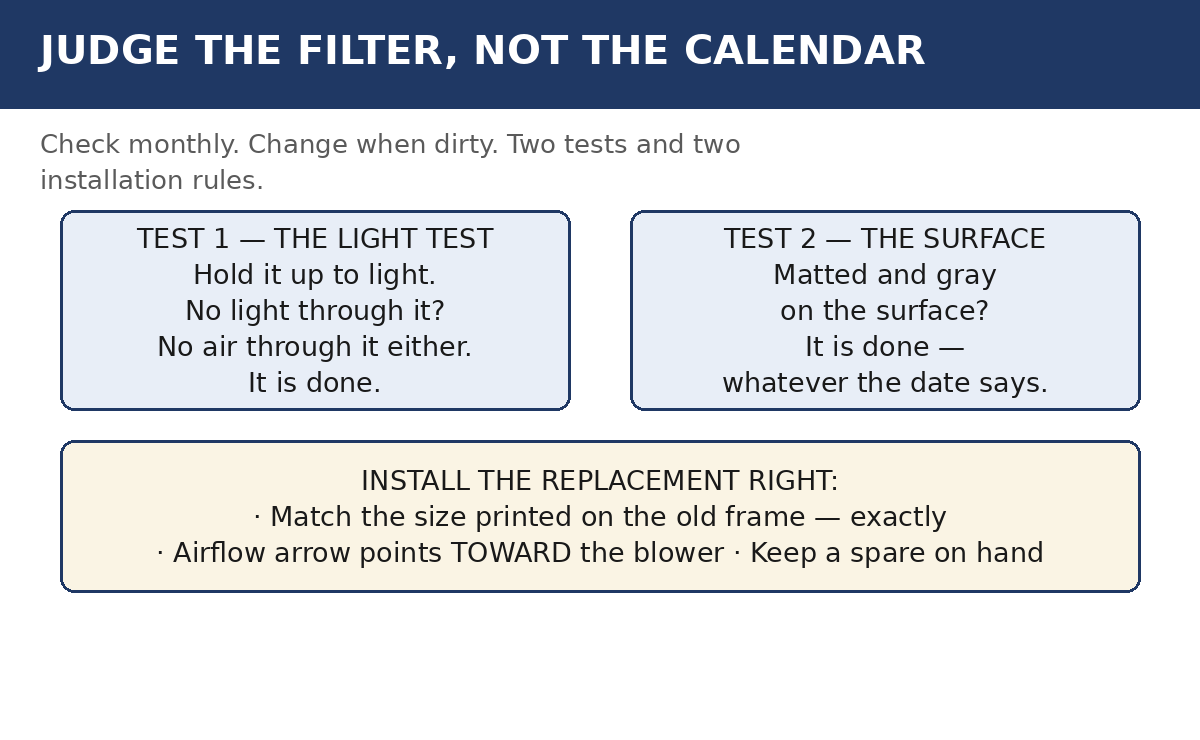
- Check the filter monthly and change it by how it looks, not by the calendar. If you cannot see light through it, it is done.
- A filter cannot fix moisture, gases, odors, or a pollution source. And dust at a vent, by itself, does not prove your ducts need cleaning.
How it works
The air loop, and where the filter sits in it
Follow one parcel of air. Your system pulls room air in through return vents. That air passes through the filter. Then the blower pushes it across the indoor coil. Cold in summer, warm in winter. And out the supply vents into your rooms. The filter stands at the front of that line for two reasons. It catches particles before they coat the coil and blower. And, as a side benefit, it cleans some of the air you breathe.
That position explains both its power and its limits. Everything the system heats or cools passes the filter. But only the air that circulates gets treated. Air in a closed room with the door shut, moisture rising from a shower, fumes from a cleaning product: the filter never sees them until they mix into the return stream. And some things it can never catch at all.
Restriction: the price every filter charges
Air does not pass through filter media for free. The blower must push against the filter's resistance. Technicians call that resistance static pressure. In plain terms, how hard the blower has to push to move air through the home. The resistance rises in two ways. A finer filter resists more from the day it is installed. And every filter resists more as it loads: the dust it catches becomes part of the barrier. A filter near the end of its life is not just dirty. It is a steadily tightening choke point.
The chain downstream matters more than the filter itself. Too little airflow makes a cooling coil run too cold, and it can freeze solid. It makes a furnace run too hot. Safety limits shut it down mid-cycle. It lengthens run times, raises bills. Strains the blower motor on every start. This is why the filter is the first thing checked in half the problem guides in this library. It is the cheapest part in the system. The one whose neglect travels furthest.
What MERV actually measures
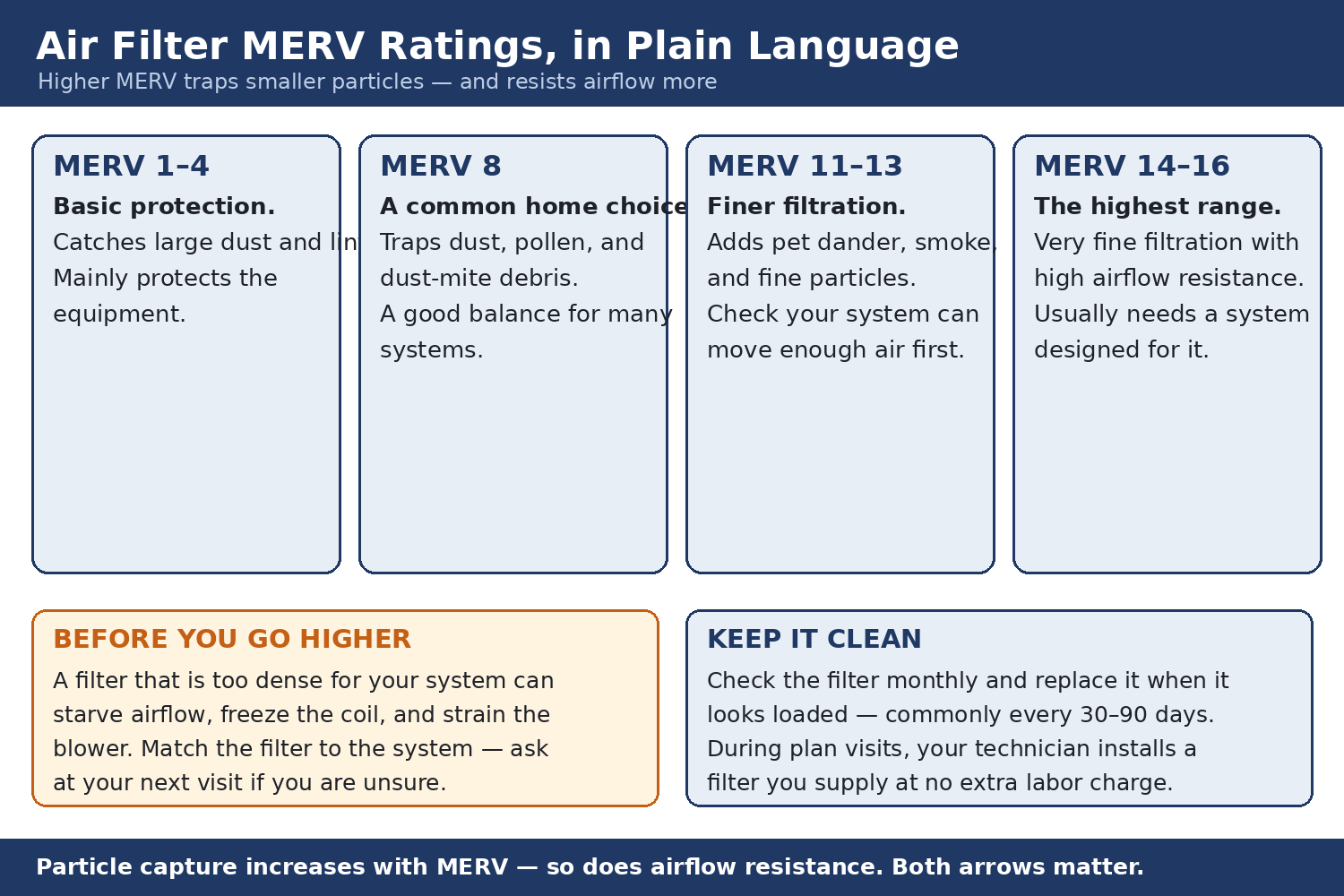
MERV is short for Minimum Efficiency Reporting Value. It is a rating of how much dust and fine particles an air filter catches. Higher numbers catch smaller particles. The rating covers a range of particle sizes, from large lint and dust down to fine, smoke-sized particles. Low numbers (1–4) catch mostly the big stuff and mainly protect system. The middle range (around 8) is the common home choice, catching dust, pollen, and dust-mite debris. Higher ranges (11–13) add pet dander, smoke, and finer particles. The top range (14–16) approaches hospital-style filtration and resists airflow strongly. Most home systems were never designed to push air through it.
Two things the number does not tell you: how much resistance that filter adds in your system. Whether it fits your filter slot. Both of those are decided at your house, not on the package.
Bypass: the silent failure
Air is lazy. Given a choice between pushing through dense filter media and slipping through a quarter-inch gap at the frame, it slips. A wrong-size filter, a bent frame. A rack that does not seal lets a share of your air skip filtration entirely. That air carries its dust straight to the coil the filter was meant to protect. Back out to your rooms. This is why a modest filter installed snugly outperforms an expensive filter installed badly. And it is why "check the fit" appears in this guide as often as "check the rating."
The situations homeowners ask about
What care is safely yours — and where the line is
The safe list is short but mighty: replace an accessible air filter. Keep supply vents open and return vents uncovered (closing many vents does not save energy. It strains airflow); keep about two feet of clearance around the outdoor unit, clearing leaves and debris with no covers removed; and use the thermostat correctly. The thermostat is the wall control that reads the room temperature and tells the system when to start and stop. System manuals define exactly what the maker counts as homeowner-safe for your model, and they are worth keeping.
The line sits where it does for concrete reasons. Capacitors — electric parts that store a charge and help motors start and run — hold a dangerous charge even with the power off. Refrigerant handling is restricted by law to certified technicians. Gas and combustion parts can produce carbon monoxide, a poisonous gas with no color and no smell, when mishandled. Anything that needs a cover removed, a wire touched. A gas or refrigerant part handled is pro work — full stop.
The short answer: Q64 — What HVAC care can I safely do myself? (/hvac-help/hvac-care-you-can-safely-do-yourself/)
The filter rhythm: judge it by sight
Check the filter every month, especially during heavy use. Replace it when it looks dirty. Many common filters need changing at least every three months, but the filter itself is the real schedule. Hold it up: if you cannot see light through it. The surface is matted gray, it is done — whatever the date says. Filters load at different speeds. Pets, nearby construction, open windows. Long summer run times can fill one in weeks. A lightly used system may go a full season.
Three habits make the rhythm stick. Match the size printed on the old filter's frame exactly. Install with the airflow arrow pointing toward the blower. And keep a spare on hand, so a dirty filter never waits on a shopping trip. If filters clog unusually fast. Airflow stays weak with a clean filter installed, treat that as a symptom worth raising at your next service visit. It can point to duct leaks. Conditioned air escaping through gaps in the ducts. Or other problems beyond the filter.
The short answer: Q65 — How often should I change my air filter? (/hvac-help/how-often-should-i-change-my-air-filter/)
Choosing a MERV: the tradeoff, decided at your house
Ask Texas Heat & Air about the training and credentials of the technician coming to your home. Read that sentence whole, because both halves matter. MERV 13 captures a genuinely useful share of fine particles. But "your system can safely handle" is a condition, not a footnote. In a system with weak airflow or older system, a dense filter can create the freeze-ups, shutdowns. Strain described above. The practical path is this: confirm the exact size and a snug fit first. Then step the rating up within what your system tolerates. And ask a technician about your airflow before jumping to the top of the scale — especially on older system.
Keep the expectations honest, too. Filtration is one of three indoor-air strategies the EPA describes. The other two are source control (removing or reducing what pollutes the air) and ventilation (bringing in fresh air). A filter does nothing for moisture and mold sources, carbon monoxide, or gases and odors. For most homes, the best air-cleaning investment remains unglamorous: the right filter, fitting snugly, changed on time.
The short answer: Q88 — Will a better HVAC filter clean my indoor air? (/hvac-help/will-a-better-hvac-filter-clean-indoor-air/)
Dust at the vents: follow it backward
Some dust near vents is normal. Room air carries dust. Vents are where air moves. Dark streaks around a supply vent (sometimes called ghosting) form when moving air deposits fine particles on the cooler surface around the opening. The useful question is where the particles came from. There are three usual answers. First, the house itself: cooking, candles, pets, carpet fibers. Outdoor air all load indoor air with dust. Second, filter bypass: a poorly fitting filter lets unfiltered air through at its edges. Third — the one worth investigating — return-side duct leaks. A return duct pulling air from a dusty attic or wall cavity loads the system with debris. The system then delivers that debris to every room.
The pattern tells you which answer you have. Dust that returns within days of cleaning, worst around vents, alongside a filter that clogs fast, merits a filter-fit and duct inspection. But hold the honest limit from the EPA's duct guidance: dust at vents alone is not a diagnosis. By itself, it is not a reason to buy duct cleaning. Duct cleaning has specific, narrower indications. Visible mold growth in ducts, vermin infestation, or debris clogging the system. Routine cleaning as a dust cure is not one of them.
The short answer: Q90 — Why is there dust around my air vents? (/hvac-help/why-is-there-dust-around-my-air-vents/)
Diagrams and comparisons
F11R-merv-guide.png—MERV ratings in plain language: finer filtration traps smaller particles and resists airflow more. Match the filter to what your system can handle.Read the four panels as a seesaw: the left side is what you gain (smaller particles captured), the right side is what you pay (airflow resistance). The right filter for your home is the highest step your system can stand on without the seesaw tipping into strain.
b3-14-q65-filter-judgment-panel.png—Judge the filter, not the calendar: light test, surface test, exact size, arrow toward the blower.The panel turns the monthly check into a 30-second routine: hold the filter to the light, look at the surface. When you replace it, match the frame size exactly and point the arrow toward the blower.
| As MERV rises… | You gain | You pay |
|---|---|---|
| 1–4 → 8 | Real dust, pollen, and debris capture; still easy airflow | Slightly more resistance; the standard home balance |
| 8 → 11–13 | Pet dander, smoke, finer particles; EPA's MERV 13 target lives here | Noticeably more resistance — confirm your system can handle it |
| 13 → 14–16 | The finest capture available in a filter | High resistance; usually needs a system designed for it |
What you can safely do yourself
- Check the filter monthly; change it when it is dirty, matted, or blocks the light.
- Match the replacement's size to the old filter's frame exactly. Install it with the airflow arrow toward the blower.
- Verify the fit: no gaps at the edges where air can slip past.
- Keep supply vents open and return vents clear of furniture.
- Keep about two feet of clearance around the outdoor unit; clear leaves and debris without removing any covers.
- Clean accessible vent covers if dust is visible on them.
- Keep a spare filter on hand so a change never waits.
What a technician checks
When a filter question is really a system question, a technician measures instead of guessing. The technician measures the system's airflow and static pressure with your chosen filter installed. The technician checks the filter rack's condition and seal. And when dust or fast-clogging filters point deeper, the technician looks for return duct leakage and checks supply duct condition. That measurement is how "how high can my system go on MERV?" gets a real answer for your house, instead of a generic one. At a maintenance visit, the filter is also part of the standard check. And if you supply the filter, it is installed during the visit.
Making the decision
Choose your filter in this order. Size first: the exact dimensions on your current frame. Fit second: a rack that seals, a frame that is not bent. Rating third: the highest MERV your system's airflow tolerates. MERV 13 is the EPA's suggested target where the system can handle it. A lower rating changed on time beats a higher rating left in too long. Rhythm last: monthly checks, changed by sight. And keep the decision in proportion: if your concern is a smell, a moisture problem, or a specific pollutant, a filter is the wrong tool. Name the source first. Use source control or ventilation for what filtration cannot touch.
North Texas notes
North Texas systems run long hours through the cooling season. Runtime is what loads filters. A filter that would last a season in a mild climate can load in weeks here during peak summer. Pollen seasons compound it: spring and fall pollen, plus dust from dry, windy stretches, all pass through the same return air. The practical translation is boring and valuable: in a North Texas summer, "check monthly" is not a suggestion. It is the difference between a system breathing freely in August and one straining against a matted filter at the hottest moment of the year.
Related resources
- Q64 — What HVAC care can I safely do myself? (/hvac-help/hvac-care-you-can-safely-do-yourself/)
- Q65 — How often should I change my air filter? (/hvac-help/how-often-should-i-change-my-air-filter/)
- Q88 — Will a better HVAC filter clean my indoor air? (/hvac-help/will-a-better-hvac-filter-clean-indoor-air/)
- Q90 — Why is there dust around my air vents? (/hvac-help/why-is-there-dust-around-my-air-vents/)
- Guide 10 — Preventive Maintenance and the Home Comfort Maintenance Plan (/hvac-help/guides/maintenance-and-membership/)
- Guide 12 — HVAC Engineering Explained Simply: How Cooling, Sizing, and Efficiency Really Work (/hvac-help/guides/hvac-engineering-explained/)
Texas Heat & Air next step
If your filters clog fast, airflow feels weak. You are unsure how high a MERV rating your system can handle, that is a measurement question. And it is answered during a service visit. When a technician can check airflow and filter fit on your actual system. Texas Heat & Air serves Cleburne, Burleson, Granbury, and Fort Worth. Call (682) 438-8127 to confirm coverage for your address.

Understanding the system comes first: learn how the pieces work together, use the safe checks. Let a qualified technician confirm anything inside the system.
Related Homeowner Questions
 How often should I change my air filter?Will a better HVAC filter clean my indoor air?Why is there dust around my air vents?

Still Have Questions? Ask an HVAC Expert.
Couldn't find the answer you need? Tell us what's happening. Our team will review your question and contact you to help.
Ask Your Question →Sources
- https://www.epa.gov/indoor-air-quality-iaq/guide-air-cleaners-home — U.S. EPA, Guide to Air Cleaners in the Home: MERV guidance, filter capabilities and limits, and the three indoor-air strategies
- https://www.epa.gov/indoor-air-quality-iaq/should-you-have-air-ducts-your-home-cleaned — U.S. EPA: dust sources, and when duct cleaning is and is not warranted
- https://www.energystar.gov/saveathome/heating-cooling/maintenance-checklist — ENERGY STAR's maintenance checklist: homeowner scope, monthly filter checks
- https://www.energystar.gov/saveathome/heating-cooling — ENERGY STAR heating and cooling hub: filter guidance and efficient use
- https://www.epa.gov/section608/section-608-technician-certification-requirements — EPA Section 608: refrigerant handling is restricted to certified technicians