
Diagnostic Fees, Repair Pricing, and Written Estimates: What You Are Paying For
How HVAC pricing honestly works: the flat diagnostic fee, why repair prices can't be quoted before diagnosis. How to read a written estimate.

Almost every argument about HVAC pricing starts with one misunderstanding: expecting a repair price before anyone knows what is broken. A symptom is not a cause. "It stopped cooling" can end at a small electric part. Or it can end at the most expensive part in the system. No honest person can tell you which from a phone call. Or what it will cost.
This guide explains the structure that replaces guessing with knowledge. There is one fixed, published price in the process: the diagnostic visit. Everything after it is priced from evidence, in writing, with your approval as the gate. You will learn what the diagnostic fee buys. You will learn why it is charged separately from repairs. You will learn what sets a repair's price once the failed part is known. And you will learn how to read an estimate. Anyone's estimate. So an invoice cannot surprise you.
Key takeaways
- Ask Texas Heat & Air to confirm the diagnostic fee when you book. It pays for finding the problem.
- The fee is a standalone service, not a deposit: it is not credited toward repairs. The written findings are yours to keep in every outcome.
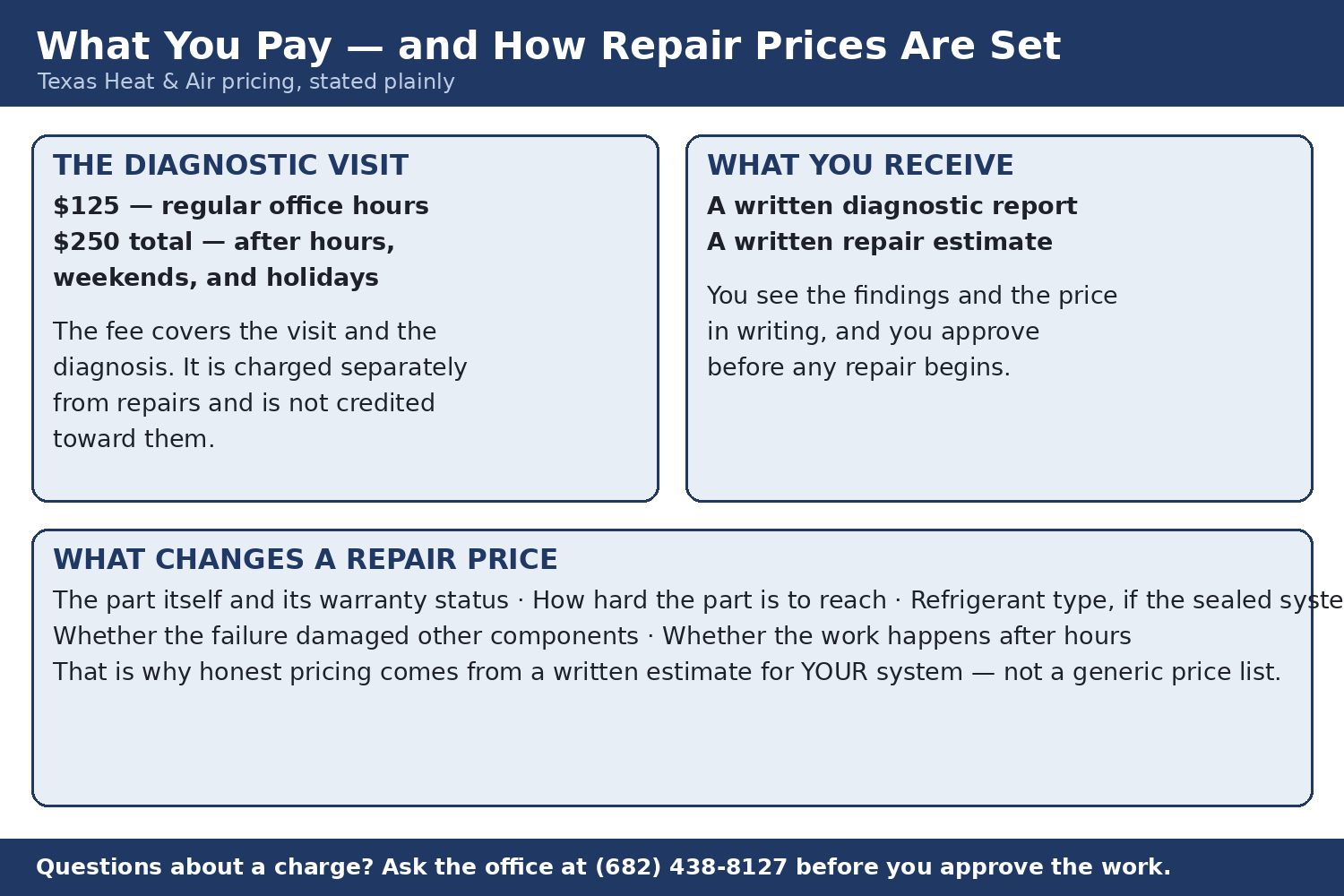
- A repair's price is built from facts a technician can find: the failed part and its exact specification, labor, access, warranty status. Any collateral damage. That is why it can only be quoted after diagnosis.
- The written estimate, approved by you before work begins, is the document that makes the final invoice predictable.
- A final repair price quoted sight unseen, over the phone, is a guess — treat it as one.
How it works
A symptom is a question, not an answer
AC units fail in overlapping ways. A system that hums but will not start might have a failed capacitor, a failed contactor, a motor problem, or a control fault. Those parts have very different prices, yet they produce nearly identical behavior. Warm air can come from airflow, refrigerant, electric, or control causes. Diagnosis turns that overlap into one proven cause. The technician follows the symptom through the system and tests each part that could produce it. Testing — not pattern-matching — says which one failed.
That proven answer is what the diagnostic fee buys. Think of it as buying a verified answer, not a first installment on a repair. Seen that way, every other pricing rule in this guide falls into place.
Three different appointments, three different products
Much pricing confusion dissolves once three kinds of visit are kept separate:
| Appointment | What it produces | Price |
|---|---|---|
| Diagnostic visit | A proven cause, a written diagnostic report, and a written repair estimate | Costs vary by home, system, and repair. Ask Texas Heat & Air for a written estimate before work begins. |
| Repair visit | The approved repair, performed at the estimated price | The written estimate you approved |
| Replacement estimate | A proposal for new system or a complete replacement | Ask Texas Heat & Air what it costs before you book |
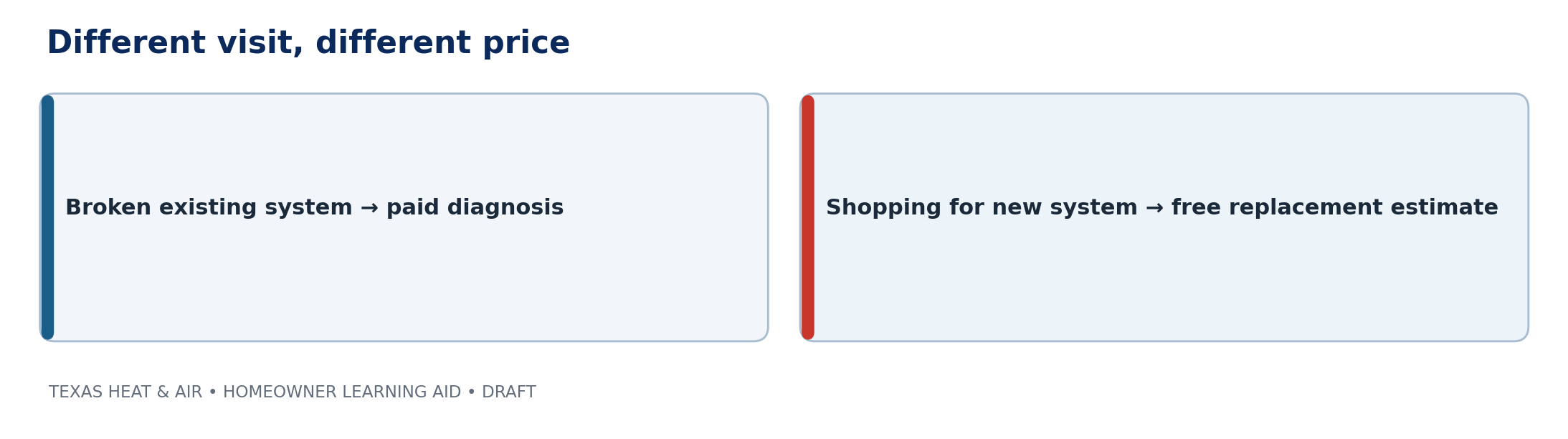
Ask Texas Heat & Air what a review or estimate costs before you book. You have already decided to shop for a new system. The diagnostic visit is paid because the fault-findingisthe work. Confusing the two is the most common booking mistake in this category. It means expecting a free visit to diagnose a broken system. Or paying a diagnostic fee when all you want is a replacement proposal.
Why the fee stands alone
Companies run two models. In the credit model, the diagnostic fee folds into the repair price if you hire that company for the repair. That quietly ties the value of the diagnosis to buying the repair. And the fee's value stays behind if you take the finding elsewhere. Texas Heat & Air uses the standalone model: the fee buys the answer outright. The written report and estimate are yours either way. You can approve the repair, postpone it, replace the system instead. Carry the documents to a second company for comparison. The technician's job on the visit is the accuracy of the finding. Because the finding is the product.
Budget with open eyes: count both lines from the start. There is the diagnostic fee, plus the repair estimate if you go ahead. One related question: ask Texas Heat & Air whether a plan's repair discount applies to the diagnostic fee. Plan terms live in Guide 10 (/hvac-help/guides/maintenance-and-membership/).
What a repair price is actually made of
Once the failed part is proven, the estimate is arithmetic, not a mystery. Its ingredients:
- The part itself— what the part is. Its exact rating and specification for your system. Many parts are not interchangeable shelf items. Getting the specification right is part of the price.
- Labor— the time the job takes. The time grows with refrigerant recovery and recharge, attic or tight-space access, and multi-stage work.
- Warranty status— a part under the maker's warranty may leave you paying mainly labor. The same repair out of warranty is a different number.
- Collateral damage— a fault left running often injures neighboring parts. A dying capacitor strains a motor. An arcing contactor damages what it feeds. Honest estimates state what else was found.
- Timing— after-hours work carries the after-hours structure described above.
These ingredients differ from house to house. So published "typical repair cost" lists. Including the precise-looking ranges on national websites — cannot price your repair. They describe other people's systems. Your price exists only after your diagnosis. That is the entire design of the process.
The situations homeowners ask about
What the visit costs and what it includes
Ask Texas Heat & Air to confirm the diagnostic fee when you book. Costs vary by home, system, and repair. Ask Texas Heat & Air for a written estimate before work begins. Ask Texas Heat & Air to confirm the diagnostic fee when you book. The scope follows your symptom. It can cover thermostat signals, electric controls and connections, motors, airflow, the condensate drain (the pipe that carries away the water the system removes from the air). Measured cooling or heating performance, as the problem needs. If your system needs specialized testing beyond the standard evaluation, that should be explained. With its cost — before it is done. The visit always ends the same way: a plain-language explanation, a written diagnostic report, and a written repair estimate. The short answers: Q51 — How much is an HVAC diagnostic visit? (/hvac-help/hvac-diagnostic-visit-cost/) and Q52 — What does the diagnostic fee include? (/hvac-help/what-does-the-diagnostic-fee-include/)
Why the fee is not credited toward the repair
Because the diagnosis is a complete service with its own deliverable — not a down payment. You keep the value either way. The verified finding and the written estimate are yours in every outcome, including the outcome where another company does the work. The short answer: Q53 — Does the diagnostic fee count toward my repair? (/hvac-help/does-the-diagnostic-fee-count-toward-repair/)
Why nobody can quote your repair yet
Ask for a "typical" repair price and the honest answer is that the category spans too much. The same symptom can resolve to a modest part or to a compressor. The pump at the heart of the system. Its most expensive part. What can be given in advance is the structure: the fixed diagnostic price, then an estimate built from the drivers above. When you call, give the office your unit's make, model, and age. Age and warranty status move prices, and having them ready speeds honest answers. The short answer: Q54 — How much does a typical AC repair cost? (/hvac-help/how-much-does-a-typical-ac-repair-cost/)
Two small parts that prove the rule
Capacitors and contactors are quoted together because they live in the same cabinet and fail with similar sounds: humming, clicking, a unit that will not start. But they are different parts doing different jobs. A capacitor is an electric part that stores a charge and helps a motor start and run. A contactor is a heavy-duty electric switch in the outdoor unit. It turns the compressor and outdoor fan on when the thermostat (the wall control that tells the system when to start and stop) calls for cooling. Each part has its own price, set by its specification for your system and the labor involved. That is why neither can be priced before testing shows which one failed. And neither should ever be replaced on a symptom alone. One safety note outranks the pricing: a capacitor holds a dangerous electric charge even with the power off. These parts are technician-only, always. The short answer: Q55 — How much does a capacitor or contactor repair cost? (/hvac-help/capacitor-or-contactor-repair-cost/)
The paper that protects you
After diagnosis, you receive two documents with two different jobs. The diagnostic report records the finding: what failed and what was measured. The repair estimate records the proposed work and its price. Keep the two together. Together they form the complete record: what was found, what it cost to fix, and what you approved. That is exactly what a second opinion or a warranty question will ask for later. No repair begins until you approve the estimate. Sometimes a job changes mid-repair. Older system can reveal a second problem once it is opened. Then the process repeats: an explanation, an updated written quote, your approval. Verbal add-ons are where misunderstandings are born. A legitimate discovery survives being written down. The short answer: Q58 — Will I get a written estimate before repairs begin? (/hvac-help/written-estimate-before-repairs/)
Diagrams and comparisons
F08R-pricing-transparency.pngAsk Texas Heat & Air to confirm the diagnostic fee when you book.
Q051_hvac-diagnostic-visit-cost.svg— "Different visit, different price." The diagram draws the fork homeowners most often miss: a broken existing system leads to a paid diagnosis. Ask Texas Heat & Air what an estimate for a replacement system costs before you book.
What a complete estimate contains
| Element | Why it matters |
|---|---|
| The finding, tied to the diagnostic report | Separates "what is wrong" from "what it costs" |
| The work and parts, in plain terms | You know what you are approving |
| Parts and labor, separated | You can see how the price is built |
| The total price | The number the finished invoice should match |
| The change procedure | Mid-job discoveries get a new written quote, not a verbal add-on |
| Warranty terms | Workmanship and parts coverage, stated before work begins |
What you can safely do yourself
- Describe symptoms precisely when you book: what the system does. When it started, what changed, any sounds or smells. Good details makes the diagnosis faster and its scope smaller.
- Have the unit's make, model. Age from the outdoor label ready (read the label without opening covers).
- Read any estimate before signing: scope, parts, warranties, total. Ask questions before approval, not after.
- Keep your copies of the report and estimate. They are your reference for second opinions and warranty questions.
- Record symptoms of electric failures as notes. Never open the outdoor unit's cabinet to look: capacitors store a dangerous charge even when the power is off.
What a technician checks
Diagnosis is testing directed by the symptom. Depending on the problem, the technician may check the thermostat and its signals to the system. The list can also include electric controls and connections, including the starting parts. It can include the capacitor's rating against its specification, the contactor's condition, and motor use. It can include airflow through the filter and at the vents, the condensate drain and its safety switch. Measured cooling or heating performance. The point of the sequence is proof. Each test rules causes in or out until the failed part is identified. And only a proven part gets priced.
Making the decision
Comparing two companies' recommendations.Line the documents up on four points. Is the diagnosis the same, and proven by the same kind of tests? Is the proposed scope the same. Or does one estimate quietly include collateral repairs the other leaves out? Are parts and labor separated on both? Are warranty terms stated on both? Bottom lines become comparable only once the scopes match. Where a major repair is involved, a second opinion is a proportionate step. Your written report from the first visit is exactly what makes that step efficient — see Q50 (/hvac-help/second-opinion-before-replacing-ac/).
Red flags worth recognizing.A final repair price quoted over the phone, sight unseen. Reluctance to put an estimate in writing. A part recommended for replacement with no test result behind it. Pressure to approve before you have read the documents. Each is a pricing practice, not a personality trait. And each is avoidable by choosing the process described in this guide.
Budgeting the whole decision.Count the diagnostic fee and the repair estimate as separate lines from the start. Ask Texas Heat & Air what a review or estimate costs before you book. Weigh the two paths with the framework in Guide 7 (/hvac-help/guides/repair-or-replace/) before signing either.
North Texas notes
One regional reality shapes how this pricing gets used. In North Texas, AC units do most of their failing in the first serious heat of summer. That is also when every service company is busiest. Knowing the structure in advance. The diagnostic price to confirm when you book, the total to confirm for that time of day, the written-estimate rule. Lets you make calm decisions in the exact weeks when rushed ones cost the most. Costs vary by home, system, and repair. Ask Texas Heat & Air for a written estimate before work begins. You can decide whether a breakdown waits for regular hours with the price already in hand.
Related resources
- Q51 — How much is an HVAC diagnostic visit? (/hvac-help/hvac-diagnostic-visit-cost/)
- Q52 — What does the diagnostic fee include? (/hvac-help/what-does-the-diagnostic-fee-include/)
- Q53 — Does the diagnostic fee count toward my repair? (/hvac-help/does-the-diagnostic-fee-count-toward-repair/)
- Q54 — How much does a typical AC repair cost? (/hvac-help/how-much-does-a-typical-ac-repair-cost/)
- Q55 — How much does a capacitor or contactor repair cost? (/hvac-help/capacitor-or-contactor-repair-cost/)
- Q58 — Will I get a written estimate before repairs begin? (/hvac-help/written-estimate-before-repairs/)
- Guide 1 — Service Scheduling, Dispatch, and Preparing for an HVAC Appointment (/hvac-help/guides/scheduling-and-dispatch/)
- Guide 7 — Repair or Replace? A Homeowner's Decision Framework (/hvac-help/guides/repair-or-replace/)
- Guide 10 — Preventive Maintenance and Home Comfort Membership (/hvac-help/guides/maintenance-and-membership/)
Texas Heat & Air next step
Ask Texas Heat & Air to confirm the diagnostic fee when you book. Call (682) 438-8127.

Understanding the system comes first: learn how the pieces work together, use the safe checks. Let a qualified technician confirm anything inside the system.
Related Homeowner Questions
 What does the diagnostic fee include?Does the diagnostic fee count toward my repair?How much does a typical AC repair cost?How much does a capacitor or contactor repair cost?Will I get a written estimate before repairs begin?

Still Have Questions? Ask an HVAC Expert.
Couldn't find the answer you need? Tell us what's happening. Our team will review your question and contact you to help.
Ask Your Question →Sources
- https://www.energystar.gov/saveathome/heating-cooling/maintenance-checklist — what a pro heating and cooling evaluation generally examines (ENERGY STAR)
- https://www.energystar.gov/saveathome/heating-cooling — general system and repair context (ENERGY STAR)
- https://www.carrier.com/us/en/residential/hvac-resources/air-conditioners/ac-parts/ — what capacitors, contactors, and other AC parts do (Carrier)
- https://www.trane.com/residential/en/resources/troubleshooting/air-conditioners/ac-fan-not-working/ — the failure symptoms common electric parts share (Trane)
- Source note: the company-specific details in this article are awaiting confirmation from Texas Heat & Air.