
Buying a New HVAC System: Efficiency, Sizing, Financing, and Warranties
How to judge a new HVAC system beyond the system price: sizing, installation quality, efficiency, honest financing questions. The two warranties.

A new HVAC system is usually the largest mechanical buy a homeowner makes. The system price is only the visible part of it. What a system costs over its life is decided by four layers that are easy to blur together. There is the installed scope you buy. There is the energy it uses every month for fifteen-plus years. There are the terms on which you pay for it. And there are the warranties that stand behind it. Sales conversations tend to collapse all four into one number: a sticker price. Or worse, a monthly payment.
This guide separates the layers. You will learn why correct sizing and installation quality outweigh brand. You will learn how efficiency ratings translate into lower bills. And how they can fail to. You will learn which questions expose the real cost of a financing offer. And you will learn how the two warranties on your job differ, including the seam between them where surprises happen.
Key takeaways
- The system you buy is the one installed in your house. Load-calculated sizing and installation quality decide whether the rated efficiency ever reaches your bills.
- A quote is a bundle: system, efficiency tier, duct work, electric work, labor, and warranty. Quotes differ mostly in what they silently include or exclude.
- Savings from higher efficiency are real but not guaranteed — ducts, sizing, installation. Your habits share the credit or the blame.
- Judge financing by the APR and the total repayment cost in the lender's disclosures. Never by the monthly payment or a promotional headline. Approval is never guaranteed.
- Ask Texas Heat & Air about the warranty terms that apply to your repair before work begins. Labor on a maker-warranty repair may be billed separately — ask in writing.
How it works
Total cost has four layers
Think of a new system as four stacked costs. Thepurchase layeris the installed price — the subject of the quote comparison below. Theenergy layeris fifteen to twenty years of monthly electricity. Small efficiency differences add up across thousands of run-hours. Over the system's life, this layer can rival the buy layer. Theownership layeris maintenance, repairs outside warranty. The habit of keeping records that makes warranty claims simple. Thefinancing layer, if you use it, is the total repayment cost of the credit: every payment and every fee. That number belongs in the comparison beside the cash price. Not hidden inside a monthly figure. A good decision prices all four layers. A rushed one prices only the first.
Sizing is the master variable
System size should come from a load calculation. The standard calculation (called a Manual J) used to size a new system for a specific home, based on its size, insulation, windows, sun exposure. Local climate. Size should never be copied from the old unit. The old unit may have been wrong for the house as it stands today. And a size error cannot be corrected later by brand or budget. An oversized system short-cycles: it turns on and off again and again in short bursts instead of running steady, longer cycles. That wastes energy and leaves the house damp. An undersized system runs constantly and loses ground on the hottest days. Every other factor in this guide comes after this one. A proposal that names a size without measuring your home has skipped the step the whole buy stands on. Guide 12 teaches the sizing method itself (/hvac-help/guides/hvac-engineering-explained/).
Efficiency is a rating; savings are an outcome
SEER2 is the current federal rating for how efficiently a cooling system uses electricity across a season. Higher numbers mean more cooling for each dollar of electricity. For most new split-system AC units in the South. A split system is the common home setup, with one unit outdoors and one indoors. The federal minimum is 14.3 SEER2. The exact minimum depends on the type of system and its size. (Guide 12 explains the ratings in depth.) What a rating does not do is guarantee a bill. The rating is earned under test conditions. Whether your home sees it depends on several things: correct sizing. Installation quality, with the refrigerant charge (the amount of refrigerant in the system) and airflow set right; the condition of the ducts the system breathes through; your insulation; and your thermostat habits. That is why honest savings talk is a comparison with the conditions named. A guaranteed percentage or payback date, offered before anyone has measured your home, should end the conversation — not start the paperwork.
Installation quality is the multiplier
Two identical systems, installed by different crews, can perform measurably differently. Installation decides whether laboratory performance survives contact with a real attic. Federal purchasing guidance stresses proper sizing and installation for exactly this reason. The buyer's practical tool is one question: "Walk me through what you check after the system is in." The answer reveals the method. And a contractor whose method is sound is the one whose efficiency claims deserve weight.
The ducts are part of the purchase
New system connected to old, leaking ducts inherits the old loss. Cooled air escapes into the attic before it reaches a room. That loss is called duct leakage. An honest proposal inspects the ducts and says plainly whether duct work belongs in the scope. Leaving it out makes a quote cheaper and the system worse. It is the most common way a low bid wins on paper and loses in the house.
The situations homeowners ask about
Will a new system lower my power bill?
Often, yes — especially when you replace a 15- to 20-year-old unit, whose efficiency sits far below current system. But the savings have four known thieves: leaky ducts, wrong sizing, poor installation. A household that spends the gain on colder temperatures. Expect a comparison, not a promise. You should see your current system's rating set against the proposed one. Ducts should be discussed openly. A load calculation should stand behind the size. Judge the results across a full season, against the same season last year. Weather dominates any short comparison. The short answer: Q48 — Can a new AC lower my power bill? (/hvac-help/can-a-new-ac-lower-my-power-bill/)
What actually matters when buying?
In order: load-calculated sizing. Installation quality. Duct condition. Then efficiency tier, warranty terms stated separately for parts and labor, comfort features such as variable-speed use (system that runs at different speeds. More like a dimmer than a simple on/off switch). A complete installed price in writing. Brand is the last tiebreaker, not the first question. Bring your comfort-problem list to every estimate conversation: the rooms that run hot or cold, humidity complaints, noise. That list is part of the specification a good proposal is built from. The short answer: Q49 — What matters most when buying a new HVAC system? (/hvac-help/what-matters-when-buying-a-new-hvac-system/)
Why do quotes for "the same system" differ?
Because the quotes are rarely for the same scope. One includes duct repairs, a panel upgrade, a new pad and line set, permits, and disposal. The other quietly leaves them out. System type and efficiency tier add their own spread. The comparison method is mechanical. Line the proposals up. Compare scope before price: model, efficiency, duct work, electric work, warranty terms, exclusions. Then ask each contractor directly what their price leaves out. The short answer: Q57 — What affects the price of a new HVAC system? (/hvac-help/what-affects-the-price-of-a-new-hvac-system/)
Paying over time, honestly
Ask Texas Heat & Air what payment and financing options are current before you decide. It exists for a fair reason: systems fail on their own schedule, not payday's. The protective facts are these. The terms are the lender's. Lenders, rates, promotional periods. Eligibility vary by program and applicant, and they change over time. So no specific offer printed anywhere stays reliable. What is available for your job today is confirmed with the company and read in the lender's own disclosures. Approval is never guaranteed. A contractor who promises approval. Or promises a specific rate. Is describing something they do not control. The full question set for reading an offer is in the decision section below. The short answer: Q59 — Does Texas Heat & Air offer financing? (/hvac-help/does-texas-heat-and-air-offer-financing/)
The two warranties
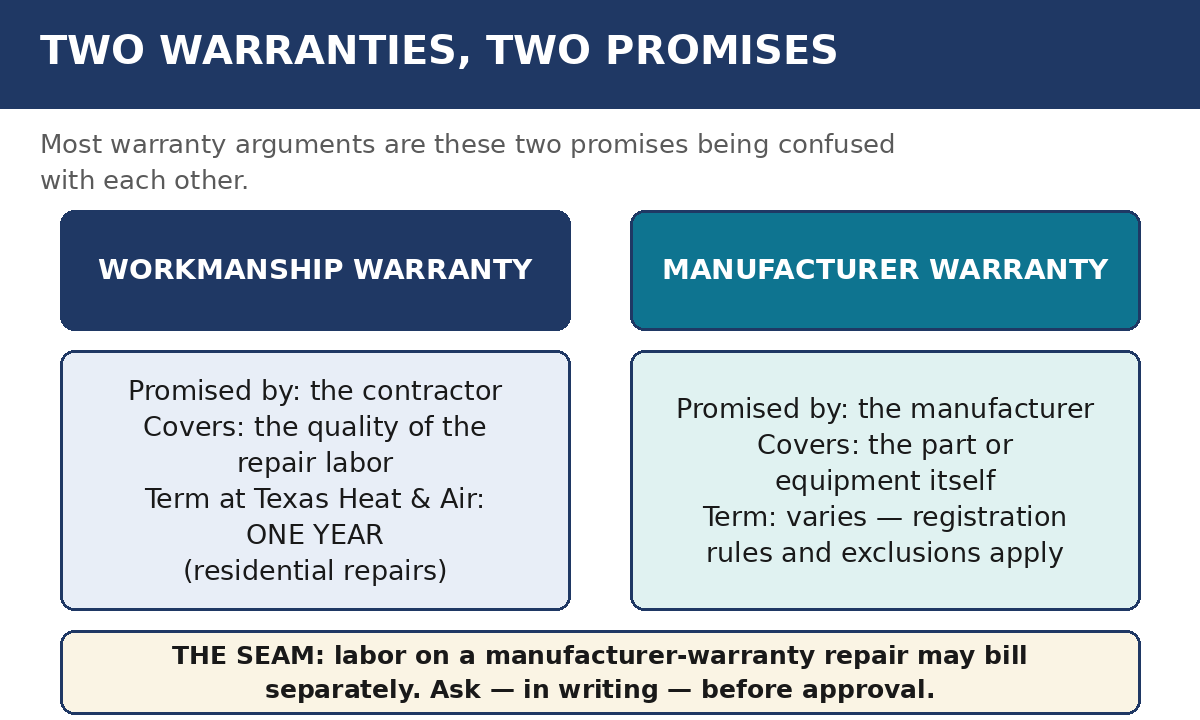
Confusing the two warranties causes most warranty arguments, so keep the parties straight. Themanufacturer warrantycovers the part or system itself, under the maker's own terms. Those terms vary by brand, model, and registration. They carry their own exclusions and claim process. Theworkmanship warrantyis the contractor's promise about the quality of its own labor. Ask Texas Heat & Air about the warranty terms that apply to your repair before work begins. The seam between them is labor on a maker-warranty repair. The maker may cover the failed part while the labor to install it is billed separately. Or it may cover both, depending on the specific coverage. Ask which applies, and what you would owe, in writing, before you approve warranty work. One administrative act protects the maker side: registration. On many products, the full term depends on registering the system. Ask who registers yours, and keep the confirmation. The short answer: Q60 — What warranty comes with an HVAC repair? (/hvac-help/what-warranty-comes-with-an-hvac-repair/)
Maintenance and your coverage
Your system warranty is a contract. Its terms may need reasonable care. On a major claim, a maker can ask for service records. A failurecausedby neglect can be denied on that basis, because the neglect is the failure's mechanism. The textbook case is a coil destroyed by years of clogged filters. Federal law protects in the other direction. Under the Magnuson-Moss Warranty Act, administered by the FTC, a maker generally cannot void coverage merely because you used an independent servicer or non-branded parts. Unless it can show that work caused the damage. Nor can coverage generally be conditioned on using the maker's own service or parts, unless those are given free. The practical program is unglamorous. Keep the system reasonably maintained. Keep every invoice and report in one file. If a claim is ever questioned, ask for the exact clause being applied. This is general consumer details, not legal advice about a specific dispute. The short answer: Q70 — Can missing maintenance affect your warranty? (/hvac-help/can-missing-maintenance-affect-your-warranty/)
Diagrams and comparisons
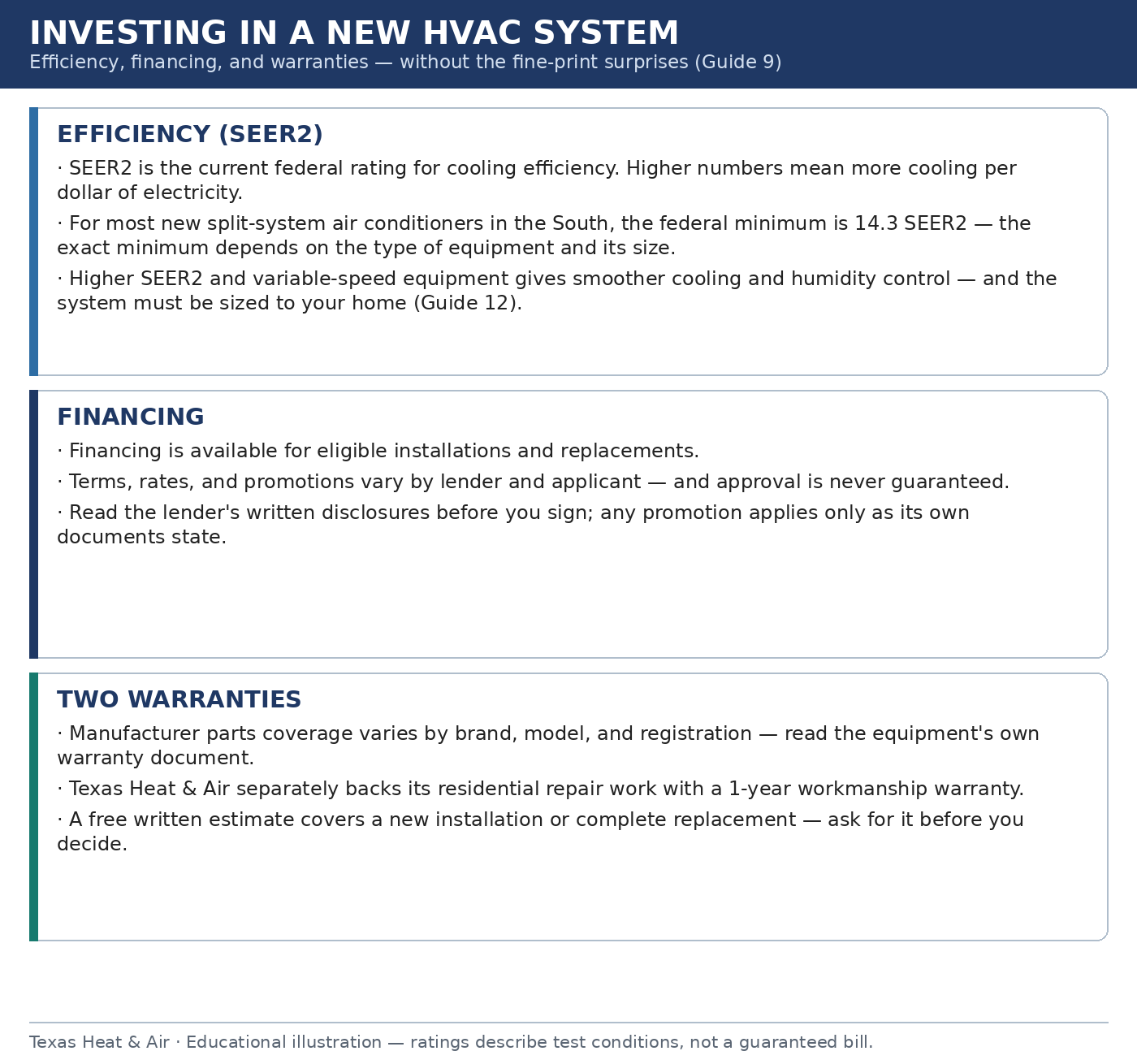
F09R-new-system-investment.pngAsk Texas Heat & Air about the warranty terms that apply to your repair before work begins.
b3-11-q60-two-warranties-chart.png— "Two warranties, two promises: the contractor covers workmanship. The maker covers parts." The chart contrasts the two columns and marks the seam: labor on a maker-warranty repair may be billed separately.
The two warranties, compared
| Manufacturer warranty | Workmanship warranty | |
|---|---|---|
| Promised by | The equipment/part manufacturer | The contractor (Texas Heat & Air) |
| Covers | The part or system itself | The quality of the repair/installation labor |
| Term | Varies by brand, model, and registration | Ask Texas Heat & Air to confirm in writing |
| Watch for | Registration rules, exclusions, claim process | — |
| The seam | Labor on a warranty-part replacement may bill separately — ask in writing |
What you can safely do yourself
- Write your comfort-problem list before collecting proposals: rooms too hot or cold, humidity, noise, rooms you want to use differently.
- Gather a year of electric bills if you can. They ground the savings conversation in your home's reality.
- Keep every written proposal for side-by-side comparison; quotes can only be compared if you keep them all.
- Start the paperwork folder now: proposals, the final contract, warranty documents, registration confirmation, invoices. Service reports all live in one place.
- Read any financing disclosures yourself — slowly, completely — before signing anything.
What a technician checks
A serious replacement proposal is built on measurements, not a catalog. The load calculation sets the correct size from your home's characteristics. The duct system is inspected for leakage, sizing, and condition. Electric capacity is checked against the new system's requirements. Site conditions — attic access, pad and line-set condition, drain routing — shape the installation scope and its labor. Those findings separate a complete proposal from an system price with installation simply assumed.
Making the decision
Compare scopes before totals.Use the same discipline as Guide 8 (/hvac-help/guides/diagnostic-fees-and-pricing/): identical scope, then price. Add the energy layer honestly. Compare tiers with conditions named, not percentages promised. Ask Texas Heat & Air what an estimate for a replacement system costs before you book. Ask each company what its estimate costs before you collect same-scope proposals to compare. Ask Texas Heat & Air what maintenance plan options are current. Get the full terms in writing before you enroll. Plan terms are in Guide 10 (/hvac-help/guides/maintenance-and-membership/).
Read any financing offer with this checklist:
| Question to ask | Why |
|---|---|
| What is the APR — not just the interest rate? | The APR folds in fees and reflects the total cost of credit (the CFPB's core lesson) |
| Are there fees beyond interest? | Origination or program fees change the true cost |
| Is any promotion a deferred-interest arrangement? | If a balance remains when the window closes, interest can be billed for the entire period, back to the start |
| What is the total repayment cost — every payment, every fee? | That is the number to set beside the written cash estimate |
| Is there a prepayment penalty? | It decides whether paying early saves you anything |
| Who is the lender, and who approves? | Approval and terms belong to the lender, not the salesperson. And approval is never guaranteed |
Choose financing, if you use it, with the total repayment cost and the cash price in view at the same time. Financing should solve a timing problem; priced honestly, it never has to create a cost problem.
Close the warranty loop before work begins.Confirm which warranty covers what on your specific job, whether labor on a maker-warranty part is covered or billed, who registers the system. Get the answers in writing on the proposal.
North Texas notes
The region's long cooling season changes the weighting of two layers. Energy first: with thousands of cooling run-hours a year, efficiency-tier differences that look small on paper add up to real money here. The energy layer deserves more weight in a North Texas buy than in a mild climate. Timing second: systems here tend to fail in the first serious heat. When installers are busiest and decisions get rushed. A homeowner who has already collected a same-scope proposal. And read the financing questions in a mild month. Makes this buy from a different, better position. That preparation is free, and this guide is most of it.
Related resources
- Q48 — Can a new AC lower my power bill? (/hvac-help/can-a-new-ac-lower-my-power-bill/)
- Q49 — What matters most when buying a new HVAC system? (/hvac-help/what-matters-when-buying-a-new-hvac-system/)
- Q57 — What affects the price of a new HVAC system? (/hvac-help/what-affects-the-price-of-a-new-hvac-system/)
- Q59 — Does Texas Heat & Air offer financing? (/hvac-help/does-texas-heat-and-air-offer-financing/)
- Q60 — What warranty comes with an HVAC repair? (/hvac-help/what-warranty-comes-with-an-hvac-repair/)
- Q70 — Can missing maintenance affect your warranty? (/hvac-help/can-missing-maintenance-affect-your-warranty/)
- Guide 7 — Repair or Replace? A Homeowner's Decision Framework (/hvac-help/guides/repair-or-replace/)
- Guide 10 — Preventive Maintenance and Home Comfort Membership (/hvac-help/guides/maintenance-and-membership/)
- Guide 12 — HVAC Engineering Explained Simply (/hvac-help/guides/hvac-engineering-explained/)
Texas Heat & Air next step
Ask Texas Heat & Air what a review or estimate costs before you book. Call (682) 438-8127.

Understanding the system comes first: learn how the pieces work together, use the safe checks. Let a qualified technician confirm anything inside the system.
Related Homeowner Questions
 What matters most when buying a new HVAC system?What affects the price of a new HVAC system?Does Texas Heat & Air offer financing?What warranty comes with an HVAC repair?Can missing maintenance affect my warranty?

Still Have Questions? Ask an HVAC Expert.
Couldn't find the answer you need? Tell us what's happening. Our team will review your question and contact you to help.
Ask Your Question →Sources
- https://www.energy.gov/femp/purchasing-energy-efficient-residential-central-air-conditioners — efficiency levels; sizing and installation quality as the determinants of delivered performance and savings (U.S. Department of Energy)
- https://www.energystar.gov/saveathome/heating-cooling/replace — replacement timing and efficiency context (ENERGY STAR)
- https://www.consumerfinance.gov/ask-cfpb/what-is-the-difference-between-a-loan-interest-rate-and-the-apr-en-733/ — why the APR, not the interest rate, shows the true cost of credit (Consumer Financial Protection Bureau)
- https://www.ftc.gov/business-guidance/resources/businesspersons-guide-federal-warranty-law — the Magnuson-Moss framework behind the servicer and parts protections (Federal Trade Commission)
- Source note: the company-specific details in this article are awaiting confirmation from Texas Heat & Air.