
Can missing maintenance affect my warranty?
Neglect-caused failures can be denied; your choice of servicer is federally protected. The difference, the records that decide claims, and the question to ask.

It can complicate a claim — and the exact written terms control. A warranty may need reasonable care, and makers can ask for service records. But federal law protects your choice of servicer: coverage generally cannot be voided just because you used an independent company or non-branded parts. Keep records either way.
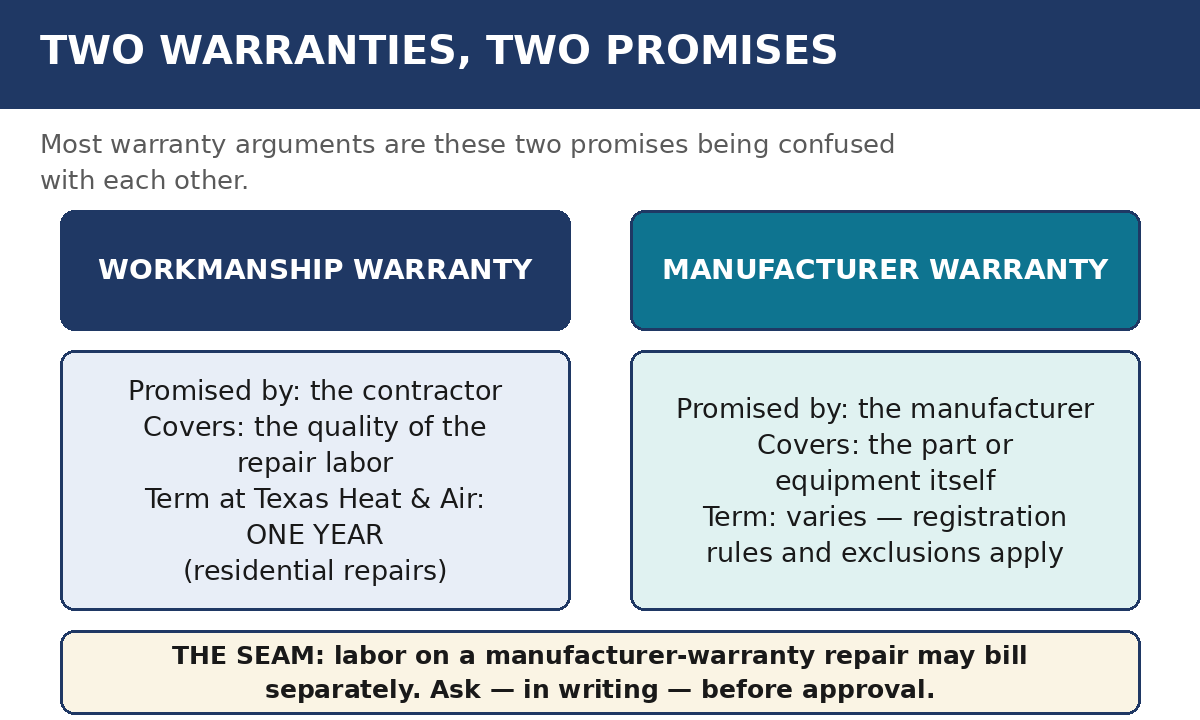
Visual explanation
Caption: Two warranties, two promises: the maker covers the system under its own terms. The contractor covers its repair workmanship — shared with Q60.The chart teaches the split this article depends on: two different warranties, two different promise-makers, two different sets of terms.
What you can safely check
- Keep invoices, maintenance notes, diagnostic reports, System Health Reports. The product warranty itself together in one file.
- Read your own warranty's maintenance language. Or ask for it to be produced. Before believing any claim about it, from anyone.
- If a claim is ever questioned, ask the maker to point to the exact clause being applied.
- Ask your contractor for copies of any service records you are missing; a well-run company keeps them and produces them.
How this works
Two different protections meet in this question. Separating them is most of the answer.
A third party sits behind many repairs: the contractor's own promise. Ask Texas Heat & Air about the warranty terms that apply to your repair before work begins. That is separate from the maker's system coverage. This varies by brand, model. Registration, and is read in its own contract terms.
The first protection is your system warranty, and it works like a contract.Its written terms may need that the system be installed correctly and reasonably maintained. When a major claim arrives. A compressor, a heat exchanger. The maker can ask for proof of that care. If a failure wascausedby neglect, the claim can be denied on that basis. A coil destroyed by years of clogged filters is the textbook example. The neglect is not incidental to that failure — it is the failure's mechanism (Q66). In a dispute, what "reasonable care" means comes down to records.
The second protection runs the other direction, and it is federal.Under the Magnuson-Moss Warranty Act, administered by the Federal Trade Commission, a maker generally cannot void your warranty just because you used an independent servicer instead of its own network. The same goes for using non-branded parts. Unless the maker can show the work or the parts caused the damage. Coverage also generally cannot be tied to using the maker's own service or parts, unless those are given free. That distinction matters in practice: having your system serviced by a local independent company does not endanger your coverage. Anyone who tells you otherwise, to sell you a service contract, is misusing the law.
So the practical program is cheap and unglamorous. Keep the system reasonably maintained, on the twice-a-year rhythm (Q61). Keep every invoice, report, and the warranty document in one file. If a claim is questioned, ask for the exact clause. Contracts are read, not vibes.
| Habit | Why it matters |
|---|---|
| Regular maintenance (Q61 rhythm) | Satisfies "reasonable care" terms |
| Records kept (invoices, reports) | Evidence when a claim is examined |
| Independent servicer | Protected by federal law — not grounds to void by itself |
| Neglect-caused failure | Can be denied — the neglect is the mechanism |
| Questioned claim | Ask for the exact clause, in writing |
One boundary: this article is general consumer details about how warranty claims work. It is not legal advice about a specific dispute. A denied high-value claim is worth a conversation with a consumer attorney. A routine one is usually settled by the paperwork habit above.
When to call a professional
Call your servicer when you are missing records for past work. Call when a claim has been questioned and you need the service history produced. Or call before a major repair if you are unsure which warranty applies. The maker's or the workmanship warranty (Q60 walks through that split).
What happens next
Start the folder today: the warranty document, your registration confirmation if you have it. Every invoice and report from here on. If your service history has gaps, do not backfill fiction. Start the rhythm now (Q61). A current, documented record is worth more than a perfect-looking past.
Texas Heat & Air next step
Missing records for service we performed? Ask for copies before you need them — (682) 438-8127.
Related Questions
 What happens if I skip HVAC maintenance?What does a Texas Heat & Air maintenance plan include?

Still Have Questions? Ask an HVAC Expert.
Couldn't find the answer you need? Tell us what's happening. Our team will review your question and contact you to help.
Ask Your Question →Sources
- https://www.ftc.gov/business-guidance/resources/businesspersons-guide-federal-warranty-law — FTC, "Businessperson's Guide to Federal Warranty Law": the Magnuson-Moss framework behind the servicer and parts protections described here. (This live FTC guide replaces the retired consumer.ftc.gov warranties page, which returned 404 on October 13, 2026.)