
Booking an HVAC Service Visit: Scheduling, Dispatch, and How to Prepare
Ask Texas Heat & Air to confirm the diagnostic fee when you book.

Most of the stress in a breakdown comes from not knowing how the process works. Who do you call? How soon can anyone really get there? What does the visit cost, and what do you get for that money? At what point are you committed to anything?
This guide answers those questions as one connected lesson, because they are connected. How a visit is booked shapes when it happens. What happens at the visit shapes every decision after it.
By the end, you will know how coverage is confirmed. You will know why honest companies give arrival windows instead of exact times. You will know what a diagnostic visit is — and what it is not. And you will know which decisions stay in your hands, from the first call to the final bill.
Key takeaways- Coverage is confirmed by your exact street address when you book. Not by a published ZIP code list. - You get a confirmed arrival window, never a guaranteed exact time. Ask Texas Heat & Air to confirm the diagnostic fee when you book. The fee is charged on its own. It is not credited toward repairs. - No repair work begins until you approve the estimate. You can approve it, decline it. Take the written report to another company. - Good preparation is simple: access, pets secured, symptom notes. Past records. It never includes opening the system.
How it works
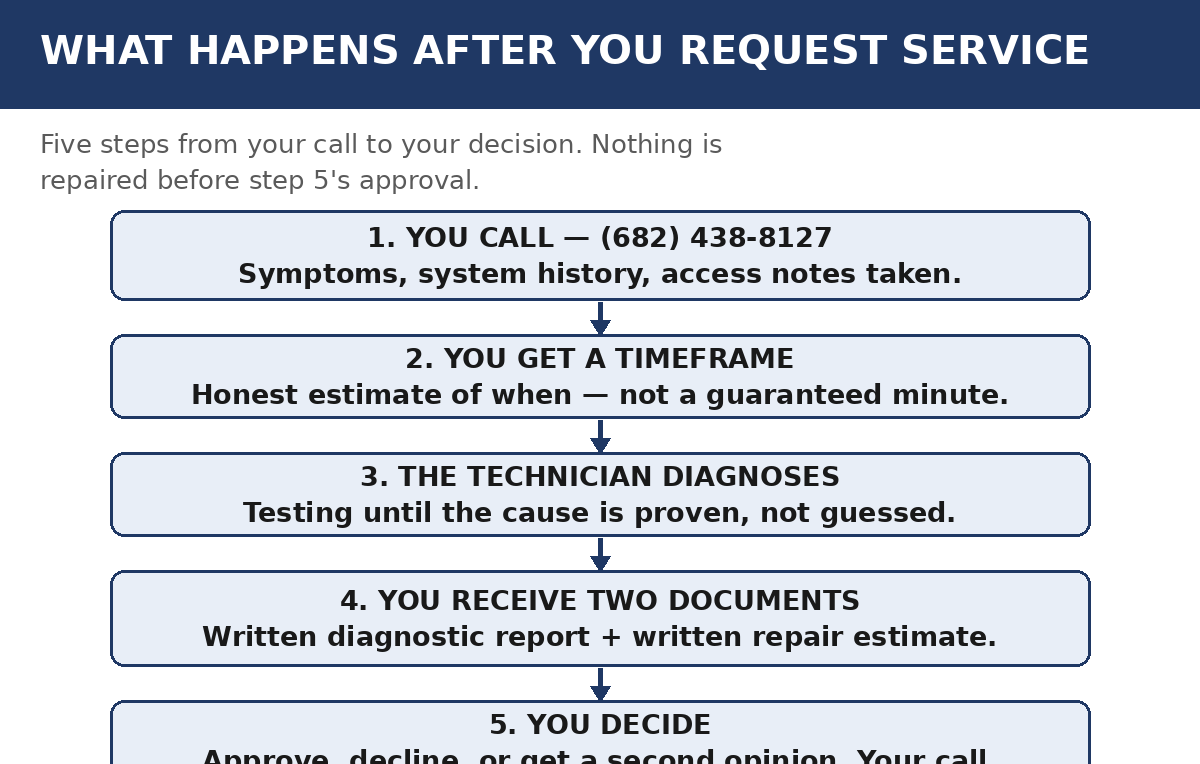
A service visit moves through five stages. Most frustration comes from mixing them up. People expect stage four. A decision about repairs. Before stage three, diagnosis, has even happened. Or they hear "same-day" as a promise about stage five, a finished repair. When it only ever described stage two, getting a visit booked.
Stage 1 — The request.You describe the problem: what the system is doing, when it started. Anything you noticed — sounds, smells, leaks, messages on the thermostat. That description is not small talk. It shapes how much time the office allows for the visit, and what the technician brings.
Stage 2 — Scheduling and dispatch.The office confirms that your address is in the service area. It fits the visit into the day's routes and confirms your arrival window. Dispatch is route planning. Technicians move from home to home across a wide area. Each job takes as long as it takes. The day's plan is built around the windows already promised.
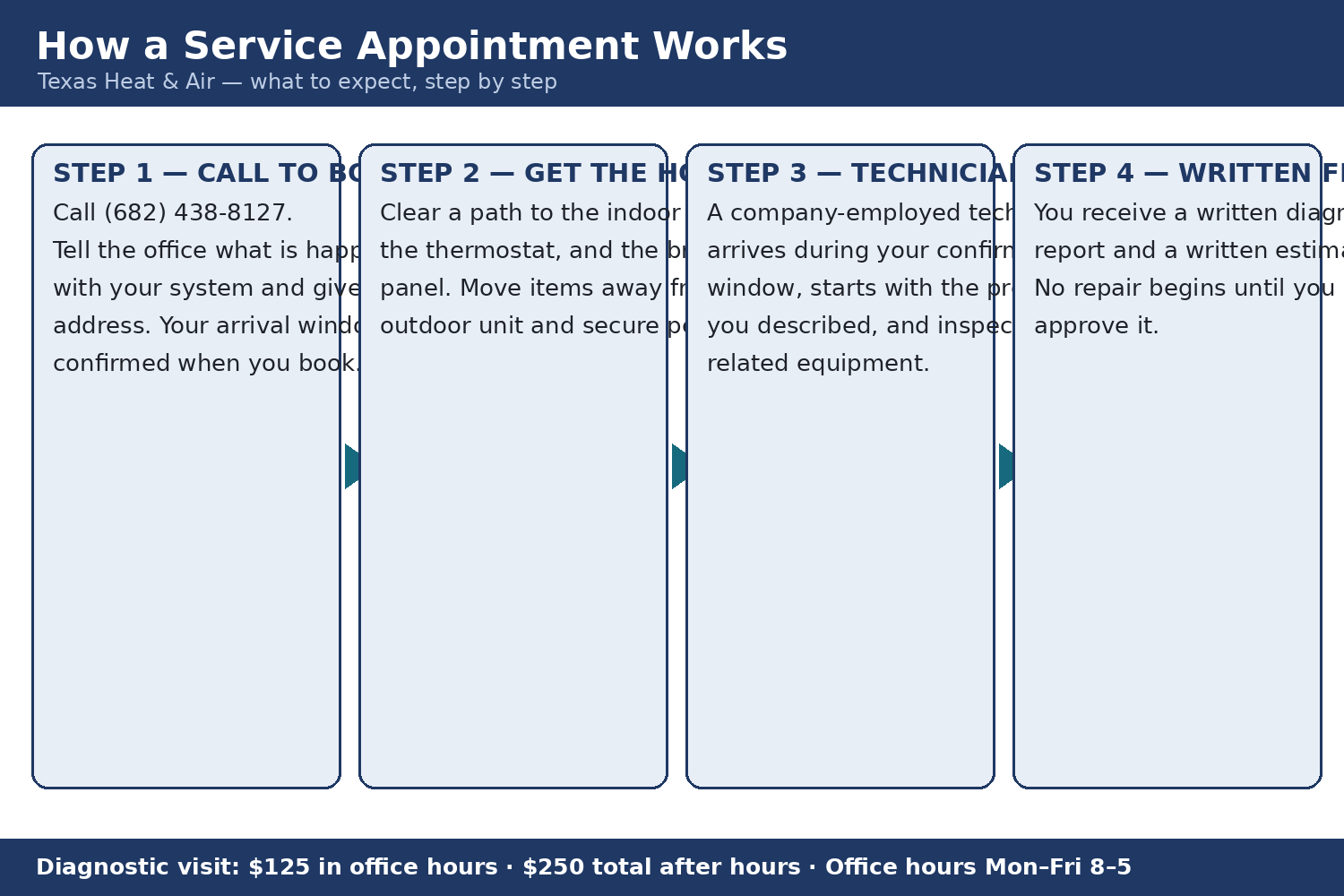
That is why timing comes as a window. A window is a promise a company can keep. An exact arrival time, down to the minute, is not. Nobody controls the job before yours. The traffic on the way to you.
Urgency shapes the order, too. Calls are sorted by need, not just by who phoned first. A complete failure in extreme weather is ordered ahead of a routine request. Even more so when an older adult, a baby. Someone at medical risk is in the home. If someone at home is vulnerable to heat or cold, say so plainly. That details changes the plan.
Stage 3 — The diagnostic visit.The technician tests the system tied to your symptoms until the cause is proven. Diagnosis is its own product, separate from repair. The same symptom can come from several different parts. Each one has a different fix and a different price. Guessing wrong costs more than testing does.
Stage 4 — Documents and your decision.The visit produces two documents in writing. The diagnostic report says what was tested, what failed, and why. The repair estimate says what the fix involves and what it costs. Then everything stops, and the decision waits for you.
Stage 5 — The repair, only if you approve it.If you approve the estimate, the work goes ahead at the estimated price. If the technician finds something clearly different partway through the job, the process loops back to stage four: an explanation, an updated written estimate. Your approval. Never a surprise line on the bill.
Three different products hide inside this chain. Confusing them causes most pricing misunderstandings:
| Diagnostic visit | Repair | Replacement estimate | |
|---|---|---|---|
| What it is | Testing to prove what failed | Fixing the proven failure | Pricing a new system or complete replacement |
| What it costs | Costs vary by home, system, and repair. Ask Texas Heat & Air for a written estimate before work begins. | Priced in the written estimate, after diagnosis | Ask Texas Heat & Air what it costs before you book |
| What you receive | Written diagnostic report + written repair estimate | The completed repair | A written quote for the new system |
| What it commits you to | Nothing beyond the visit | Only the work you approved | Nothing — it is a quote |
One more detail, stated plainly because it affects your day: the office confirms your appointment and your window when you book. On that call, ask how your confirmation and any updates will reach you — phone, text, or email. Confirm the number the office should use. Write down what you were told. Keep that phone within reach on the service day.
The situations homeowners ask about
"Is my home even in the area?"
Texas Heat & Air is based in Cleburne. Texas Heat & Air serves Cleburne, Burleson, Granbury, and Fort Worth. Call (682) 438-8127 to confirm coverage for your address.
The key idea: coverage follows routes and driving time, not ZIP code borders. Two homes in the same town can sit on different routes. So there is no published ZIP code list to check yourself against. The office confirms your exact address on the booking call. That confirmation — not a map pin or an old directory listing — is the reliable answer. If you live just outside a named city, ask anyway — coverage is confirmed for your exact address when you call.
The short answer: Q1 — Does Texas Heat & Air give service in my city? (/hvac-help/service-area-cities/) and Q2 — Which neighborhoods and ZIP codes do you serve? (/hvac-help/neighborhoods-and-zip-codes-served/)
"How soon can someone come — and what does 'same-day' really mean?"
How long you wait depends on the jobs already booked, your distance from the day's routes, the problem and any parts it may need. How urgent it is. Two distinctions keep expectations honest.
First, a same-dayvisitand a same-dayfinished repairare different things. Many common faults can be fixed during the visit. But a failed part that has to be ordered cannot be. And neither can a larger job.
Second, emergency service outside office hours — nights, weekends, holidays — is a question for the call: ask what help is available. It never comes with a guaranteed response time. Call (682) 438-8127 to ask about current hours and the soonest opening.
The short answer: Q3 — How quickly can a technician reach my home? (/hvac-help/how-quickly-can-a-technician-arrive/) and Q4 — Do you offer same-day HVAC repairs? (/hvac-help/same-day-hvac-repairs/)
"I've booked. What happens, in order?"
The sequence is the five stages above. The diagnostic stage deserves a closer look, because it is the one homeowners most often misjudge.
It starts with listening. Your description is evidence. A noise at startup points somewhere different from a noise after an hour of running.
Then comes testing, aimed at the parts that could cause your symptom: thermostat signals, airflow, electric controls and connections, motors, the condensate drain. The pipe that carries away the water the system removes from indoor air. Or measured heating and cooling performance. A careful technician follows the symptom instead of running every test on a list.
The stage ends with the two written documents and your decision. If you decline the repair, you still leave with the report. It is yours, and you can use it for a second opinion.
The short answer: Q7 — What happens after I request an appointment? (/hvac-help/what-happens-after-you-request-an-appointment/) and Q10 — What should I expect during the first diagnostic visit? (/hvac-help/first-diagnostic-visit-what-to-expect/)
"What should I do before the technician arrives?"
Preparation has its own checklist below. The principle is simple: everything helpful happensoutsidethe system — access, animals, notes, paperwork. Nothing helpful needs opening a panel. And the electric parts inside the system can hold a dangerous charge even when the system is switched off.
The short answer: Q8 — What should I do before the technician arrives? (/hvac-help/prepare-for-technician-visit/)
"How will I hear, and what if the window slips?"
Your confirmation and your arrival window are two different things. The confirmation is the record that the visit exists: the day, the kind of visit, the window. The window is the range of time to plan around.
If the window passes with no word, call the office and ask for an update. A quick call settles it either way, and asking is always fair. If your own plans change, call as early as you can. Routes are built around booked windows. Early notice may free your slot for someone whose system has failed completely.
And never stay in a dangerously hot home just to keep a window. Get somewhere cool, and manage the appointment from there.
The short answer: Q9 — Will I receive an appointment confirmation or arrival window? (/hvac-help/appointment-confirmation-and-arrival-window/)
Diagrams and comparisons
F01R-appointment-workflow.png— How a service appointment works: call to book, prepare the home, the technician's visit during your confirmed window. Written findings before any repair. It teaches the four-stage shape of the process, so you always know which stage you are in.
b3-02-q07-service-visit-flow.png— The diagnostic visit: listen, test, report, estimate — then your decision. It teaches what happens inside the diagnostic stage and where it ends: at your approval, not at an assumed repair.
The comparison table in "How it works" above. Diagnostic visit vs. repair vs. replacement estimate. Is the third teaching aid in this guide: three products, three prices, three different commitments.
What you can safely do yourself
The preparation checklist — do these before the visit:
- Clear the path.Make sure the technician can reach the indoor unit (closet, attic, or garage), the outdoor unit, the thermostat. The electric panel. Move stored items and vehicles that block the way.
- Tidy around the outdoor unit.Trim back plants crowding it, if you can do so safely. Do not open the unit.
- Secure pets.Keep animals in another room or away from the work area. Doors and gates may stand open during the visit.
- Write down the symptoms.When the problem started, what the system does, and any sounds, smells, leaks, or thermostat messages. Timing details really do help the diagnosis.
- Gather paperwork.The system's brand and model, if you know them, plus past repair bills. They show what has already been tried.
- Confirm your phone numberwith the office, and ask how your confirmation and updates will reach you.
- Neveropen system, remove electric covers. Try to "get a head start" on the repair.
If conditions change before the visit. Water spreading near electric system, a new burning smell, a total failure. Call the office ahead and say so. That can change how your visit is prioritized.
What a technician checks
The technician starts with your description. Then they verify the symptom and test the system tied to it. Depending on the problem, that can include thermostat use and signals, electric controls and connections, motors, airflow, the condensate drain. Overall heating or cooling performance.
The point of the testing is a cause that isproven, not suspected. Several different failures can produce the same symptom. Each one carries a different repair and price. Anything beyond the standard evaluation. Extra testing that a certain symptom calls for. Should be explained before it is done, along with any added cost.
Making the decision
Your approval rights hold this whole process together, so be clear about them:
- You approve before any repair.The written estimate comes first; work starts only after you say yes.
- You may decline.You still keep the written diagnostic report. You paid for the diagnosis, and the finding is yours.
- You may get a second opinion.The written report is exactly the document another company needs to quote against.
- Changes require re-approval.If a repair uncovers something clearly different, you get an explanation and an updated written estimate before the extra work proceeds.
Questions worth asking before you approve: What failed? How do you know — what did the test show? What are my options, including doing nothing for now? What happens if I wait? A good diagnosis stands up to those questions comfortably.
North Texas notes
Distances here are real. The service area runs from Cleburne across Fort Worth. A technician's day is a route across that map. That is one reason windows are windows.
Summer changes the math, too. During a heat wave, every company's waiting list grows by the hour. Calling early in a failure really does buy you options that are gone by afternoon. When you have the choice, booking the diagnostic before the weather turns extreme is the cheapest scheduling advantage there is.
Related resources
- Q1 — Does Texas Heat & Air give service in my city? (/hvac-help/service-area-cities/)
- Q2 — Which neighborhoods and ZIP codes do you serve? (/hvac-help/neighborhoods-and-zip-codes-served/)
- Q3 — How quickly can a technician reach my home? (/hvac-help/how-quickly-can-a-technician-arrive/)
- Q4 — Do you offer same-day HVAC repairs? (/hvac-help/same-day-hvac-repairs/)
- Q7 — What happens after I request an appointment? (/hvac-help/what-happens-after-you-request-an-appointment/)
- Q8 — What should I do before the technician arrives? (/hvac-help/prepare-for-technician-visit/)
- Q9 — Will I receive an appointment confirmation or arrival window? (/hvac-help/appointment-confirmation-and-arrival-window/)
- Q10 — What should I expect during the first diagnostic visit? (/hvac-help/first-diagnostic-visit-what-to-expect/)
- Guide 2 — HVAC Emergencies and Severe-Weather Safety: What to Do First (/hvac-help/guides/emergencies-and-weather-safety/) — when the problem is not scheduling but danger, start there instead.
Texas Heat & Air next step
Ready to book? Call (682) 438-8127 with your address and a one-sentence description of the problem. The office will confirm coverage, set your window. Tell you how your confirmation will reach you. And the price of the diagnostic visit is settled before anyone is sent.

Understanding the system comes first: learn how the pieces work together, use the safe checks. Let a qualified technician confirm anything inside the system.
Related Homeowner Questions
 Which neighborhoods and ZIP codes do you serve?How quickly can a technician reach my home?Do you offer same-day HVAC repairs?What happens after I request an appointment?What should I do before the technician arrives?Will I receive an appointment confirmation or arrival window?What should I expect during the first diagnostic visit?

Still Have Questions? Ask an HVAC Expert.
Couldn't find the answer you need? Tell us what's happening. Our team will review your question and contact you to help.
Ask Your Question →Sources
- https://www.bbb.org/us/tx/cleburne/profile/commercial-air-conditioning-contractors/texas-heat-and-air-0825-235981897 — Better Business Bureau profile for Texas Heat & Air. Lists 104 Vantage Dr Ste B, Cleburne, TX 76031, (682) 438-8127. Call (682) 438-8127 for current hours. (Listing accessed October 13, 2026).
- https://www.energystar.gov/saveathome/heating-cooling/maintenance-checklist — ENERGY STAR, Heating & Cooling Maintenance Checklist: what diagnostic and maintenance visits generally examine (accessed October 13, 2026).
- https://www.cdc.gov/extreme-heat/prevention/ — CDC, "About Heat and Your Health": who is most at risk from heat illness. This is why urgency shapes triage (accessed October 13, 2026).
- Source note: the company-specific details in this article are awaiting confirmation from Texas Heat & Air.