
Choosing and Verifying an HVAC Contractor in Texas
A two-minute license check, three credentials that mean three different things. How to read reviews and repair examples — a Texas homeowner's due-diligence guide.

Hiring an HVAC contractor usually happens under pressure. The house is hot, the system is down. A stranger is about to open the most expensive machine you own. That is exactly when verification feels hardest — and matters most. The good news: the checks that protect you are few, fast, and entirely in your control.
This guide walks through them in the order a careful homeowner runs them. You will learn how Texas licensing works. How to read the state record yourself. You will learn what three commonly name-dropped credentials really mean. And what they do not. You will see why it matters whether the technician is an employee or a subcontractor. You will learn how to read independent reviews without being gamed by them. And you will learn how to tell a documented repair example from a marketing illustration. Texas Heat & Air's own facts appear along the way, labeled for exactly what they are. Company-supplied, owner-confirmed, or independently shown. So you can practice the checks on us.
Key takeaways- The state record is the verification that counts. A license number on a website is a claim. The same number looked up in TDLR's public search is a check. It takes about two minutes. - Three credentials mean three different things. TDLR licenses the contracting company. EPA Section 608 certifies technicians to handle refrigerant. NATE is a voluntary skills certification technicians earn by passing industry tests. - Who employs the technician decides who stands behind the work. With employees, one business is responsible from the phone call to the warranty. - Reviews inform; they do not verify. Read recent, detailed reviews on platforms the company cannot edit. And pair them with the license check. - A real repair example comes with a service record and the homeowner's signed permission. Anything else is an illustration. Honest companies label it that way.
How it works
The layers of "qualified," from the state down to the individual
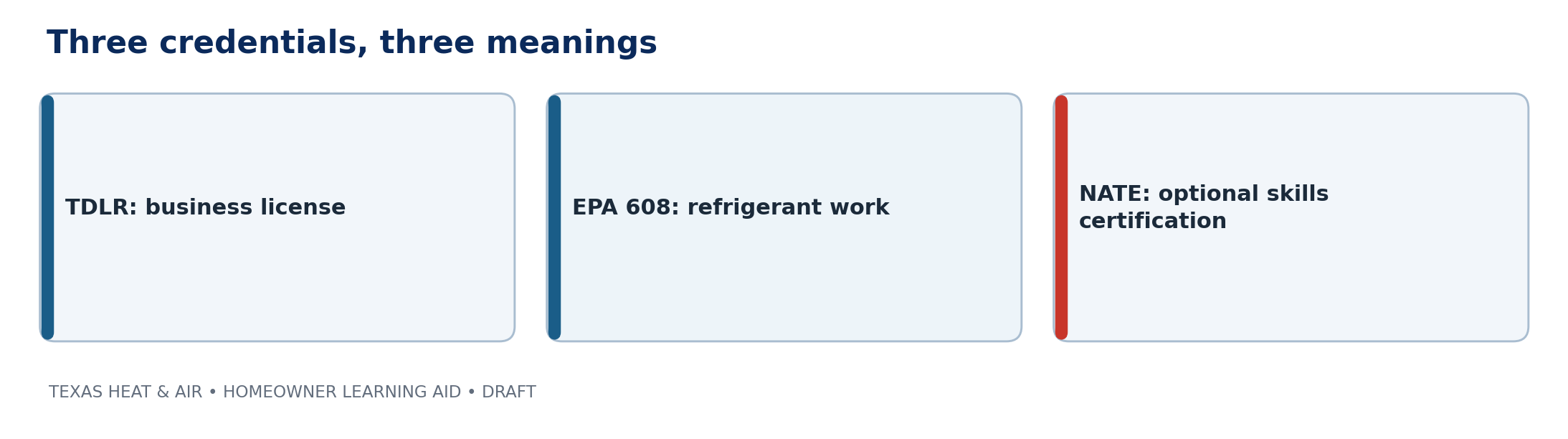
The company license (TDLR).Texas needs AC and refrigeration contractors to be licensed by the Texas Department of Licensing and Regulation (TDLR). The license belongs to the business. It means the company met the state's requirements to contract for this work. It also means the company answers to a regulator, with complaint and enforcement processes, if something goes wrong. Texas needs the license number on the contractor's advertising and documents. That is what makes your two-minute check possible: the number is published precisely so you can look it up.
The regulated task (EPA Section 608).EPA Section 608 is a federal certification that individual technicians must hold to work with refrigerant. Technicians earn it by passing a U.S. EPA exam on safe handling and environmental rules. Federal law needs it for refrigerant work. This credential covers one regulated task: buying, handling. Recovering refrigerant without releasing it. By itself, it says nothing about general repair skill. And it is not a business license.
The individual skill credential (NATE).NATE certification is a voluntary national certification that individual technicians earn by passing exams on real HVAC work. It is evidence of a technician's tested knowledge and skill in the specialty it covers. No government issues it. And it does not license anyone to run a contracting business.
The employment model.Underneath the credentials sits a simpler question: whose technician is at your door? A company's own employees work under its license, its training, and its warranty. A subcontractor is a separate business handed your job. The subcontractor may be perfectly competent. But the responsibility chain, the insurance. The warranty follow-through all get one step harder to trace. There is no public registry of employment models. The only way to know is to ask. And to make sure the answer matches the written estimate.
How independent records work
Reviews and ratings help when you understand what each one measures. On a Google Business Profile, customers post reviews the business cannot edit or remove for being negative. The value is the pattern across many unfiltered voices. A BBB profile is a different instrument. BBB Accreditation means the business committed to BBB standards. The letter grade reflects the BBB's view of the business's record. How it handles complaints, and its business practices. Customer reviews appear on the profile too, but they do not count toward the letter grade. The two numbers answer different questions. Neither source replaces the state license record. Together — license, reviews, complaint record — they triangulate.
The evidence standard for "work we've done"
Contractor websites love "recent jobs near you" pages. The honest version of that page has a paper trail: a real service record, plus the customer's separate signed permission to publish their job. Without both, a "job story" cannot be verified. Stock photos and plausible captions cost nothing to fabricate. A clearly labeled hypothetical example is a legitimate teaching tool. "Here is how a diagnosis like this usually unfolds". As long as it never poses as a real job. When you judge any contractor's examples, including ours, ask one question: is this documented, or is this illustrated? Both can be useful. Only one is evidence.
The situations homeowners ask about
"Is this company actually licensed?" — the two-minute check
Get the license number from the company's website, truck, or paperwork. Open TDLR's public license search (tdlr.texas.gov/acr/) and enter it. Confirm three things. The record's business name matches the company you are hiring. The license type is the AC and refrigeration contractor license. And the status is current. Red flags with any contractor: no number available anywhere. A number that belongs to a different company; or pressure to skip paperwork and pay cash. An unlicensed operator can be cheaper for a reason. There is no accountability to a regulator. And there can be trouble with permits, insurance. Warranty validity if the work goes wrong. A legitimate company will never be offended that you looked. The system is built for it.
Texas Heat & Air's number isTACLB00051450E, supplied by the company. That is exactly why this guide teaches you to run the search yourself, instead of taking this page's word for it.
The short answer: Q91 — Is Texas Heat & Air licensed in Texas? (/hvac-help/is-texas-heat-and-air-licensed/) and Q92 — How do I verify an HVAC contractor license? (/hvac-help/how-to-verify-an-hvac-contractor-license-texas/)
"Who is actually behind this company?"
Identity is the second check. A real business has a real address, a working phone. A consistent story across its records. It is based at 104 Vantage Drive, Suite B, Cleburne, TX 76031. Call (682) 438-8127 to ask about current hours and the soonest opening. That year reflects BBB listing activity, not the founding. Texas Heat & Air serves Cleburne, Burleson, Granbury, and Fort Worth. Call (682) 438-8127 to confirm coverage for your address. Coverage is confirmed by your exact address when you book. When any contractor's details conflict across sources, the tiebreakers are the state license record and asking the company directly. A legitimate business can always explain its own details.
The short answer: Q93 — Who owns Texas Heat & Air? (/hvac-help/who-owns-texas-heat-and-air/)
"The technician has certifications — what do they prove?"
Use the three-meanings map from the section above. Ask Texas Heat & Air about the training and credentials of the technician coming to your home. That is stated here as owner-reported. The way this guide labels any claim you should weigh accordingly. Credentials also have a limit worth knowing. They describe training and testing, not experience withyoursystem. Heat pumps, gas furnaces, and high-efficiency variable-speed systems reward different hands. So the most useful booking question is specific: "Does the technician coming to my home often work on my type of system?" Have your system's make and model ready, so the office can match the visit properly.
The short answer: Q94 — What qualifications do Texas Heat & Air's technicians have? (/hvac-help/hvac-technician-qualifications/)
"Employees or subcontractors — why should I care?"
Because responsibility is the product you are buying. Ask Texas Heat & Air who will do your work, and whose license covers it, before work begins. With any contractor, the key question is whether the business you hire is the business that arrives, does the work, and stands behind the warranty. Settle four things before work begins: the legal name of the business responsible for the job. Its license number; who will arrive at your home; and who honors the warranty afterward. Those points belong in the written estimate, so the paper and the promise match.
The short answer: Q95 — Does Texas Heat & Air use employees or subcontractors? (/hvac-help/employees-or-subcontractors-texas-heat-and-air/)
"Can I see repairs done near me?"
Apply the evidence standard. A documented example traces to a service record, with the homeowner's signed permission to publish it. Texas Heat & Air publishes examples only on that basis. That collection is still being assembled. So today, the honest answer is that documented examples are not posted yet. Anything shown as a teaching example is labeled hypothetical. If references matter for a major project, ask the office directly. Weigh independent reviews (next section) alongside — no company can edit those.
The short answer: Q99. CAn I see examples of Texas Heat & Air's repair work? (/hvac-help/examples-of-hvac-repairs/)
"Where are the reviews I can trust?"
Two places the company does not control. Its Google Business Profile carries customer reviews the business cannot edit. Its BBB profile carries a complaint record. Ask Texas Heat & Air about any accreditation or rating before you rely on one. And, as explained above, the grade and the customer reviews on that profile measure different things. Read reviews the way a careful shopper does. Weight recent reviews over old ones. Read the middling ones closely. They are usually the most detailed. Notice whether — and how — the company responds to criticism. Then pair what you read with the two-minute license check. Reviews tell you how a company behaves. The state record tells you it is accountable.
The short answer: Q100. WHere can I find independent reviews of Texas Heat & Air? (/hvac-help/independent-texas-heat-air-reviews/)
Diagrams and comparisons
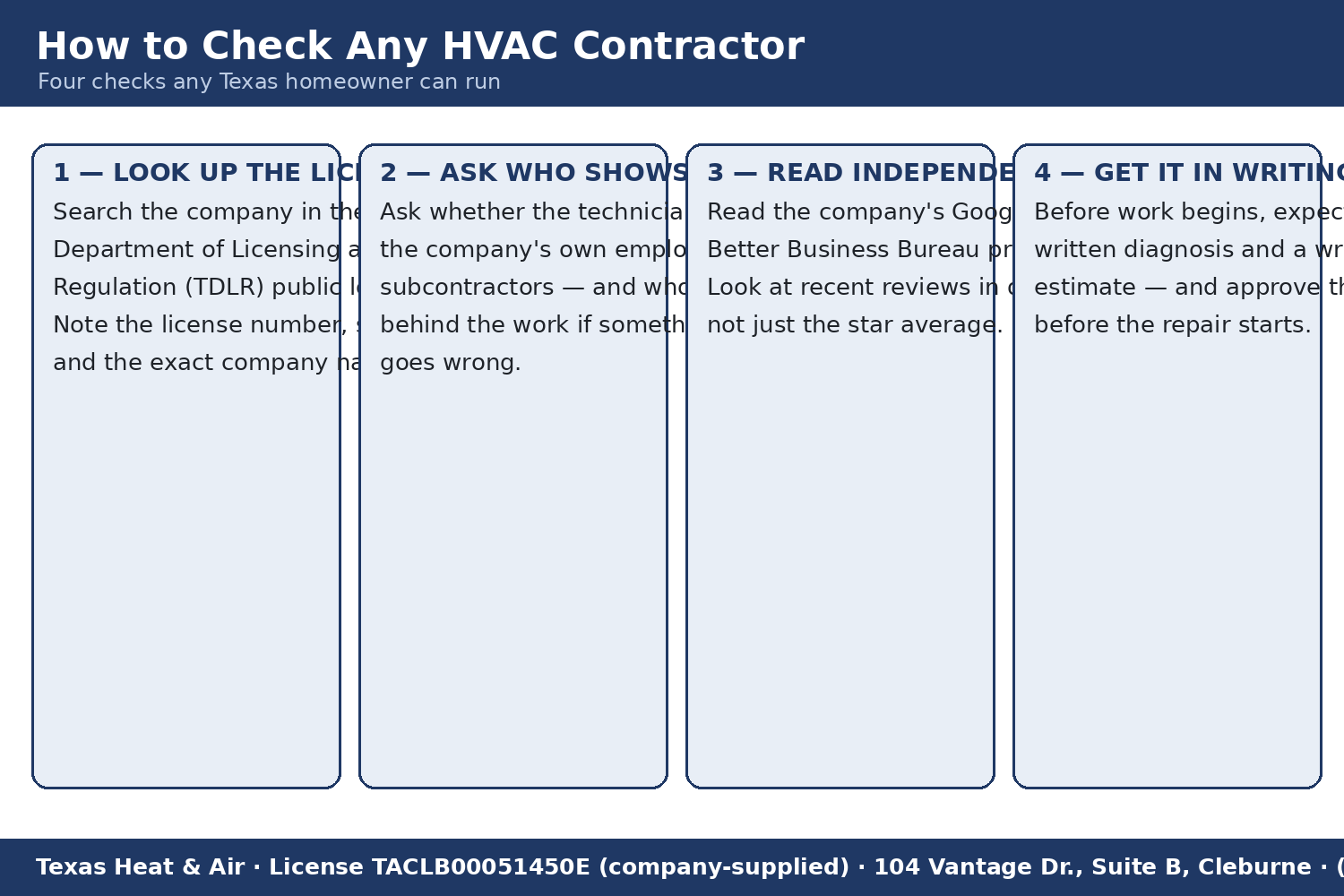
F15R-check-any-contractor.png— The four checks, in order: look up the license in TDLR's public search. Ask who employs the technicians; read independent profiles on Google and the BBB in detail, not just the star average; and get the diagnosis and price in writing before work begins. Every step is something you do yourself. That is the point of the graphic.
Q094_hvac-technician-qualifications.svg— Three credentials, three meanings: TDLR licenses the company, EPA Section 608 certifies refrigerant handling, NATE certifies technician skills. A learning aid about what the credentials mean. Not a claim about any individual's records.
| TDLR contractor license | EPA Section 608 | NATE certification | |
|---|---|---|---|
| Who issues it | State of Texas (TDLR) | U.S. EPA (federal) | Industry organization (voluntary) |
| Who holds it | The contracting business | Individual technicians who handle refrigerant | Individual technicians, by specialty |
| What it proves | The business may legally contract for HVAC work in Texas and answers to the regulator | The technician may legally buy and handle refrigerant | The technician passed industry knowledge and skills tests |
| What it does not prove | Any individual technician's skill | General repair skill, or a business license | A license to run a business, or refrigerant-handling rights by itself |
What you can safely do yourself
Every check in this guide is a homeowner-safe action by design:
- Run the license searchfor any contractor you are considering — free, public, about two minutes.
- Read the label on your own system(make and model) so you can ask system-specific questions when you book.
- Read reviews on the platforms themselves— recent and middling reviews, complaint history, and how the company responds.
- Ask the four questions— legal name, license number, who arrives, who honors the warranty. And compare the answers to the written estimate.
- Ask to see the technician's EPA cardwhen refrigerant work is proposed; certified technicians carry it.
What a technician checks
Due diligence continues at the door. A pro diagnostic visit should produce something you can verify. The technician inspects and tests the system tied to your problem. The visit ends with findings, not a pitch. Ask Texas Heat & Air what you will get in writing, and what your approval covers, before you book. No repair begins until you approve it. Ask Texas Heat & Air to confirm the diagnostic fee when you book. It is charged separately from repairs and is not credited toward them. Two warranty layers should be spelled out in writing on any repair. Ask Texas Heat & Air about the warranty terms that apply to your repair before work begins. The other is the maker's parts coverage. That varies by brand, model, and registration, and it is read in its own terms. If a visit produces none of this paper, that absence is itself due-diligence details.
Making the decision
Put the checks in order, and hiring gets simple.First, the license record — current, matching name, right type. A failure here ends the evaluation.Second, the employment answer and the paper: who arrives, who is responsible. A written estimate that matches.Third, the independent record: recent reviews in detail, the BBB profile, and how criticism gets answered.Fourth, for larger work, compare two written estimates line by line. Scope, system, warranty terms. Rather than comparing two totals. Price matters, and it is the last filter, not the first. The cheapest unlicensed repair is the most expensive one if it fails without recourse. Keep the documents from every step. They are your leverage if anything is ever disputed.
North Texas notes
Texas is a license-verification state in practice as well as on paper. TDLR publishes the record and needs the number on advertising. So a contractor who makes the number hard to find is telling you something. Demand surges add a regional wrinkle. After hail storms, and during the first brutal heat wave of summer, out-of-area operators flood in. They work fast and leave before their repairs are tested. The two-minute check matters most exactly then. Local companies with a physical address in the community — findable, licensed. Still there next season — are the structural answer to the storm-chaser problem.
Related resources
- Q91 — Is Texas Heat & Air licensed in Texas? (/hvac-help/is-texas-heat-and-air-licensed/)
- Q92 — How do I verify an HVAC contractor license? (/hvac-help/how-to-verify-an-hvac-contractor-license-texas/)
- Q93 — Who owns Texas Heat & Air? (/hvac-help/who-owns-texas-heat-and-air/)
- Q94 — What qualifications do Texas Heat & Air's technicians have? (/hvac-help/hvac-technician-qualifications/)
- Q95 — Does Texas Heat & Air use employees or subcontractors? (/hvac-help/employees-or-subcontractors-texas-heat-and-air/)
- Q99 — Can I see examples of Texas Heat & Air's repair work? (/hvac-help/examples-of-hvac-repairs/)
- Q100 — Where can I find independent reviews of Texas Heat & Air? (/hvac-help/independent-texas-heat-air-reviews/)
- Guide 1 — Service Scheduling, Dispatch. Preparing for an HVAC Appointment (/hvac-help/guides/scheduling-and-dispatch/). What a properly run visit looks like from booking to approval
- Guide 8 — Diagnostic Fees, HVAC Repair Pricing. Written Estimates (/hvac-help/guides/diagnostic-fees-and-pricing/) — how to read the written estimate this guide tells you to need
Texas Heat & Air next step
Run the checks on us — that is what they are for. License TACLB00051450E in TDLR's public search, our BBB profile. The reviews on our Google profile will tell you most of what this guide teaches. Call (682) 438-8127 to ask about current hours and the soonest opening.

Understanding the system comes first: learn how the pieces work together, use the safe checks. Let a qualified technician confirm anything inside the system.
Related Homeowner Questions
 How do I verify an HVAC contractor license?Who owns Texas Heat & Air, and where is it based?Are technicians trained for my system?Does Texas Heat & Air use employees or subcontractors?Can I see HVAC repairs done near me?Where can I find independent reviews of Texas Heat & Air?

Still Have Questions? Ask an HVAC Expert.
Couldn't find the answer you need? Tell us what's happening. Our team will review your question and contact you to help.
Ask Your Question →Sources
- https://www.tdlr.texas.gov/acr/ — Texas Department of Licensing and Regulation: the ACR contractor program and the public license search — the regulator's own record
- https://www.bbb.org/us/tx/cleburne/profile/commercial-air-conditioning-contractors/texas-heat-and-air-0825-235981897 — Texas Heat & Air's BBB profile: address and phone. Call (682) 438-8127 for current hours
- https://www.epa.gov/section608/section-608-technician-certification-requirements — U.S. EPA: what Section 608 certification is and that federal law needs it for refrigerant work
- https://natex.org/technician/become-nate-certified/getting-started-2 — NATE: what NATE certification is and how technicians earn it